1US Army Armed Forces Research Institute of Medical Sciences, Bangkok, Thailand.
2The Henry M. Jackson Foundation for the Advancement of Military Medicine, Inc., Bethesda, Maryland.
Am J Trop Med Hyg. 2020 Aug;103(2):756-759. doi: 10.4269/ajtmh.20-0061. Epub 2020 May 7.
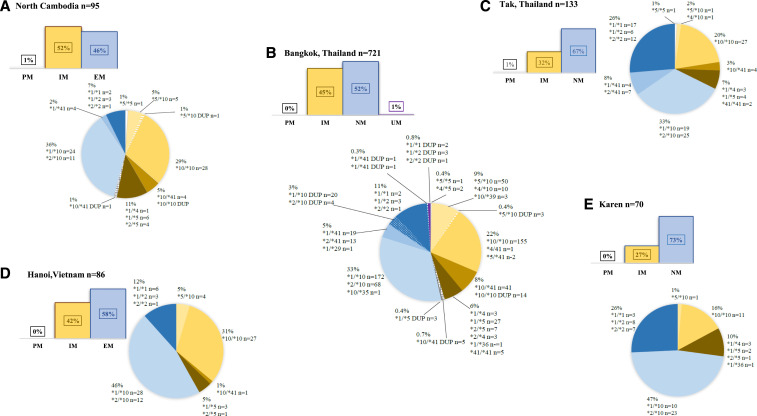
Clinical failure of primaquine (PQ) has been demonstrated in people with CYP450 2D6 genetic polymorphisms that result in reduced or no enzyme activity. The distribution of CYP2D6 genotypes and predicted phenotypes in the Cambodian population is not well described. Surveys in other Asian countries have shown an approximate 50% prevalence of the reduced activity CYP2D6 allele *10, which could translate into increased risk of PQ radical cure failure and repeated relapses, making interruption of transmission and malaria elimination difficult to achieve. We determined CYP2D6 genotypes from 96 volunteers from Oddor Meanchey Province, Cambodia, an area endemic for . We found a 54.2% frequency of the *10 allele, but in approximately half of our subjects, it was paired with a normal activity allele, either *1 or *2. The prevalence of *5, a null allele, was 9.4%. Overall predicted phenotype percentages were normal metabolizers, 46%; intermediate metabolizers, 52%; and poor metabolizers, 1%.
在 CYP450 2D6 基因多态性导致酶活性降低或缺失的人群中,已证实伯氨喹(PQ)临床治疗失败。柬埔寨人群 CYP2D6 基因型和预测表型的分布情况尚未得到充分描述。在其他亚洲国家的调查显示,大约有 50%的活性降低 CYP2D6 等位基因 *10,这可能会增加 PQ 根治失败和反复复发的风险,使传播中断和消除疟疾变得困难。我们从柬埔寨奥多棉芷省的 96 名志愿者中确定了 CYP2D6 基因型,该地区是. 的流行区。我们发现 *10 等位基因的频率为 54.2%,但在我们大约一半的受试者中,它与正常活性等位基因 *1 或 *2 配对。无效等位基因 *5 的患病率为 9.4%。总体预测表型百分比为正常代谢者,46%;中间代谢者,52%;和弱代谢者,1%。