Ghilotti James, Sanz José Luis, López-García Sergio, Guerrero-Gironés Julia, Pecci-Lloret María P, Lozano Adrián, Llena Carmen, Rodríguez-Lozano Francisco Javier, Forner Leopoldo, Spagnuolo Gianrico
Department of Stomatology, Faculty of Medicine and Dentistry, Universitat de València, 46010 Valencia, Spain.
Research Group Cellular Therapy and Hematopoietic Transplant, Biomedical Research Institute, Virgen de la Arrixaca Clinical University Hospital, IMIB-Arrixaca, University of Murcia, 30120 Murcia, Spain.
Materials (Basel). 2020 May 10;13(9):2189. doi: 10.3390/ma13092189.
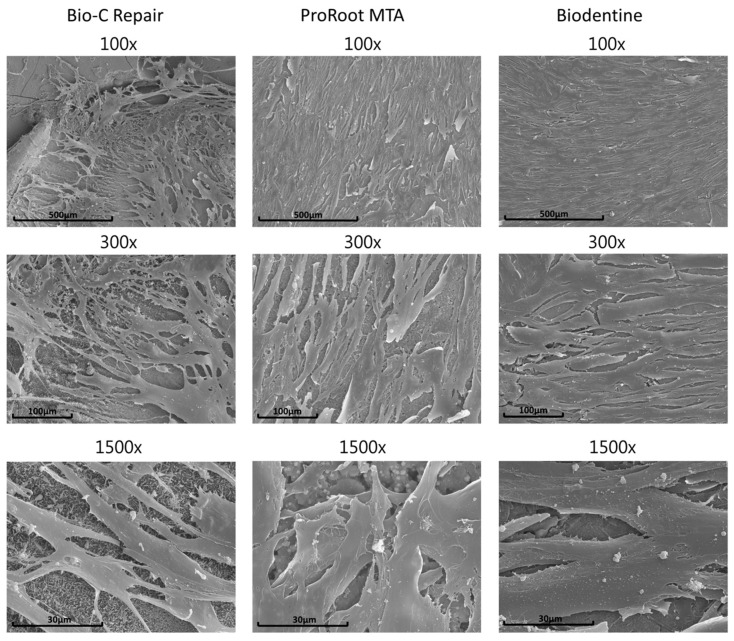
Biocompatibility is an essential property for any vital pulp material that may interact with the dental pulp tissues. Accordingly, this study aimed to compare the chemical composition and ultrastructural morphology of Biodentine (Septodont, Saint Maur-des-Fosses, France), ProRoot MTA (Dentsply Tulsa Dental Specialties, Johnson City, TN, USA), and Bio-C Repair (Angelus, Londrina, PR, Brazil), as well as their biological effects on human dental pulp cells. Chemical element characterization of the materials was undertaken using scanning electron microscopy and energy dispersive X-ray analysis (SEM-EDX). The cytotoxicity was assessed by analyzing the cell viability (MTT assay), cell morphology (immunofluorescence assay), and cell attachment (flow cytometry assay). The results were statistically analyzed using ANOVA and Tukey's test ( < 0.05). EDX revealed that ProRoot MTA and Biodentine were mostly composed of calcium, carbon, and oxygen (among others), whereas Bio-C Repair evidenced a low concentration of calcium and the highest concentration of zirconium. SEM showed adequate attachment of human dental pulp cells (hDPCS) to vital pulp materials and cytoskeletal alterations were not observed in the presence of material eluates. Remarkably, the undiluted Biodentine group showed higher viability than the control group cells (without eluates) at 24 h, 48 h, and 72 h ( < 0.001). Based on the evidence derived from an in vitro cellular study, it was concluded that Bio-C Repair showed excellent cytocompatibility that was similar to Biodentine and ProRoot MTA.
生物相容性是任何可能与牙髓组织相互作用的牙髓活性材料的一项基本属性。因此,本研究旨在比较生物陶瓷(法国圣莫尔-德富塞Septodont公司)、ProRoot MTA(美国田纳西州约翰逊市登士柏 Tulsa 牙科专业公司)和生物C修复材料(巴西隆德里纳安热卢斯公司)的化学成分和超微结构形态,以及它们对人牙髓细胞的生物学效应。使用扫描电子显微镜和能量色散X射线分析(SEM-EDX)对材料进行化学元素表征。通过分析细胞活力(MTT 法)、细胞形态(免疫荧光法)和细胞附着(流式细胞术法)来评估细胞毒性。结果采用方差分析和 Tukey 检验进行统计学分析(<0.05)。EDX 显示,ProRoot MTA 和生物陶瓷主要由钙、碳和氧(以及其他元素)组成,而生物C修复材料的钙浓度较低,锆浓度最高。SEM 显示人牙髓细胞(hDPCS)能充分附着于牙髓活性材料,且在材料洗脱液存在的情况下未观察到细胞骨架改变。值得注意的是,未稀释的生物陶瓷组在24小时、48小时和72小时时的活力高于对照组细胞(无洗脱液)(<0.001)。基于体外细胞研究得出的证据,得出结论:生物C修复材料显示出与生物陶瓷和 ProRoot MTA 相似的优异细胞相容性。