Yue Chun, Guo Zi, Luo Yufang, Yuan Jingjing, Wan Xinxing, Mo Zhaohui
Department of Endocrinology and Metabolism, Third Xiangya Hospital of Central South University, Changsha, China.
Diabetic Foot Research Center, Third Xiangya Hospital of Central South University, Changsha, China.
Stem Cells Int. 2020 Jan 14;2020:7430968. doi: 10.1155/2020/7430968. eCollection 2020.
Mesenchymal stem cells (MSCs) are considered a promising therapy for wound healing. Here, we explored the role of c-Jun in diabetic wound healing using human umbilical cord-derived MSCs (hUC-MSCs).
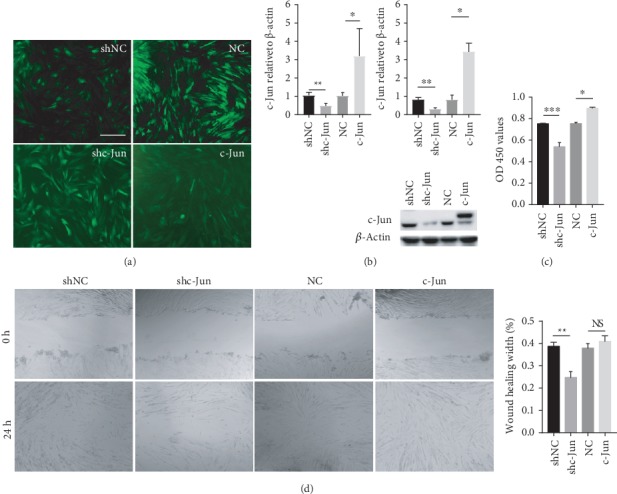
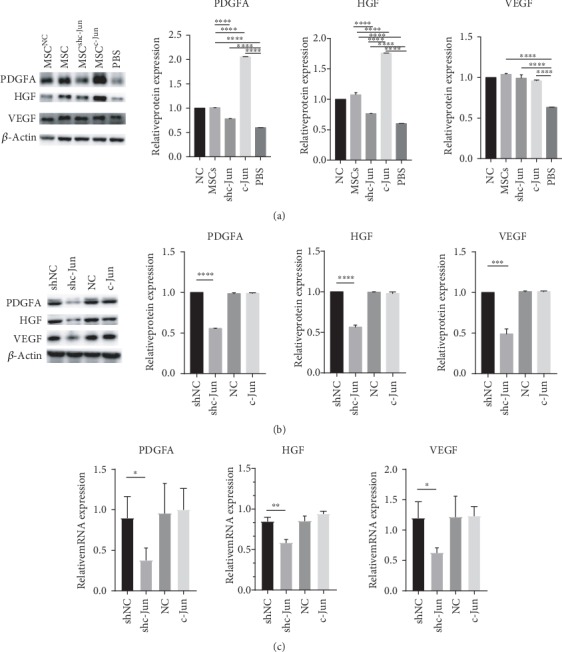
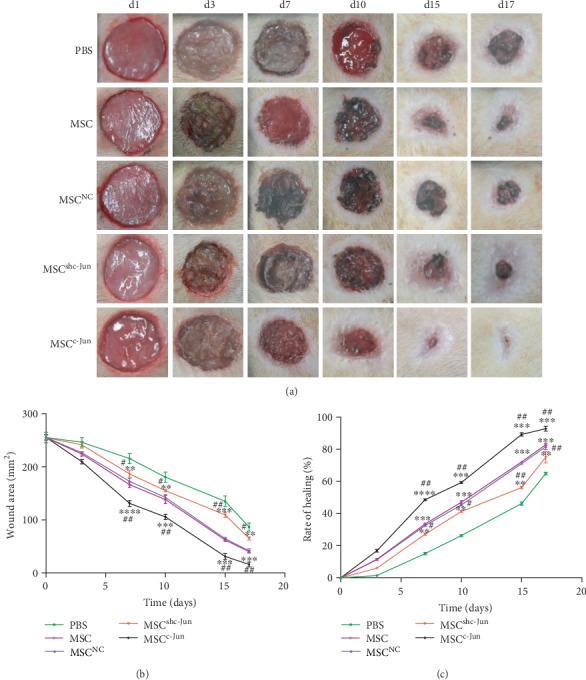
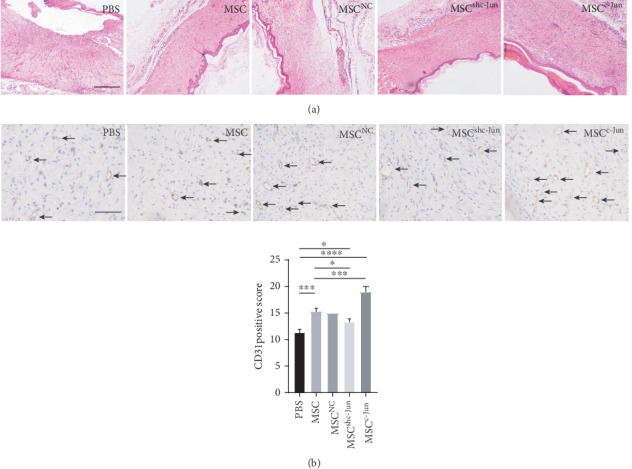
Freshly isolated hUC-MSCs were subjected to extensive subcultivation. The cell proliferative and migratory capacities were assessed by the Cell Counting Kit-8 and scratch assays, respectively. c-Jun expression was evaluated by RT-PCR and western blot analysis. The function of c-Jun was investigated with lentivirus transduction-based gene silencing and overexpression. Diabetes mellitus was induced in SD rats on a high-glucose/fat diet by streptozocin administration. Wounds were created on the dorsal skin. The effects of c-Jun silencing and overexpression on wound closure by hUC-MSCs were examined. Reepithelialization and angiogenesis were assessed by histological and immunohistochemical analysis, respectively. Platelet-derived growth factor A (PDGFA), hepatocyte growth factor (HGF), and vascular endothelial growth factor (VEGF) levels were determined by western blot analysis.
hUC-MSCs showed gradually decreased cell proliferation, migration, and c-Jun expression during subcultivation. c-Jun silencing inhibited cell proliferation and migration, while c-Jun overexpression enhanced proliferation but not migration. Compared with untransduced hUC-MSCs, local subcutaneous injection of c-Jun-overexpressing hUC-MSCs accelerated wound closure, enhanced angiogenesis and reepithelialization at the wound bed, and increased PDGFA and HGF levels in wound tissues.
c-Jun overexpression promoted hUC-MSC proliferation and migration and accelerated diabetic wound closure, reepithelization, and angiogenesis by hUC-MSCs . These beneficial effects of c-Jun overexpression in diabetic wound healing by hUC-MSCs were at least partially mediated by increased PDGFA and HGF levels in wound tissues.
间充质干细胞(MSCs)被认为是一种有前景的伤口愈合治疗方法。在此,我们利用人脐带间充质干细胞(hUC-MSCs)探讨了c-Jun在糖尿病伤口愈合中的作用。
对新鲜分离的hUC-MSCs进行广泛传代培养。分别通过细胞计数试剂盒-8和划痕试验评估细胞增殖和迁移能力。通过RT-PCR和蛋白质印迹分析评估c-Jun表达。利用基于慢病毒转导的基因沉默和过表达研究c-Jun的功能。通过给高脂高糖饮食的SD大鼠注射链脲佐菌素诱导糖尿病。在背部皮肤制造伤口。检测c-Jun沉默和过表达对hUC-MSCs伤口闭合的影响。分别通过组织学和免疫组织化学分析评估再上皮化和血管生成。通过蛋白质印迹分析测定血小板衍生生长因子A(PDGFA)、肝细胞生长因子(HGF)和血管内皮生长因子(VEGF)水平。
hUC-MSCs在传代培养过程中细胞增殖、迁移和c-Jun表达逐渐下降。c-Jun沉默抑制细胞增殖和迁移,而c-Jun过表达增强增殖但不增强迁移。与未转导的hUC-MSCs相比,局部皮下注射过表达c-Jun的hUC-MSCs加速了伤口闭合,增强了伤口床的血管生成和再上皮化,并增加了伤口组织中PDGFA和HGF水平。
c-Jun过表达促进hUC-MSC增殖和迁移,并加速hUC-MSCs介导的糖尿病伤口闭合、再上皮化和血管生成。c-Jun过表达在hUC-MSCs糖尿病伤口愈合中的这些有益作用至少部分是由伤口组织中PDGFA和HGF水平增加介导的。