Universidade Federal da Paraíba (UFPB), João Pessoa, PB, Brazil.
Centro Universitário de João Pessoa (UNIPÊ), João Pessoa, PB, Brazil.
Braz J Psychiatry. 2020 Sep-Oct;42(5):489-495. doi: 10.1590/1516-4446-2019-0593.
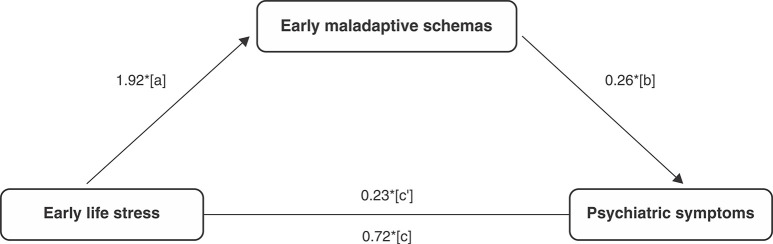
This study investigated how factors of temperament and early maladaptive schemas predict psychiatric symptoms, as well as how they mediate the relation between early life stress and psychiatric symptoms in adults.
A cross-sectional study was conducted with a sample of 200 university students. Data was collected through a sociodemographic questionnaire, the Adult Self-Report Inventory, the Childhood Trauma Questionnaire, the Young Schema Questionnaire, and the Temperament and Character Inventory-Revised.
A model including early maladaptive schemas, harm avoidance (temperament factor), and early life stress explained 69% of the variation of the psychiatric symptoms; among the predictors, early maladaptive schemas explained 31% of psychiatric symptoms, while harm avoidance explained 25%. Most of the predictive power associated with early life stress can be better explained by early maladaptive schemas and, to a lesser extent, harm avoidance.
By managing these processes therapeutically, deleterious effects associated with early life stress can be minimized.
本研究旨在探讨气质和早期适应不良模式因素如何预测成年人的精神症状,以及它们如何在早期生活压力与精神症状之间起中介作用。
本研究采用横断面研究,共纳入 200 名大学生。通过社会人口学问卷、成人自我报告量表、儿童期创伤问卷、青年模式问卷和修订后的气质与性格量表收集数据。
包括早期适应不良模式、回避(气质因素)和早期生活压力的模型解释了 69%的精神症状变化;在预测因素中,早期适应不良模式解释了 31%的精神症状,而回避解释了 25%。与早期生活压力相关的大部分预测能力可以通过早期适应不良模式和回避来更好地解释。
通过治疗管理这些过程,可以最大限度地减少与早期生活压力相关的不良影响。