Department of Chemistry and Chemical Engineering, Chalmers University of Technology, Kemigården 4, 412 96, Göteborg, Sweden.
Department of Chemistry and Molecular Biology, University of Gothenburg, Kemigården 4, 412 96, Göteborg, Sweden.
Chembiochem. 2020 Oct 1;21(19):2755-2758. doi: 10.1002/cbic.202000197. Epub 2020 Jun 16.
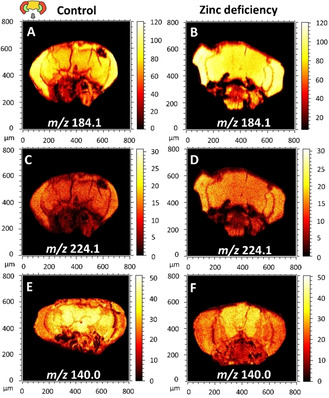
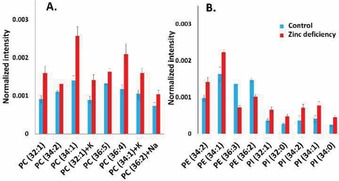
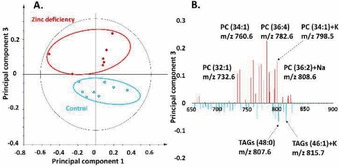
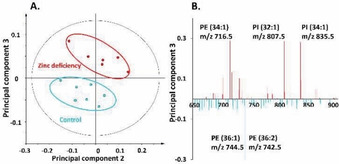
Several diseases and disorders have been suggested to be associated with zinc deficiency, especially learning and memory impairment. To have better understanding about the connection between lipid changes and cognitive impairments, we investigated the effects of a zinc-chelated diet on certain brain lipids of Drosophila melanogaster by using time-of-flight secondary ion mass spectrometry (ToF-SIMS). The data revealed that there are increases in the levels of phosphatidylcholine and phosphatidylinositol in the central brains of the zinc-deficient flies compared to the control flies. In contrast, the abundance of phosphatidylethanolamine in the brains of the zinc-deficient flies is lower. These data are consistent with that of cognitive-diminishing drugs, thus providing insight into the biological and molecular effects of zinc deficiency on the major brain lipids and opening a new treatment target for cognitive deficit in zinc deficiency.
已有研究表明,多种疾病和障碍与锌缺乏有关,尤其是学习和记忆障碍。为了更好地理解脂质变化与认知障碍之间的关系,我们使用飞行时间二次离子质谱(ToF-SIMS)研究了锌螯合饮食对黑腹果蝇某些大脑脂质的影响。研究数据表明,与对照组相比,缺锌果蝇的中枢大脑中的磷脂酰胆碱和磷脂酰肌醇水平升高。相比之下,缺锌果蝇大脑中的磷脂酰乙醇胺含量较低。这些数据与认知减退药物的结果一致,因此为锌缺乏对大脑主要脂质的生物学和分子影响提供了新的认识,并为锌缺乏引起的认知缺陷开辟了新的治疗靶点。