Department of Epidemiology and Global Health, Umeå University, Umeå, Sweden.
Aberdeen Centre for Health Data Science (ACHDS), Institute of Applied Health Sciences, School of Medicine, Medical Sciences and Nutrition, University of Aberdeen, Aberdeen, Scotland.
Glob Health Action. 2020 Dec 31;13(1):1760490. doi: 10.1080/16549716.2020.1760490.
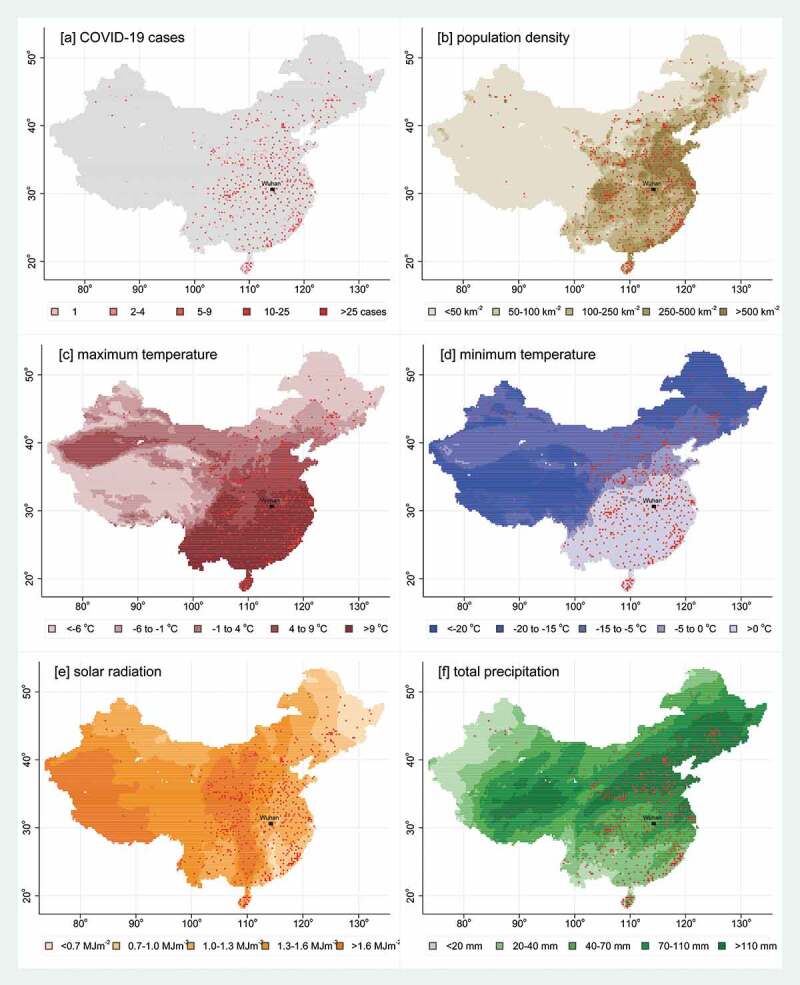
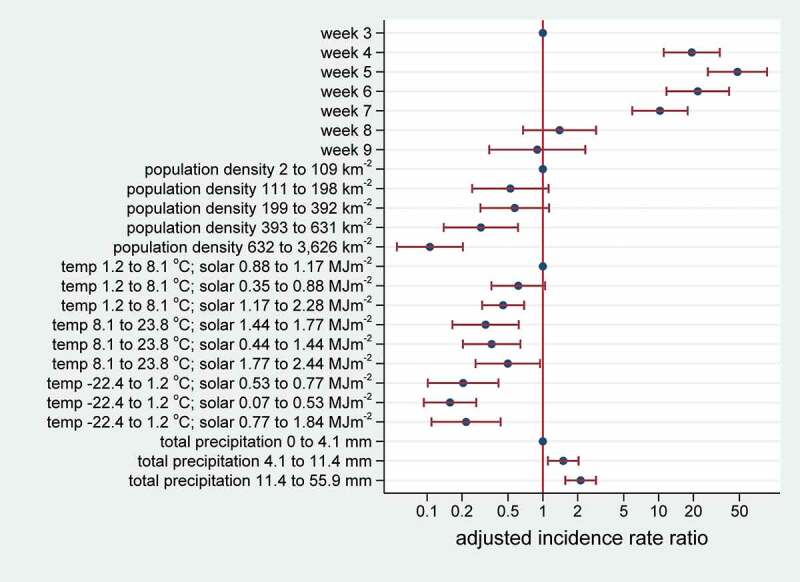
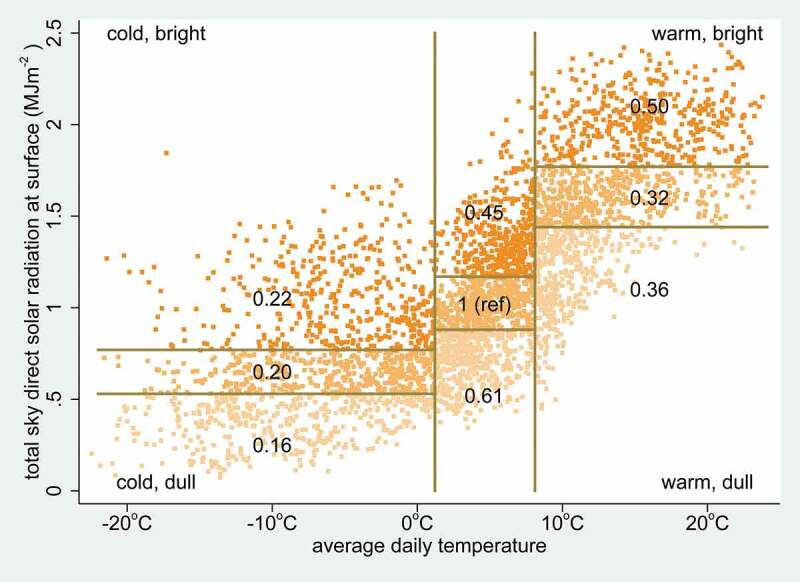
: The outbreak of COVID-19 in China in early 2020 provides a rich data source for exploring the ecological determinants of this new infection, which may be of relevance as the pandemic develops.: Assessing the spread of the COVID-19 across China, in relation to associations between cases and ecological factors including population density, temperature, solar radiation and precipitation.: Open-access COVID-19 case data include 18,069 geo-located cases in China during January and February 2020, which were mapped onto a 0.25° latitude/longitude grid together with population and weather data (temperature, solar radiation and precipitation). Of 15,539 grid cells, 559 (3.6%) contained at least one case, and these were used to construct a Poisson regression model of cell-weeks. Weather parameters were taken for the preceding week given the established 5-7 day incubation period for COVID-19. The dependent variable in the Poisson model was incident cases per cell-week and exposure was cell population, allowing for clustering of cells over weeks, to give incidence rate ratios.: The overall COVID-19 incidence rate in cells with confirmed cases was 0.12 per 1,000. There was a single confirmed case in 113/559 (20.2%) of cells, while two grid cells recorded over 1,000 confirmed cases. Weekly means of maximum daily temperature varied from -28.0°C to 30.1°C, minimum daily temperature from -42.4°C to 23.0°C, maximum solar radiation from 0.04 to 2.74 MJm and total precipitation from 0 to 72.6 mm. Adjusted incidence rate ratios suggested brighter, warmer and drier conditions were associated with lower incidence.: Though not demonstrating cause and effect, there were appreciable associations between weather and COVID-19 incidence during the epidemic in China. This does not mean the pandemic will go away with summer weather but demonstrates the importance of using weather conditions in understanding and forecasting the spread of COVID-19.
2020 年初中国新冠肺炎疫情的爆发为探索这种新感染的生态决定因素提供了丰富的数据来源,随着疫情的发展,这些因素可能具有相关性。评估新冠肺炎在中国的传播情况,与病例与人口密度、温度、太阳辐射和降水等生态因素之间的关联。公开获取的新冠肺炎病例数据包括 2020 年 1 月和 2 月期间中国的 18069 例地理位置确定的病例,这些病例与人口和气象数据(温度、太阳辐射和降水)一起被映射到 0.25°的纬度/经度网格上。在 15539 个网格单元中,有 559 个(3.6%)至少包含一个病例,这些病例被用于构建细胞周的泊松回归模型。考虑到新冠肺炎 5-7 天的潜伏期,在每周前一周采用气象参数。泊松模型中的因变量是每细胞周的发病例数,暴露因素是细胞人口,使细胞周的聚类能够进行,以给出发病率比。有确诊病例的细胞中,新冠肺炎的总发病率为每 1000 人 0.12 例。在 559 个(20.2%)有确诊病例的细胞中,有一个确诊病例,而有两个网格单元记录了超过 1000 个确诊病例。每周最高日平均温度从-28.0°C到 30.1°C不等,最低日平均温度从-42.4°C到 23.0°C不等,最高太阳辐射从 0.04 到 2.74 MJm,总降水量从 0 到 72.6mm。调整后的发病率比表明,天气晴朗、温暖和干燥的条件与较低的发病率有关。尽管没有证明因果关系,但在中国疫情期间,天气与新冠肺炎发病率之间存在明显的关联。这并不意味着随着夏季天气的到来,大流行就会结束,但这表明在了解和预测新冠肺炎的传播时,利用天气条件非常重要。