Institute of Geosciences and Earth Resources (IGG), National Research Council of Italy (CNR), Via G. Gradenigo, 6, 35131, Padova, Italy.
Internal Medicine Unit, Budrio Hospital, Azienda USL, Via Benni, 44, 40054, Bologna, Italy.
Environ Res. 2022 Jul;210:112921. doi: 10.1016/j.envres.2022.112921. Epub 2022 Feb 10.
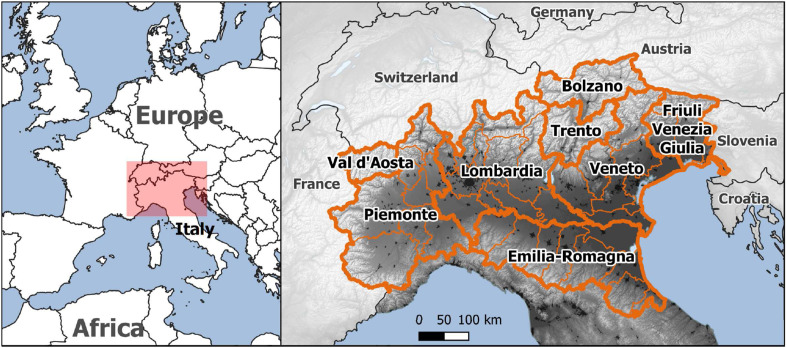
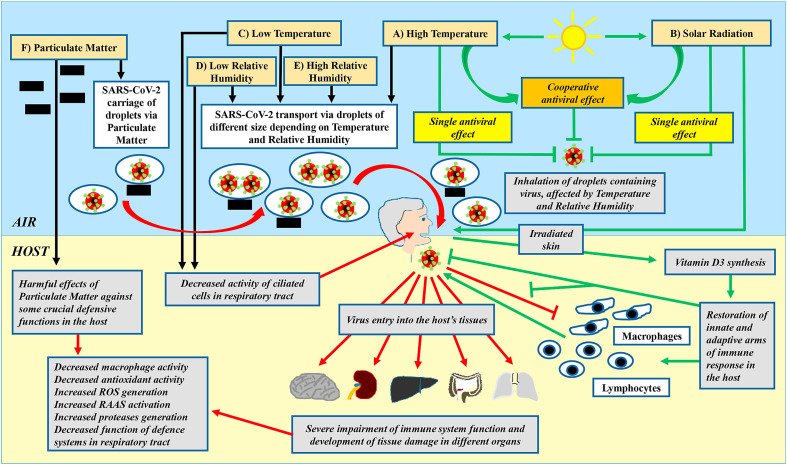
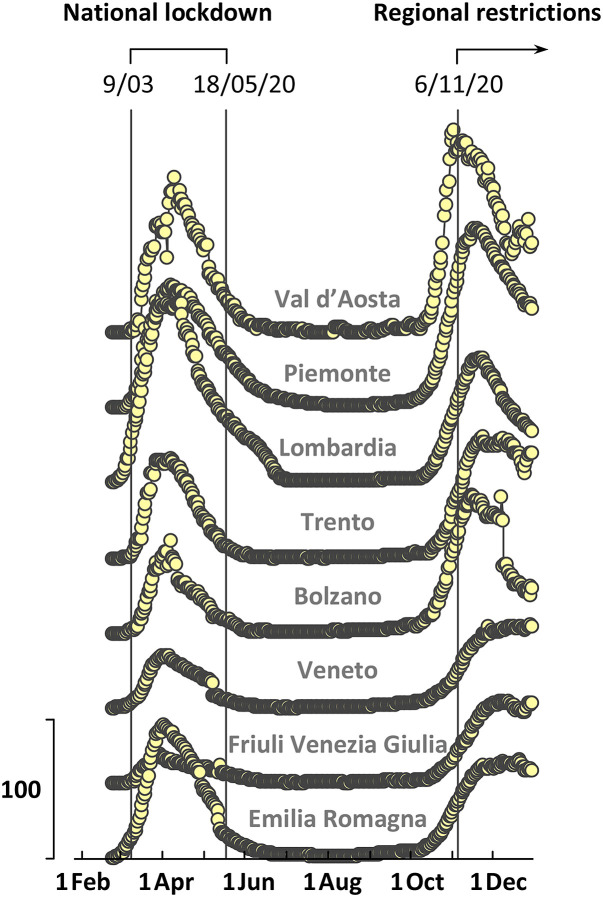
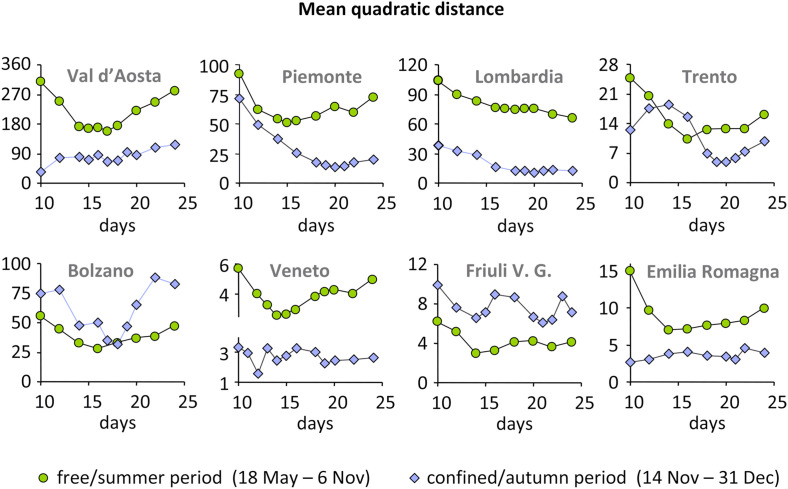
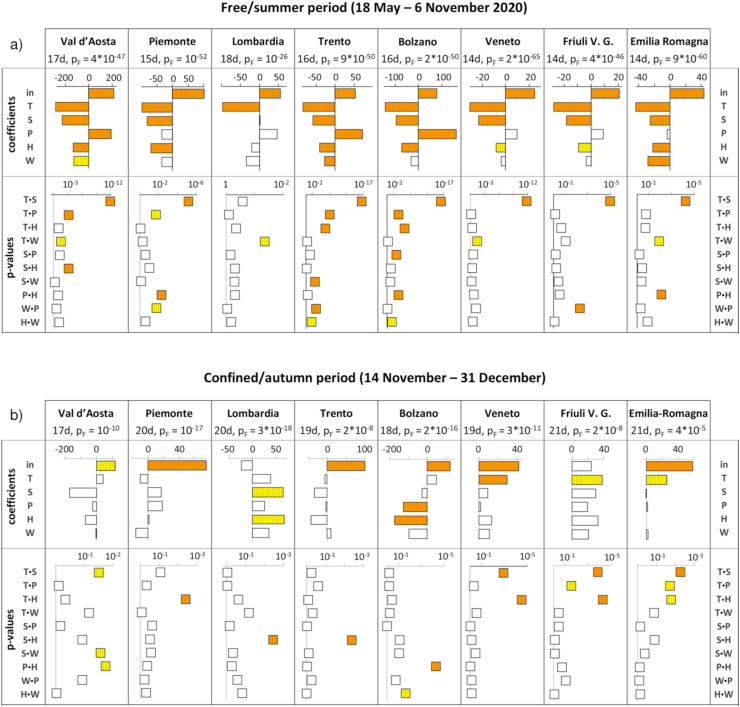
In 2020 North Italy suffered the SARS-CoV-2-related pandemic with a high number of deaths and hospitalization. The effect of atmospheric parameters on the amount of hospital admissions (temperature, solar radiation, particulate matter, relative humidity and wind speed) is studied through about 8 months (May-December). Two periods are considered depending on different conditions: a) low incidence of COVID-19 and very few regulations concerning personal mobility and protection ("free/summer period"); b) increasing incidence of disease, social restrictions and use of personal protections ("confined/autumn period"). The "hospitalized people in medical area wards/100000 residents" was used as a reliable measure of COVID-19 spreading and load on the sanitary system. We developed a chemometric approach (multiple linear regression analysis) using the daily incidence of hospitalizations as a function of the single independent variables and of their products (interactions). Eight administrative domains were considered (altogether 26 million inhabitants) to account for relatively homogeneous territorial and social conditions. The obtained models very significantly match the daily variation of hospitalizations, during the two periods. Under the confined/autumn period, the effect of non-pharmacologic measures (social distances, personal protection, etc.) possibly attenuates the virus diffusion despite environmental factors. On the contrary, in the free/summer conditions the effects of atmospheric parameters are very significant through all the areas. Particulate matter matches the growth of hospitalizations in areas with low chronic particulate pollution. Fewer hospitalizations strongly correspond to higher temperature and solar radiation. Relative humidity plays the same role, but with a lesser extent. The interaction between solar radiation and high temperature is also highly significant and represents surprising evidence. The solar radiation alone and combined with high temperature exert an anti-SARS-CoV-2 effect, via both the direct inactivation of virions and the stimulation of vitamin D synthesis, improving immune system function.
2020 年,意大利北部遭遇了与 SARS-CoV-2 相关的大流行,导致大量死亡和住院。通过大约 8 个月(5 月至 12 月)的研究,探讨了大气参数(温度、太阳辐射、颗粒物、相对湿度和风速)对住院人数的影响。考虑了两个时期,这取决于不同的条件:a)COVID-19 发病率低,个人流动性和保护措施的规定很少(“自由/夏季时期”);b)疾病发病率增加,社会限制和个人保护措施的使用(“封闭/秋季时期”)。“每 10 万居民中住院的人数”被用作 COVID-19 传播和卫生系统负担的可靠指标。我们开发了一种化学计量方法(多元线性回归分析),将每日住院人数作为单个独立变量及其乘积(相互作用)的函数。考虑了八个行政区(共有 2600 万居民),以考虑相对同质的领土和社会条件。在所考虑的两个时期,获得的模型非常显著地符合住院人数的日常变化。在封闭/秋季时期,尽管环境因素,非药物措施(社会距离、个人保护等)的效果可能会减轻病毒的扩散。相反,在自由/夏季条件下,大气参数的影响通过所有地区都非常显著。颗粒物与低慢性颗粒物污染地区住院人数的增加相吻合。较少的住院人数与较高的温度和太阳辐射强烈相关。相对湿度也起着相同的作用,但程度较小。太阳辐射与高温之间的相互作用也具有高度显著性,这是一个令人惊讶的证据。太阳辐射单独以及与高温结合在一起,通过直接灭活病毒和刺激维生素 D 合成,改善免疫系统功能,对 SARS-CoV-2 产生了抗病毒作用。