Department of Pediatric Dentistry, Peking University School and Hospital of Stomatology & National Engineering Laboratory for Digital and Material Technology of Stomatology & Research Center of Engineering and Technology for Digital Dentistry of Ministry of Health & Beijing Key Laboratory of Digital Stomatology & National Clinical Research Center for Oral Diseases, Beijing, 100081, China.
State Key Laboratory of Virtual Reality Technology and Systems, Beihang University, Beijing, China.
BMC Oral Health. 2020 May 13;20(1):141. doi: 10.1186/s12903-020-01114-6.
Dental plaque causes many common oral diseases (e.g., caries, gingivitis, and periodontitis). Therefore, plaque detection and control are extremely important for children's oral health. The objectives of this study were to design a deep learning-based artificial intelligence (AI) model to detect plaque on primary teeth and to evaluate the diagnostic accuracy of the model.
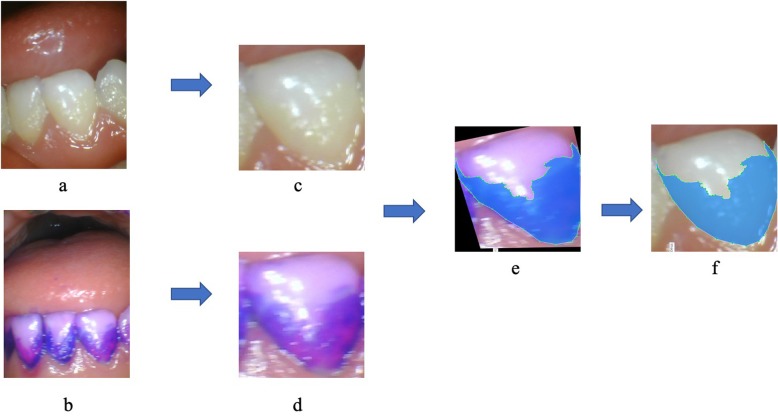
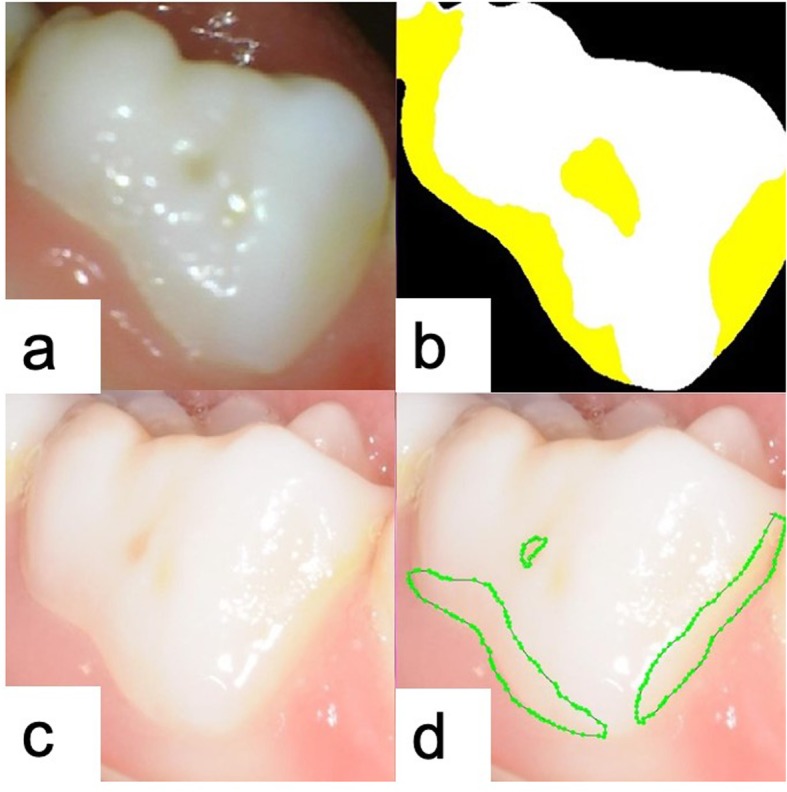
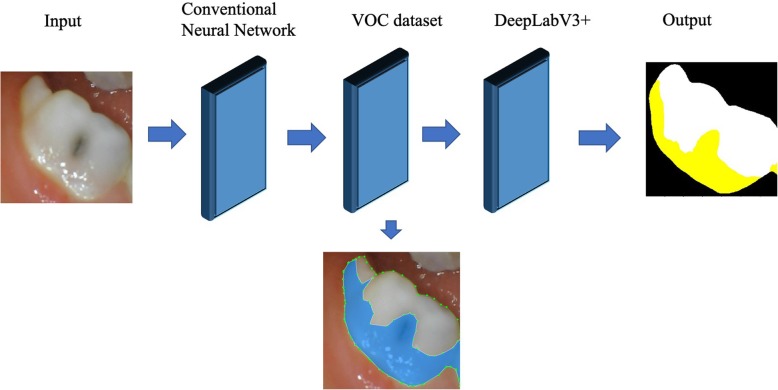
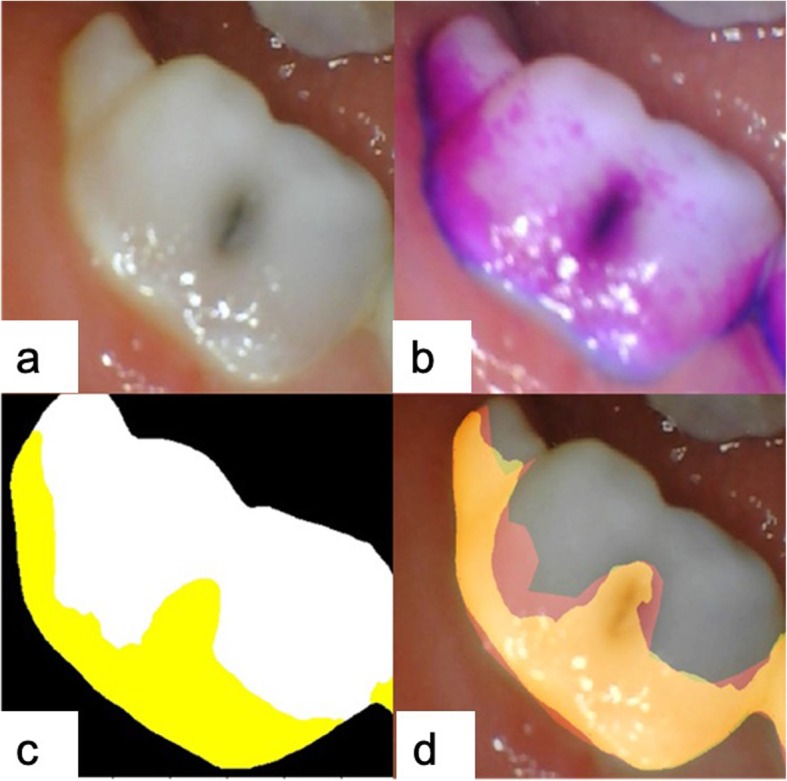
A conventional neural network (CNN) framework was adopted, and 886 intraoral photos of primary teeth were used for training. To validate clinical feasibility, 98 intraoral photos of primary teeth were assessed by the AI model. Additionally, tooth photos were acquired using a digital camera. One experienced pediatric dentist examined the photos and marked the regions containing plaque. Then, a plaque-disclosing agent was applied, and the areas with plaque were identified. After 1 week, the dentist drew the plaque area on the 98 photos taken by the digital camera again to evaluate the consistency of manual diagnosis. Additionally, 102 intraoral photos of primary teeth were marked to denote the plaque areas obtained by the AI model and the dentist to evaluate the diagnostic capacity of each approach based on lower-resolution photos. The mean intersection-over-union (MIoU) metric was employed to indicate detection accuracy.
The MIoU for detecting plaque on the tested tooth photos was 0.726 ± 0.165. The dentist's MIoU was 0.695 ± 0.269 when first diagnosing the 98 photos taken by the digital camera and 0.689 ± 0.253 after 1 week. Compared to the dentist, the AI model demonstrated a higher MIoU (0.736 ± 0.174), and the results did not change after 1 week. When the dentist and the AI model assessed the 102 intraoral photos, the MIoU was 0.652 ± 0.195 for the dentist and 0.724 ± 0.159 for the model. The results of a paired t-test found no significant difference between the AI model and human specialist (P > .05) in diagnosing dental plaque on primary teeth.
The AI model showed clinically acceptable performance in detecting dental plaque on primary teeth compared with an experienced pediatric dentist. This finding illustrates the potential of such AI technology to help improve pediatric oral health.
牙菌斑会导致许多常见的口腔疾病(例如龋齿、牙龈炎和牙周炎)。因此,菌斑的检测和控制对儿童的口腔健康至关重要。本研究旨在设计一种基于深度学习的人工智能(AI)模型来检测乳牙上的菌斑,并评估该模型的诊断准确性。
采用传统的神经网络(CNN)框架,对 886 张乳牙的口腔内照片进行训练。为了验证临床可行性,使用 AI 模型对 98 张乳牙的口腔内照片进行了评估。此外,还使用数码相机获取了牙齿照片。一位经验丰富的儿科牙医检查了这些照片,并标记了含有菌斑的区域。然后,使用菌斑显色剂识别出有菌斑的区域。一周后,牙医再次在数码相机拍摄的 98 张照片上画出菌斑区域,以评估手动诊断的一致性。此外,还对 102 张乳牙的口腔内照片进行了标记,以表示 AI 模型和牙医识别的菌斑区域,从而评估两种方法基于低分辨率照片的诊断能力。采用平均交并比(MIoU)指标来表示检测准确性。
在测试牙照片上检测菌斑的 MIoU 为 0.726±0.165。牙医在首次诊断数码相机拍摄的 98 张照片时的 MIoU 为 0.695±0.269,一周后为 0.689±0.253。与牙医相比,AI 模型的 MIoU 更高(0.736±0.174),且一周后结果不变。当牙医和 AI 模型评估 102 张口腔内照片时,牙医的 MIoU 为 0.652±0.195,模型的 MIoU 为 0.724±0.159。配对 t 检验的结果表明,AI 模型与口腔专科医生在诊断乳牙上的牙菌斑方面没有显著差异(P>.05)。
与经验丰富的儿科牙医相比,AI 模型在检测乳牙上的牙菌斑方面表现出了临床可接受的性能。这一发现表明,这种 AI 技术有可能帮助改善儿童的口腔健康。