Haines Melanie S, Dichtel Laura E, Santoso Kate, Torriani Martin, Miller Karen K, Bredella Miriam A
Neuroendocrine Unit, Department of Medicine, Massachusetts General Hospital, Boston, MA, USA.
Harvard Medical School, Boston, MA, USA.
Int J Obes (Lond). 2020 Sep;44(9):1851-1858. doi: 10.1038/s41366-020-0590-y. Epub 2020 May 13.
BACKGROUND/OBJECTIVE: Less muscle mass has been associated with greater insulin resistance, but whether the association is independent of deleterious adipose depots in young adults with overweight/obesity who are at high risk for type 2 diabetes (T2DM) but are otherwise metabolically healthy is not known. The objective of this study was to determine whether muscle mass is independently associated with insulin sensitivity (IS) in young adults with overweight/obesity.
SUBJECTS/METHODS: Cross-sectional Clinical Research Center study of 132 adults, 21-45yo, BMI ≥ 25 kg/m and metabolically healthy without T2DM. Primary independent variable: percent ideal appendicular lean mass (ALM) calculated as measured ALM divided by predicted ALM for age, weight, and height, calculated using validated NHANES data-based equation. Primary dependent variable: IS by Matsuda index.
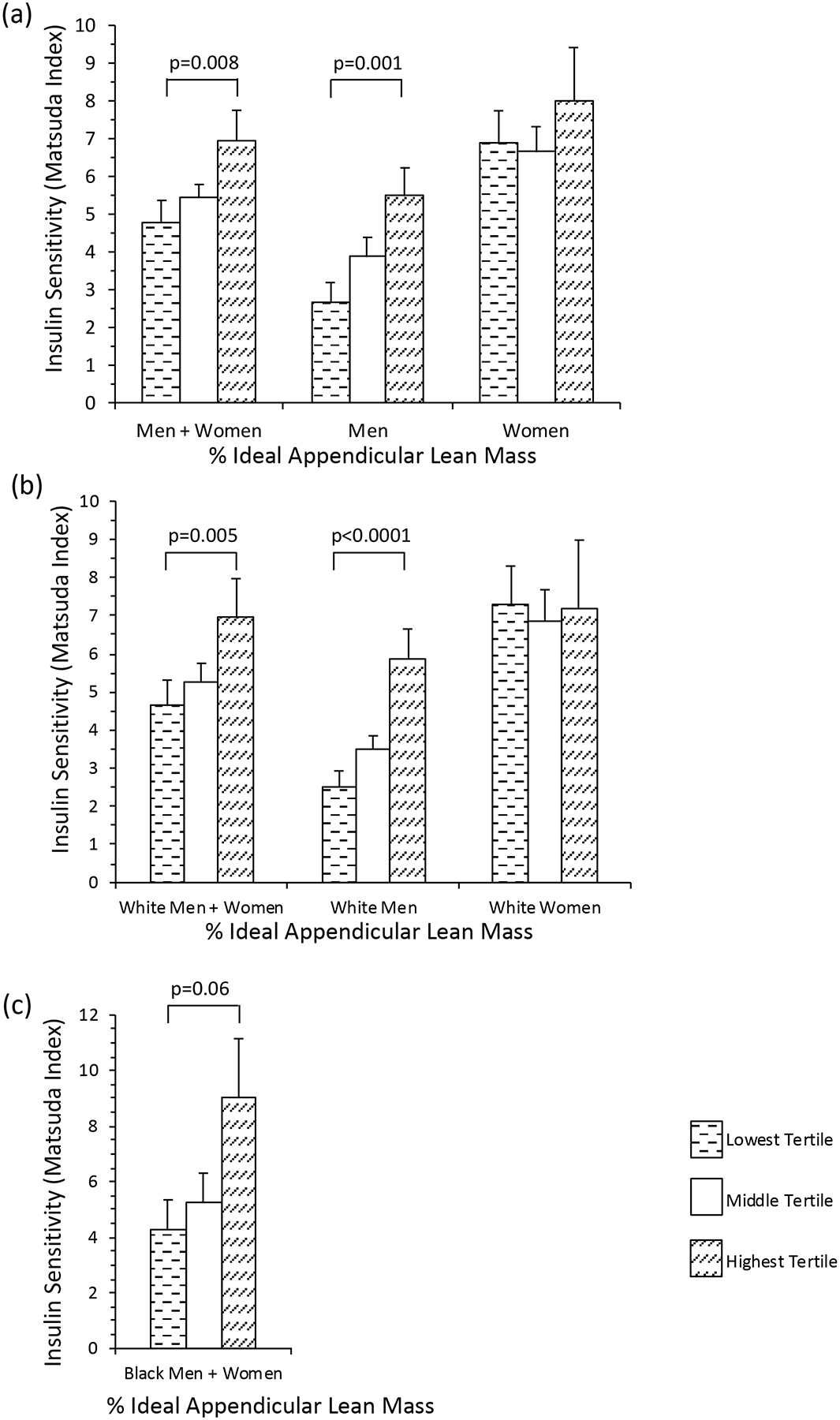
Mean age was 34.3 ± 6.8 years, and mean BMI 35.8 ± 5.8 kg/m (mean ± SD). Individuals in the highest % ideal ALM tertile had mean IS 45% higher than the lowest tertile [6.94 ± 0.85 vs 4.80 ± 0.56 (mean ± SEM), p = 0.008] (sex interaction p = 0.003). Men in the highest % ideal ALM tertile had mean IS twice the lowest tertile (5.47 ± 0.68 vs 2.68 ± 0.34, p = 0.001), which remained significant controlling for visceral/subcutaneous and intermuscular adipose tissue, and intramyocellular and intrahepatic lipids (p = 0.03). The association was not significant in women.
Muscle mass is associated with IS independent of detrimental adipose depots in young men with overweight/obesity, at risk for T2DM but currently metabolically healthy. Muscle mass relative to sex, age, weight, and height-specific norms may be used to ascertain individual T2DM risk associated with low muscle mass.
背景/目的:肌肉量减少与胰岛素抵抗增加有关,但在有2型糖尿病(T2DM)高风险但代谢健康的超重/肥胖年轻成年人中,这种关联是否独立于有害脂肪堆积尚不清楚。本研究的目的是确定在超重/肥胖的年轻成年人中,肌肉量是否与胰岛素敏感性(IS)独立相关。
受试者/方法:对132名年龄在21 - 45岁、BMI≥25 kg/m²且无T2DM的代谢健康成年人进行横断面临床研究中心研究。主要自变量:理想的四肢瘦体重(ALM)百分比,计算方法为测量的ALM除以根据年龄、体重和身高预测的ALM,使用经过验证的基于美国国家健康与营养检查调查(NHANES)数据的方程计算。主要因变量:通过松田指数计算的IS。
平均年龄为34.3±6.8岁,平均BMI为35.8±5.8 kg/m²(平均值±标准差)。理想ALM百分比最高三分位数的个体平均IS比最低三分位数高45%[6.94±0.85对4.80±0.56(平均值±标准误),p = 0.008](性别交互作用p = 0.003)。理想ALM百分比最高三分位数的男性平均IS是最低三分位数的两倍(5.47±0.68对2.68±0.34,p = 0.001),在控制内脏/皮下和肌间脂肪组织以及肌细胞内和肝内脂质后仍具有显著性(p = 0.03)。女性中这种关联不显著。
在有T2DM风险但目前代谢健康的超重/肥胖年轻男性中,肌肉量与IS独立相关,独立于有害脂肪堆积。相对于性别、年龄、体重和身高特定标准的肌肉量可用于确定与低肌肉量相关的个体T2DM风险。