Department of Medicine, Division of Cardiovascular Medicine, Stanford University School of Medicine, Stanford, CA, 94305, USA.
Stanford Cardiovascular Institute, Stanford, CA, 94305, USA.
Sci Rep. 2020 May 13;10(1):7913. doi: 10.1038/s41598-020-64636-7.
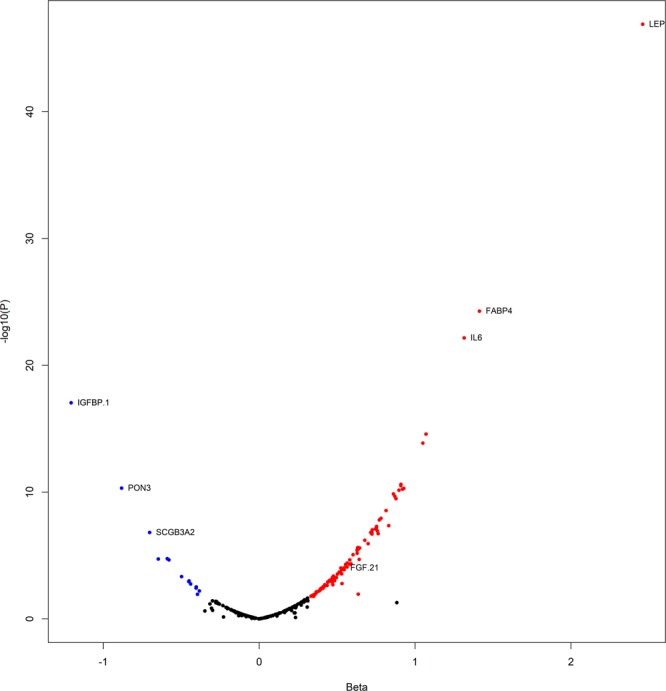
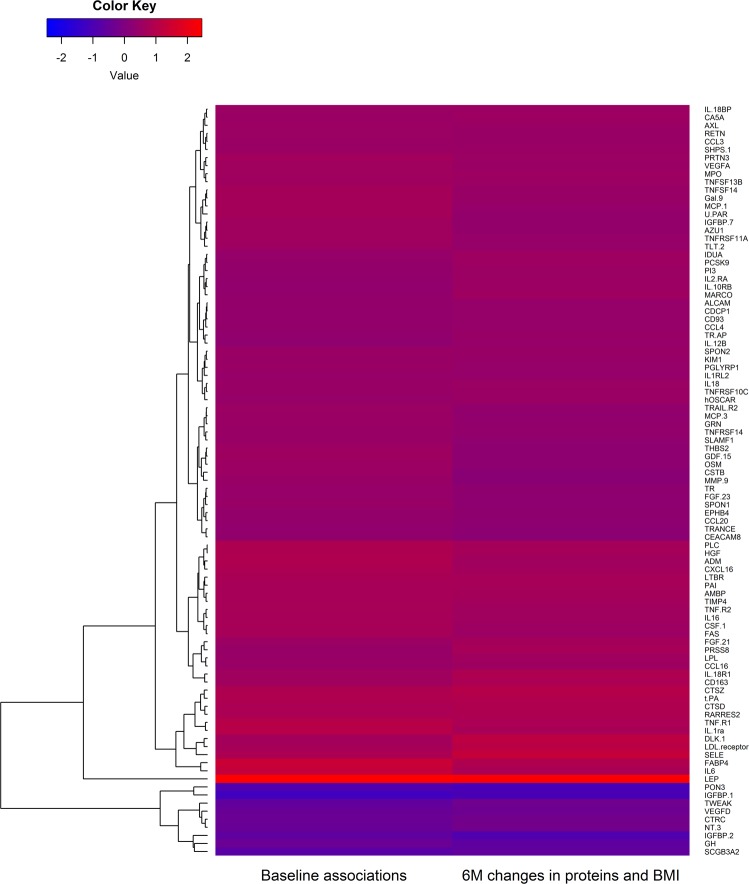
Inflammatory and cardiovascular biomarkers have been associated with obesity, but little is known about how they change upon dietary intervention and concomitant weight loss. Further, protein biomarkers might be useful for predicting weight loss in overweight and obese individuals. We performed secondary analyses in the Diet Intervention Examining The Factors Interacting with Treatment Success (DIETFITS) randomized intervention trial that included healthy 609 adults (18-50 years old) with BMI 28-40 kg/m, to evaluate associations between circulating protein biomarkers and BMI at baseline, during a weight loss diet intervention, and to assess predictive potential of baseline blood proteins on weight loss. We analyzed 263 plasma proteins at baseline and 6 months into the intervention using the Olink Proteomics CVD II, CVD III and Inflammation arrays. BMI was assessed at baseline, after 3 and 6 months of dietary intervention. At baseline, 102 of the examined inflammatory and cardiovascular biomarkers were associated with BMI (>90% with successful replication in 1,584 overweight/obese individuals from a community-based cohort study) and 130 tracked with weight loss shedding light into the pathophysiology of obesity. However, out of 263 proteins analyzed at baseline, only fibroblast growth factor 21 (FGF-21) predicted weight loss, and none helped individualize dietary assignment.
炎症和心血管生物标志物与肥胖有关,但关于它们在饮食干预和随之而来的体重减轻时如何变化知之甚少。此外,蛋白质生物标志物可能有助于预测超重和肥胖个体的体重减轻。我们对 Diet Intervention Examining The Factors Interacting with Treatment Success(DIETFITS)随机干预试验进行了二次分析,该试验纳入了 609 名健康成年人(18-50 岁),BMI 为 28-40kg/m2,以评估循环蛋白生物标志物与基线 BMI 之间的相关性、在减肥饮食干预期间、评估基线血液蛋白对体重减轻的预测潜力。我们使用 Olink Proteomics CVD II、CVD III 和炎症阵列分析了基线和干预 6 个月时的 263 种血浆蛋白。基线、膳食干预 3 个月和 6 个月时评估 BMI。在基线时,检查的 102 种炎症和心血管生物标志物与 BMI 相关(在来自社区为基础的队列研究的 1584 名超重/肥胖个体中,超过 90%的标志物复制成功),并且 130 种标志物与体重减轻相关,这揭示了肥胖的病理生理学。然而,在基线分析的 263 种蛋白质中,只有成纤维细胞生长因子 21(FGF-21)预测体重减轻,而且没有一种蛋白质可以帮助个体化饮食分配。