Maglakelidze Natella, Manto Kristen M, Craig Timothy J
Penn State University College of Medicine, 500 University Drive, Hershey, PA, 17033, USA.
Department of Medicine and Pediatrics, Penn State University, 500 University Drive, Hershey, PA, 17033, USA.
Pulm Ther. 2020 Dec;6(2):169-176. doi: 10.1007/s41030-020-00118-5. Epub 2020 May 13.
COVID-19 presentation may include a profound increase in cytokines and associated pneumonia, rapidly progressing to acute respiratory distress syndrome (ARDS). This so-called cytokine storm often leads to refractory edema, respiratory arrest, and death. At present, anti-IL-6, antiviral therapy, convalescent plasma, hydroxychloroquine, and azithromycin among others are being investigated as potential treatments for COVID-19. As the disease etiology and precise therapeutic interventions are still not definitively defined, we wanted to review the roles that complement and the contact system may have in either the treatment or pathogenesis of the disease.
We searched the recent literature (PubMed) on complement and coronavirus; contact system and coronavirus; bradykinin and coronavirus; and angiotensin receptor and coronavirus. The manuscript complies with ethics guidelines and was deemed exempt from institutional review board approval according to Human Subjects Protection Office guidelines.
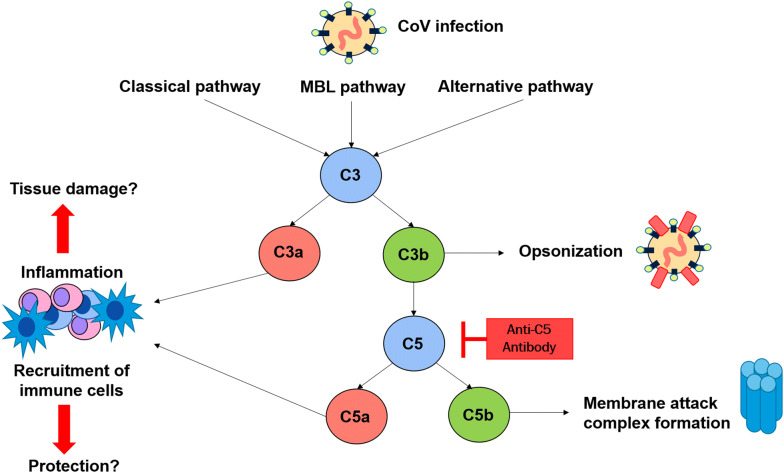
Mouse models are available for the study of coronavirus and complement. Although complement is effective in protecting against many viruses, it does not seem to be protective against coronavirus. C3 knockout mice infected with SARS-CoV had less lung disease than wild-type mice, suggesting that complement may play a role in coronavirus pathogenesis. Some evidence suggests that the observed pulmonary edema may be bradykinin-induced and could be the reason that corticosteroids, antihistamines, and other traditional interventions for edema are not effective. Angiotensin-converting enzyme 2 (ACE2) is a co-receptor for SARS-CoV-2, and studies thus far have not concluded a benefit or risk associated with the use of either ACE-inhibitors or angiotensin receptor antagonists. Activation of complement and the contact system, through generation of bradykinin, may play a role in the SARS-CoV-2-induced pulmonary edema, and our search suggests that further work is necessary to confirm our suspicions.
新型冠状病毒肺炎(COVID-19)的表现可能包括细胞因子显著增加及相关肺炎,迅速进展为急性呼吸窘迫综合征(ARDS)。这种所谓的细胞因子风暴常导致难治性水肿、呼吸骤停和死亡。目前,抗白细胞介素-6、抗病毒治疗、康复期血浆、羟氯喹和阿奇霉素等正在作为COVID-19的潜在治疗方法进行研究。由于该疾病的病因和确切治疗干预措施仍未明确界定,我们希望回顾补体和接触系统在该疾病的治疗或发病机制中可能发挥的作用。
我们检索了近期关于补体与冠状病毒、接触系统与冠状病毒、缓激肽与冠状病毒以及血管紧张素受体与冠状病毒的文献(PubMed)。该手稿符合伦理准则,根据人类受试者保护办公室的指导方针,被认为无需机构审查委员会批准。
有用于研究冠状病毒和补体的小鼠模型。尽管补体对许多病毒具有有效的保护作用,但它似乎对冠状病毒没有保护作用。感染严重急性呼吸综合征冠状病毒(SARS-CoV)的C3基因敲除小鼠比野生型小鼠的肺部疾病更少,这表明补体可能在冠状病毒发病机制中起作用。一些证据表明,观察到的肺水肿可能是由缓激肽引起的,这可能是皮质类固醇、抗组胺药和其他传统水肿干预措施无效的原因。血管紧张素转换酶2(ACE2)是严重急性呼吸综合征冠状病毒2(SARS-CoV-2)的共受体,迄今为止的研究尚未得出使用血管紧张素转换酶抑制剂或血管紧张素受体拮抗剂的益处或风险。补体和接触系统通过生成缓激肽而激活,可能在SARS-CoV-2诱导的肺水肿中起作用,我们的检索表明需要进一步开展工作来证实我们的怀疑。