Institute for Health and Sport, Victoria University, Melbourne, Australia.
Centre for Sport Research, School of Exercise and Nutrition Sciences, Deakin University, Australia.
PLoS One. 2020 May 14;15(5):e0233134. doi: 10.1371/journal.pone.0233134. eCollection 2020.
The importance of concurrent exercise order for improving endurance and resistance adaptations remains unclear, particularly when sessions are performed a few hours apart. We investigated the effects of concurrent training (in alternate orders, separated by ~3 hours) on endurance and resistance training adaptations, compared to resistance-only training.
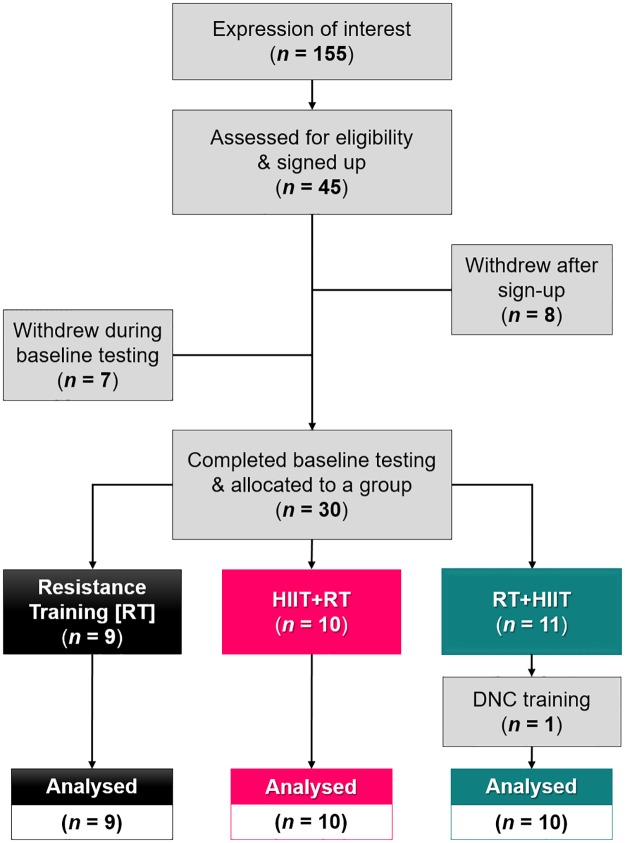
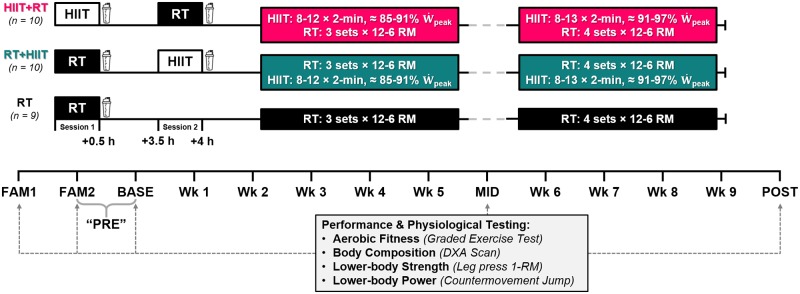
Twenty-nine healthy, moderately-active men (mean ± SD; age 24.5 ± 4.7 y; body mass 74.9 ± 10.8 kg; height 179.7 ± 6.5 cm) performed either resistance-only training (RT, n = 9), or same-day concurrent training whereby high-intensity interval training was performed either 3 hours before (HIIT+RT, n = 10) or after resistance training (RT+HIIT, n = 10), for 3 d.wk-1 over 9 weeks. Training-induced changes in leg press 1-repetition maximal (1-RM) strength, countermovement jump (CMJ) performance, body composition, peak oxygen uptake ([Formula: see text]), aerobic power ([Formula: see text]), and lactate threshold ([Formula: see text]) were assessed before, and after both 5 and 9 weeks of training.
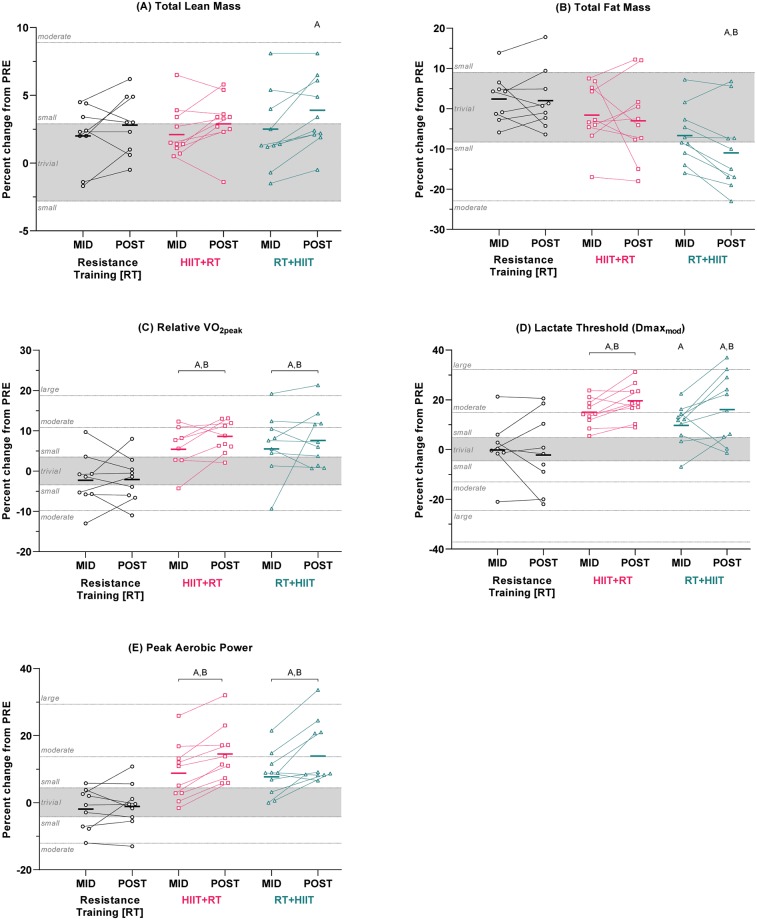
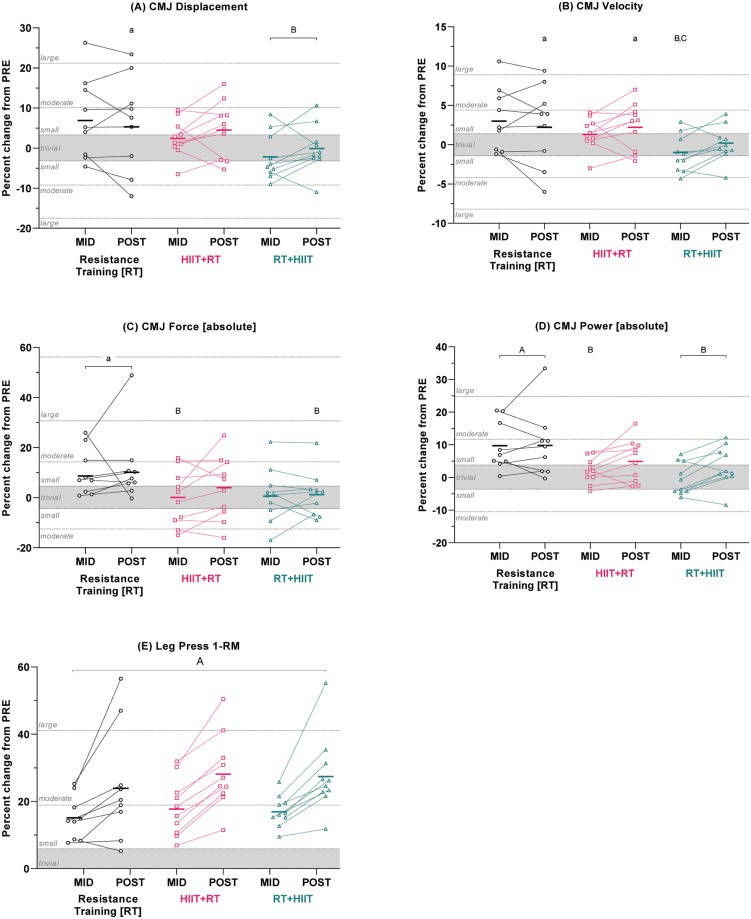
After 9 weeks, all training groups increased leg press 1-RM (24-28%) and total lean mass (3-4%), with no clear differences between groups. Both concurrent groups elicited similar small-to-moderate improvements in all markers of aerobic fitness ([Formula: see text] ~8-9%; [Formula: see text] ~16-20%; [Formula: see text] ~14-15%). RT improved CMJ displacement (mean ± SD, 5.3 ± 6.3%), velocity (2.2 ± 2.7%), force (absolute: 10.1 ± 10.1%), and power (absolute: 9.8 ± 7.6%; relative: 6.0 ± 6.6%). HIIT+RT elicited comparable improvements in CMJ velocity only (2.2 ± 2.7%). Compared to RT, RT+HIIT attenuated CMJ displacement (mean difference ± 90%CI, -5.1 ± 4.3%), force (absolute: -8.2 ± 7.1%) and power (absolute: -6.0 ± 4.7%). Only RT+HIIT reduced absolute fat mass (mean ± SD, -11.0 ± 11.7%).
In moderately-active males, concurrent training, regardless of the exercise order, presents a viable strategy to improve lower-body maximal strength and total lean mass comparably to resistance-only training, whilst also improving indices of aerobic fitness. However, improvements in CMJ displacement, force, and power were attenuated when RT was performed before HIIT, and as such, exercise order may be an important consideration when designing training programs in which the goal is to improve lower-body power.
提高耐力和抵抗力适应能力的同时进行运动的重要性尚不清楚,特别是当两次运动之间相隔数小时时。我们研究了与仅进行阻力训练相比,交替进行(相隔约 3 小时)的同时训练对耐力和阻力训练适应的影响。
29 名健康、适度活跃的男性(平均 ± 标准差;年龄 24.5 ± 4.7 岁;体重 74.9 ± 10.8 公斤;身高 179.7 ± 6.5 厘米)进行了以下训练:仅进行阻力训练(RT,n = 9),或在 9 周内每周 3 天进行同日同时训练,高强度间歇训练(HIIT)在阻力训练之前(HIIT+RT,n = 10)或之后(RT+HIIT,n = 10)进行。在训练前和训练 5 周和 9 周后评估了腿推 1 次最大重复(1-RM)强度、反向跳(CMJ)表现、身体成分、峰值摄氧量([Formula: see text])、有氧功率([Formula: see text])和乳酸阈([Formula: see text])的变化。
9 周后,所有训练组的腿推 1-RM(24-28%)和总瘦体重(3-4%)均有所增加,且各组之间无明显差异。两个同时训练组均使所有有氧健身标志物的改善程度相似,且均为小到中度([Formula: see text]8-9%;[Formula: see text]16-20%;[Formula: see text]~14-15%)。RT 提高了 CMJ 位移(平均 ± 标准差,5.3 ± 6.3%)、速度(2.2 ± 2.7%)、力量(绝对:10.1 ± 10.1%)和功率(绝对:9.8 ± 7.6%;相对:6.0 ± 6.6%)。HIIT+RT 仅使 CMJ 速度得到了类似的改善(2.2 ± 2.7%)。与 RT 相比,RT+HIIT 降低了 CMJ 位移(平均差异 ± 90%置信区间,-5.1 ± 4.3%)、力量(绝对:-8.2 ± 7.1%)和功率(绝对:-6.0 ± 4.7%)。只有 RT+HIIT 降低了绝对脂肪量(平均 ± 标准差,-11.0 ± 11.7%)。
在适度活跃的男性中,无论运动顺序如何,同时训练都是一种可行的策略,可以与仅进行阻力训练一样有效地提高下肢最大力量和总瘦体重,同时还可以提高有氧健身指数。然而,当 RT 在 HIIT 之前进行时,CMJ 位移、力量和功率的改善程度会降低,因此,在设计旨在提高下肢力量的训练计划时,运动顺序可能是一个重要的考虑因素。