• 文献检索
  • 文档翻译
  • 深度研究
  • 学术资讯
  • Suppr Zotero 插件Zotero 插件
  • 邀请有礼
  • 套餐&价格
  • 历史记录
应用&插件
Suppr Zotero 插件Zotero 插件浏览器插件Mac 客户端Windows 客户端微信小程序
定价
高级版会员购买积分包购买API积分包
服务
文献检索文档翻译深度研究API 文档MCP 服务
关于我们
关于 Suppr公司介绍联系我们用户协议隐私条款
关注我们

Suppr 超能文献

核心技术专利:CN118964589B侵权必究
粤ICP备2023148730 号-1Suppr @ 2026

文献检索

告别复杂PubMed语法,用中文像聊天一样搜索,搜遍4000万医学文献。AI智能推荐,让科研检索更轻松。

立即免费搜索

文件翻译

保留排版,准确专业,支持PDF/Word/PPT等文件格式,支持 12+语言互译。

免费翻译文档

深度研究

AI帮你快速写综述,25分钟生成高质量综述,智能提取关键信息,辅助科研写作。

立即免费体验

对不同情绪面部表情的注意偏向——≠Akhoe Hai||om儿童与青少年和德国儿童与青少年的跨文化比较

Attentional Bias to Facial Expressions of Different Emotions - A Cross-Cultural Comparison of ≠Akhoe Hai||om and German Children and Adolescents.

作者信息

Mühlenbeck Cordelia, Pritsch Carla, Wartenburger Isabell, Telkemeyer Silke, Liebal Katja

机构信息

Department of Psychology, Brandenburg Medical School Theodor Fontane, Neuruppin, Germany.

Comparative Developmental Psychology, Department of Education and Psychology, Freie Universität Berlin, Berlin, Germany.

出版信息

Front Psychol. 2020 Apr 28;11:795. doi: 10.3389/fpsyg.2020.00795. eCollection 2020.

DOI:10.3389/fpsyg.2020.00795
PMID:32411056
原文链接:https://pmc.ncbi.nlm.nih.gov/articles/PMC7199105/
Abstract

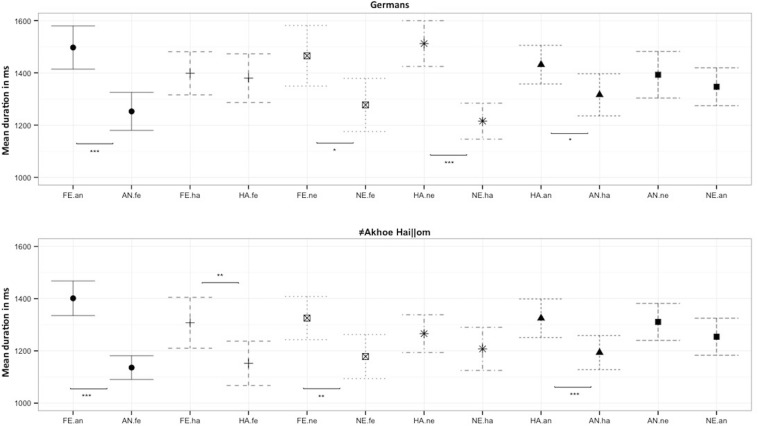
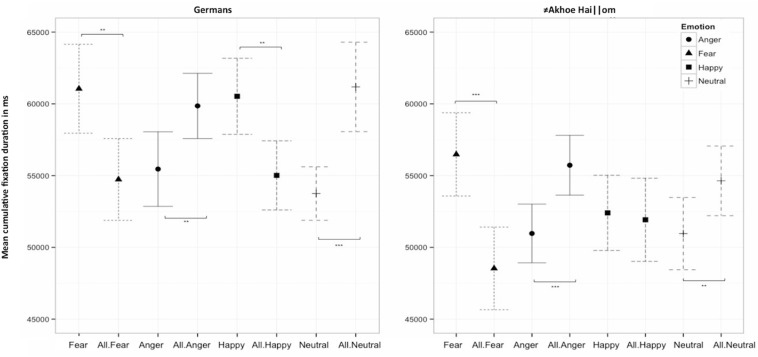
The attentional bias to negative information enables humans to quickly identify and to respond appropriately to potentially threatening situations. Because of its adaptive function, the enhanced sensitivity to negative information is expected to represent a universal trait, shared by all humans regardless of their cultural background. However, existing research focuses almost exclusively on humans from Western industrialized societies, who are not representative for the human species. Therefore, we compare humans from two distinct cultural contexts: adolescents and children from Germany, a Western industrialized society, and from the ≠Akhoe Hai||om, semi-nomadic hunter-gatherers in Namibia. We predicted that both groups show an attentional bias toward negative facial expressions as compared to neutral or positive faces. We used eye-tracking to measure their fixation duration on facial expressions depicting different emotions, including negative (fear, anger), positive (happy), and neutral faces. Both Germans and the ≠Akhoe Hai||om gazed longer at fearful faces, but shorter on angry faces, challenging the notion of a general bias toward negative emotions. For happy faces, fixation durations varied between the two groups, suggesting more flexibility in the response to positive emotions. Our findings emphasize the need for placing research on emotion perception into an evolutionary, cross-cultural comparative framework that considers the adaptive significance of specific emotions, rather than differentiating between positive and negative information, and enables systematic comparisons across participants from diverse cultural backgrounds.

摘要

对负面信息的注意偏向使人类能够快速识别潜在威胁情况并做出适当反应。由于其适应性功能,对负面信息的增强敏感性被认为是一种普遍特征,所有人类无论文化背景如何都具备。然而,现有研究几乎完全集中在西方工业化社会的人群,而他们并不能代表整个人类物种。因此,我们比较了来自两种不同文化背景的人群:来自西方工业化社会德国的青少年和儿童,以及来自纳米比亚半游牧狩猎采集部落≠Akhoe Hai||om的人群。我们预测,与中性或正面面孔相比,两组人群都会对负面面部表情表现出注意偏向。我们使用眼动追踪技术来测量他们对描绘不同情绪的面部表情的注视持续时间,包括负面表情(恐惧、愤怒)、正面表情(高兴)和中性表情。德国人和≠Akhoe Hai||om人群对恐惧面孔的注视时间都更长,但对愤怒面孔的注视时间更短,这对普遍存在对负面情绪偏向的观点提出了挑战。对于高兴面孔,两组人群的注视持续时间有所不同,这表明在对正面情绪的反应上更具灵活性。我们的研究结果强调,有必要将情绪感知研究置于一个进化的、跨文化比较框架中,该框架要考虑特定情绪的适应性意义,而不是区分正面和负面信息,并能够对来自不同文化背景的参与者进行系统比较。
https://cdn.ncbi.nlm.nih.gov/pmc/blobs/8df5/7199105/65e66fd1e237/fpsyg-11-00795-g002.jpg
https://cdn.ncbi.nlm.nih.gov/pmc/blobs/8df5/7199105/6dc874cb05f8/fpsyg-11-00795-g001.jpg
https://cdn.ncbi.nlm.nih.gov/pmc/blobs/8df5/7199105/65e66fd1e237/fpsyg-11-00795-g002.jpg
https://cdn.ncbi.nlm.nih.gov/pmc/blobs/8df5/7199105/6dc874cb05f8/fpsyg-11-00795-g001.jpg
https://cdn.ncbi.nlm.nih.gov/pmc/blobs/8df5/7199105/65e66fd1e237/fpsyg-11-00795-g002.jpg

相似文献

1
Attentional Bias to Facial Expressions of Different Emotions - A Cross-Cultural Comparison of ≠Akhoe Hai||om and German Children and Adolescents.对不同情绪面部表情的注意偏向——≠Akhoe Hai||om儿童与青少年和德国儿童与青少年的跨文化比较
Front Psychol. 2020 Apr 28;11:795. doi: 10.3389/fpsyg.2020.00795. eCollection 2020.
2
Reappraisal Modulates Attentional Bias to Angry Faces.重新评估可调节对愤怒面孔的注意偏向。
Front Psychol. 2016 Nov 22;7:1841. doi: 10.3389/fpsyg.2016.01841. eCollection 2016.
3
Orienting and maintenance of attention to threatening facial expressions in anxiety--an eye movement study.焦虑中对威胁性面部表情的定向和维持注意力——一项眼动研究。
Psychiatry Res. 2014 Dec 15;220(1-2):362-9. doi: 10.1016/j.psychres.2014.06.005. Epub 2014 Jun 24.
4
The effect of emotional uncertainty on attentional bias toward neutral infant faces in adults.情绪不确定性对成年人对中性婴儿面孔注意力偏向的影响。
Dev Psychobiol. 2022 Dec;64(8):e22335. doi: 10.1002/dev.22335.
5
More than just another face in the crowd: superior detection of threatening facial expressions in children and adults.不止是人群中另一张面孔:儿童和成人对威胁性面部表情的卓越察觉能力
Dev Sci. 2009 Mar;12(2):305-13. doi: 10.1111/j.1467-7687.2008.00767.x.
6
Memory facilitation for emotional faces: Visual working memory trade-offs resulting from attentional preference for emotional facial expressions.情绪面孔的记忆促进:注意偏向情绪面部表情导致的视觉工作记忆权衡。
Mem Cognit. 2019 Aug;47(6):1231-1243. doi: 10.3758/s13421-019-00930-8.
7
Mechanisms of attentional selection bias for threatening emotions of anger and disgust in individuals with high-trait anxiety.高特质焦虑个体对愤怒和厌恶等威胁性情绪的注意选择偏向机制。
Neuroreport. 2018 Mar 7;29(4):291-300. doi: 10.1097/WNR.0000000000000953.
8
Effects of affective and emotional congruency on facial expression processing under different task demands.在不同任务需求下,情感和情绪一致性对面部表情加工的影响。
Acta Psychol (Amst). 2018 Jun;187:66-76. doi: 10.1016/j.actpsy.2018.04.013. Epub 2018 May 8.
9
Attentional bias towards emotional facial expressions in survivors of dating violence.约会暴力幸存者对情绪化面部表情的注意偏向。
Cogn Emot. 2014;28(6):1127-36. doi: 10.1080/02699931.2013.867834. Epub 2013 Dec 17.
10
Exogenous cortisol shifts a motivated bias from fear to anger in spatial working memory for facial expressions.外源性皮质醇在面部表情的空间工作记忆中,将动机偏差从恐惧转变为愤怒。
Psychoneuroendocrinology. 2007 Jan;32(1):14-21. doi: 10.1016/j.psyneuen.2006.09.010. Epub 2006 Nov 7.

引用本文的文献

1
Deployment of attention to facial expressions varies as a function of emotional quality-but not in alexithymic individuals.对面部表情的注意力分配会因情绪特质而有所不同,但在述情障碍个体中并非如此。
Front Psychiatry. 2024 Mar 6;15:1338194. doi: 10.3389/fpsyt.2024.1338194. eCollection 2024.
2
Perceptual integration of bodily and facial emotion cues in chimpanzees and humans.黑猩猩和人类对身体及面部情绪线索的感知整合
PNAS Nexus. 2024 Jan 18;3(2):pgae012. doi: 10.1093/pnasnexus/pgae012. eCollection 2024 Feb.
3
Structural integrity of the insula and emotional facial recognition performance following stroke.

本文引用的文献

1
Systematic Review and Meta-Analysis: Eye-Tracking of Attention to Threat in Child and Adolescent Anxiety.系统评价和荟萃分析:儿童和青少年焦虑中对威胁的眼动追踪。
J Am Acad Child Adolesc Psychiatry. 2020 Jan;59(1):88-99.e1. doi: 10.1016/j.jaac.2019.06.006. Epub 2019 Jun 29.
2
An eye tracking investigation of attentional biases towards affect in young children.一项关于幼儿对情感注意力偏差的眼动追踪调查。
Dev Psychol. 2017 Aug;53(8):1418-1427. doi: 10.1037/dev0000345. Epub 2017 May 22.
3
The dot-probe task to measure emotional attention: A suitable measure in comparative studies?
中风后岛叶的结构完整性与面部表情识别能力
Brain Commun. 2023 Apr 28;5(3):fcad144. doi: 10.1093/braincomms/fcad144. eCollection 2023.
4
SMaTE: A Segment-Level Feature Mixing and Temporal Encoding Framework for Facial Expression Recognition.SMaTE:一种用于面部表情识别的分段级特征混合和时间编码框架。
Sensors (Basel). 2022 Aug 1;22(15):5753. doi: 10.3390/s22155753.
5
Attention for Emotion-How Young Adults With Neurodevelopmental Disorders Look at Facial Expressions of Affect.对情绪的关注——患有神经发育障碍的年轻人如何看待情感面部表情。
Front Psychiatry. 2022 Jun 15;13:842896. doi: 10.3389/fpsyt.2022.842896. eCollection 2022.
6
Infants are sensitive to cultural differences in emotions at 11 months.11 个月大的婴儿对情绪的文化差异很敏感。
PLoS One. 2021 Sep 30;16(9):e0257655. doi: 10.1371/journal.pone.0257655. eCollection 2021.
7
The Recognition of Cross-Cultural Emotional Faces Is Affected by Intensity and Ethnicity in a Japanese Sample.在日本样本中,跨文化情绪面孔的识别受强度和种族的影响。
Behav Sci (Basel). 2021 Apr 23;11(5):59. doi: 10.3390/bs11050059.
点探测任务测量情绪注意:在比较研究中是一种合适的测量方法吗?
Psychon Bull Rev. 2017 Dec;24(6):1686-1717. doi: 10.3758/s13423-016-1224-1.
4
Try to look on the bright side: Children and adults can (sometimes) override their tendency to prioritize negative faces.试着往好的方面看:儿童和成年人有时能够克服他们优先关注负面面孔的倾向。
J Exp Psychol Gen. 2017 Jan;146(1):89-101. doi: 10.1037/xge0000247.
5
The fear gasping face as a threat display in a Melanesian society.在一个美拉尼西亚社会中,恐惧的喘息表情作为一种威胁展示。
Proc Natl Acad Sci U S A. 2016 Nov 1;113(44):12403-12407. doi: 10.1073/pnas.1611622113. Epub 2016 Oct 17.
6
When in infancy does the "fear bias" develop?“恐惧偏见”在婴儿期何时出现?
J Exp Child Psychol. 2017 Jan;153:149-154. doi: 10.1016/j.jecp.2016.06.018. Epub 2016 Sep 28.
7
Attentional bias for positive emotional stimuli: A meta-analytic investigation.积极情绪刺激的注意偏向:元分析研究。
Psychol Bull. 2016 Jan;142(1):79-106. doi: 10.1037/bul0000026. Epub 2015 Sep 21.
8
Unconscious discrimination of social cues from eye whites in infants.婴儿对眼白中社会线索的无意识辨别。
Proc Natl Acad Sci U S A. 2014 Nov 11;111(45):16208-13. doi: 10.1073/pnas.1411333111. Epub 2014 Oct 27.
9
Shorter gaze duration for happy faces in current but not remitted depression: evidence from eye movements.当前而非缓解期抑郁患者观看快乐面孔的注视时间更短:来自眼动的证据。
Psychiatry Res. 2014 Aug 15;218(1-2):79-86. doi: 10.1016/j.psychres.2014.04.002. Epub 2014 Apr 12.
10
Perceptions of emotion from facial expressions are not culturally universal: evidence from a remote culture.从面部表情感知情绪并非具有文化普遍性:来自一个偏远文化的证据。
Emotion. 2014 Apr;14(2):251-62. doi: 10.1037/a0036052.