Shiferaw Wondimeneh Shibabaw, Akalu Tadesse Yirga, Aynalem Yared Asmare
Lecturer of Nursing, Department of Nursing, College of Health Science, Debre Berhan University, Debre Berhan, Ethiopia.
Lecturer of Nursing, Department of Nursing, College of Health Science, Debre Markos University, Debre Markos, Ethiopia.
Int J Endocrinol. 2020 Jan 18;2020:5148370. doi: 10.1155/2020/5148370. eCollection 2020.
Mortality and morbidity in patients with diabetes mellitus (DM) are attributed to both microvascular and macrovascular complications. However, there is a significant amount of variation in the primary studies on DM regarding the prevalence of erectile dysfunction (ED) in Africa. Therefore, this study was aimed to estimate the pooled prevalence of ED patients with DM and its association with body mass index (BMI) and glycated hemoglobin in Africa.
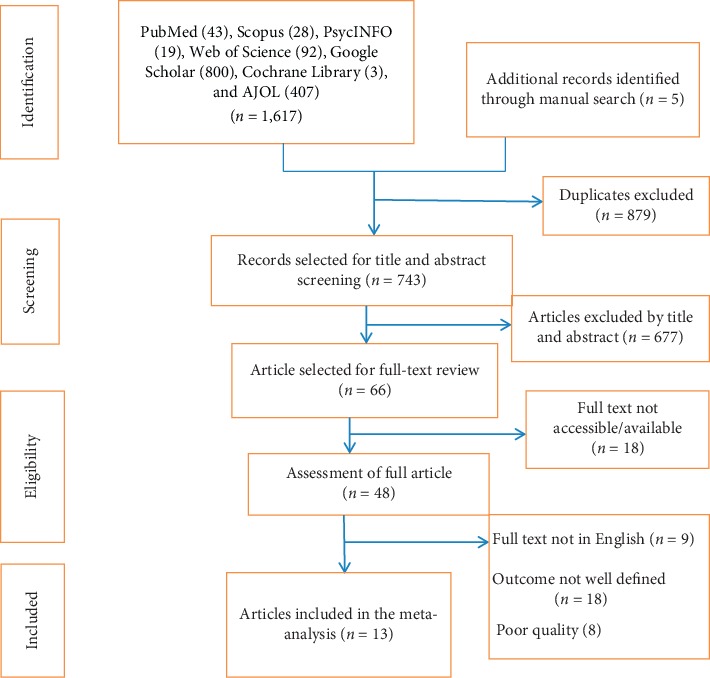
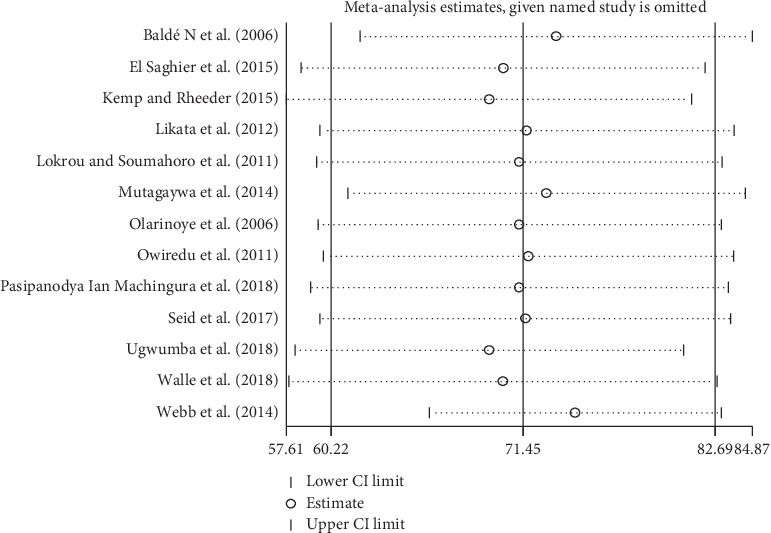
PubMed, Web of Science, Cochrane Library, Scopus, PsycINFO, African Journals Online, and Google Scholar were searched for studies that looked at ED in DM patients. A funnel plot and Egger's regression test were used to determine publication bias. The statistic was used to check heterogeneity between the studies. DerSimonian and Laird random-effects model was applied to estimate the pooled effect size. The subgroup and meta-regression analyses were conducted by country, sample size, and year of publication. Sensitivity analysis was deployed to see the effect of a single study on the overall estimation. STATA version 14 statistical software was used for the meta-analysis.
A total of 13 studies with 3,501 study participants were included in this study. We estimated that the pooled prevalence of ED in patients with DM in Africa was 71.45% (95% CI: 60.22-82.69). Diabetic patients whose BMI was ≥30 kg/m were 1.26 times more likely to develop ED (AOR = 1.26; 95% CI: 0.73-2.16) and whose glycated hemoglobin was <7% were 7% less likely to develop ED (AOR = 0.93; 95% CI: 0.5-5.9), although they were not significantly associated with ED.
The prevalence of ED in DM patients in Africa remains high. Therefore, situation-based interventions and country context-specific preventive strategies should be developed to reduce the prevalence of ED among patients with DM.
糖尿病(DM)患者的死亡率和发病率归因于微血管和大血管并发症。然而,在非洲,关于糖尿病患者勃起功能障碍(ED)患病率的初步研究存在显著差异。因此,本研究旨在估计非洲糖尿病患者勃起功能障碍的合并患病率及其与体重指数(BMI)和糖化血红蛋白的关系。
检索了PubMed、科学网、Cochrane图书馆、Scopus、PsycINFO、非洲在线期刊和谷歌学术等数据库,查找有关糖尿病患者勃起功能障碍的研究。采用漏斗图和Egger回归检验来确定发表偏倚。使用统计量来检验研究之间的异质性。采用DerSimonian和Laird随机效应模型来估计合并效应量。按国家、样本量和发表年份进行亚组分析和元回归分析。进行敏感性分析以观察单个研究对总体估计的影响。使用STATA 14统计软件进行荟萃分析。
本研究共纳入13项研究,涉及3501名研究参与者。我们估计,非洲糖尿病患者勃起功能障碍的合并患病率为71.45%(95%可信区间:60.22 - 82.69)。BMI≥30 kg/m²的糖尿病患者发生勃起功能障碍的可能性高1.26倍(优势比 = 1.26;95%可信区间:0.73 - 2.16),糖化血红蛋白<7%的患者发生勃起功能障碍的可能性低7%(优势比 = 0.93;95%可信区间:0.5 - 5.9),尽管它们与勃起功能障碍无显著关联。
非洲糖尿病患者勃起功能障碍的患病率仍然很高。因此,应制定基于具体情况的干预措施和针对特定国家背景的预防策略,以降低糖尿病患者中勃起功能障碍的患病率。