Cancer Research United Kingdom and Medical Research Council Oxford Institute for Radiation Oncology, University of Oxford, Oxford, United Kingdom.
Institute of Pharmaceutical Chemistry and Structure Genomics Consortium, Goethe-University Frankfurt, Frankfurt am Main, Germany.
J Nucl Med. 2020 Dec;61(12):1756-1763. doi: 10.2967/jnumed.120.243113. Epub 2020 May 15.
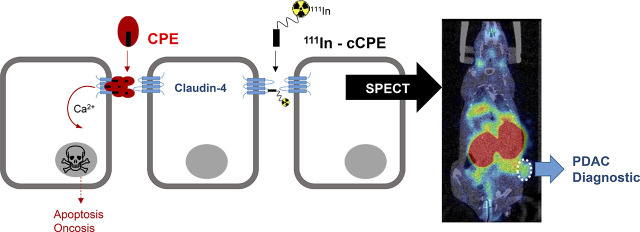
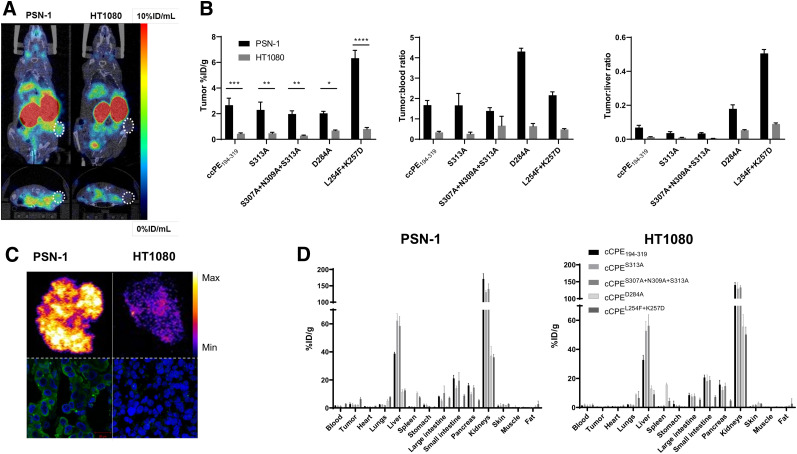
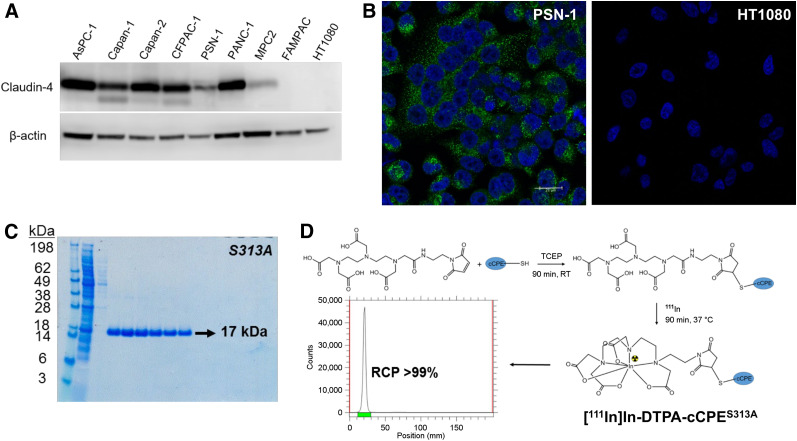
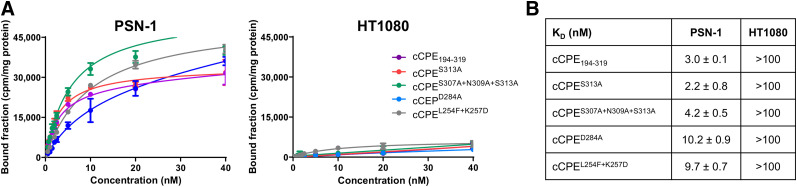
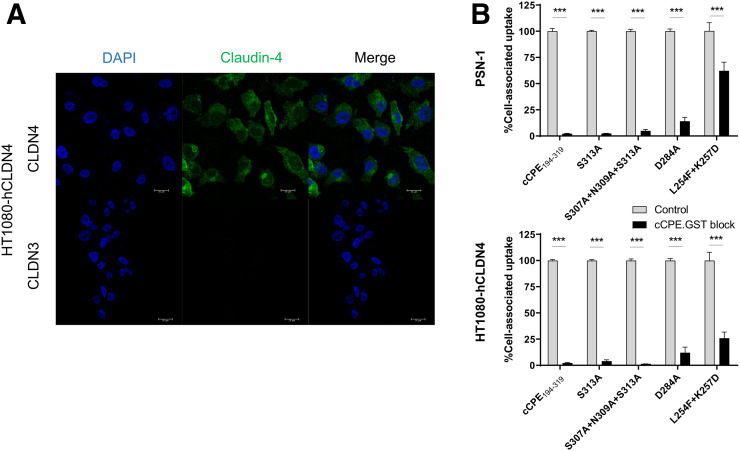
Overexpression of tight-junction protein claudin-4 has been detected in primary and metastatic pancreatic cancer tissue and is associated with better prognosis in patients. Noninvasive measurement of claudin-4 expression by imaging methods could provide a means for accelerating detection and stratifying patients into risk groups. enterotoxin (CPE) is a natural ligand for claudin-4 and holds potential as a targeting vector for molecular imaging of claudin-4 overexpression. A glutathione S-transferases (GST)-tagged version of the C terminus of CPE (cCPE) was previously used to delineate claudin-4 overexpression by SPECT but showed modest binding affinity and slow blood clearance in vivo. On the basis of the crystal structure of cCPE, a series of smaller cCPE mutants with putatively improved binding affinity for claudin-4 was generated by site-directed mutagenesis. All peptides were conjugated site-specifically on a C-terminal cysteine using maleimide-diethylenetriamine pentaacetate to enable radiolabeling with In. The binding affinity of all radioconjugates was evaluated in claudin-4-expressing PSN-1 cells and HT1080-negative controls. The specificity of all cCPE mutants to claudin-4 was assessed in HT1080 cells stably transfected with claudin-4. SPECT/CT imaging of BALB/c nude mice bearing PSN-1 or HT1080 tumor xenografts was performed to determine the claudin-4-targeting ability of these peptides in vivo. Uptake of all cCPE-based radioconjugates was significantly higher in PSN-1 cells than in HT1080-negative controls. All peptides showed a marked improvement in affinity for claudin-4 in vitro when compared with previously reported values (dissociation constant: 2.2 ± 0.8, 3 ± 0.1, 4.2 ± 0.5, 10 ± 0.9, and 9.7 ± 0.7 nM). Blood clearance of [In]In-cCPE, as measured by SPECT, was considerably faster than that of [In]In-cCPE.GST (half-life, <1 min). All radiopeptides showed significantly higher accumulation in PSN-1 xenografts than in HT1080 tumors at 90 min after injection of the tracer ([In]In-cCPE, 2.7 ± 0.8 vs. 0.4 ± 0.1 percentage injected dose per gram [%ID/g], < 0.001; [In]In-S313A, 2.3 ± 0.9 vs. 0.5 ± 0.1 %ID/g, < 0.01; [In]In-S307A + N309A + S313A, 2 ± 0.4 vs. 0.3 ± 0.1 %ID/g, < 0.01; [In]In-D284A, 2 ± 0.2 vs. 0.7 ± 0.1 %ID/g, < 0.05; [In]In-L254F + K257D, 6.3 ± 0.9 vs. 0.7 ± 0.2 %ID/g, < 0.001). These optimized cCPE-based SPECT imaging agents show great promise as claudin-4-targeting vectors for in vivo imaging of claudin-4 overexpression in pancreatic cancer.
紧密连接蛋白 Claudin-4 的过表达已在原发性和转移性胰腺癌组织中被检测到,并且与患者的预后较好相关。通过成像方法对 Claudin-4 表达进行非侵入性测量,可能为加速检测和将患者分层为风险组提供一种手段。肠毒素(CPE)是 Claudin-4 的天然配体,有可能成为 Claudin-4 过表达分子成像的靶向载体。先前使用 GST 标记的 C 末端 CPE(cCPE)来通过 SPECT 描绘 Claudin-4 过表达,但在体内显示出适度的结合亲和力和缓慢的血液清除率。基于 cCPE 的晶体结构,通过定点诱变生成了一系列假定对 Claudin-4 具有更高结合亲和力的较小 cCPE 突变体。所有肽均使用马来酰亚胺-二乙三胺五乙酸通过末端半胱氨酸特异性连接,以便用 In 进行放射性标记。在 Claudin-4 表达的 PSN-1 细胞和 HT1080 阴性对照中评估了所有放射性缀合物的结合亲和力。在稳定转染 Claudin-4 的 HT1080 细胞中评估了所有 cCPE 突变体对 Claudin-4 的特异性。用 BALB/c 裸鼠进行 PSN-1 或 HT1080 肿瘤异种移植的 SPECT/CT 成像,以确定这些肽在体内对 Claudin-4 的靶向能力。所有基于 cCPE 的放射性缀合物在 PSN-1 细胞中的摄取均明显高于 HT1080 阴性对照。与之前报道的值相比(解离常数:2.2 ± 0.8、3 ± 0.1、4.2 ± 0.5、10 ± 0.9 和 9.7 ± 0.7 nM),所有肽在体外对 Claudin-4 的亲和力均有明显提高。SPECT 测量的 [In]In-cCPE 的血液清除速度明显快于 [In]In-cCPE.GST(半衰期<1 分钟)。与 HT1080 肿瘤相比,所有放射性肽在注射示踪剂后 90 分钟在 PSN-1 异种移植瘤中的积累明显更高[In]In-cCPE,2.7 ± 0.8 比 0.4 ± 0.1 每克注射剂量的百分比(%ID/g),<0.001;[In]In-S313A,2.3 ± 0.9 比 0.5 ± 0.1 %ID/g,<0.01;[In]In-S307A + N309A + S313A,2 ± 0.4 比 0.3 ± 0.1 %ID/g,<0.01;[In]In-D284A,2 ± 0.2 比 0.7 ± 0.1 %ID/g,<0.05;[In]In-L254F + K257D,6.3 ± 0.9 比 0.7 ± 0.2 %ID/g,<0.001)。这些优化的基于 cCPE 的 SPECT 成像剂有望成为 Claudin-4 过表达的胰腺癌体内成像的 Claudin-4 靶向载体。