Department of Psychology, Brooklyn College of City University of New York, Brooklyn, New York 11210, USA.
Department of Psychology, Brooklyn College of City University of New York, Brooklyn, New York 11210, USA.
Physiol Behav. 2020 Aug 1;222:112945. doi: 10.1016/j.physbeh.2020.112945. Epub 2020 May 15.
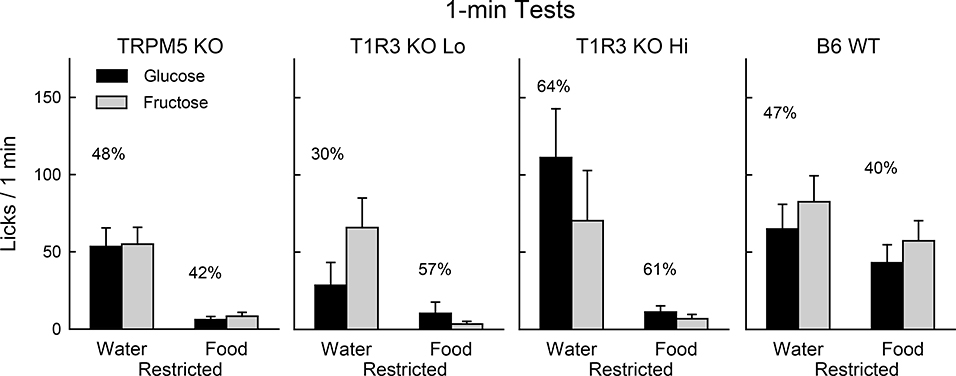
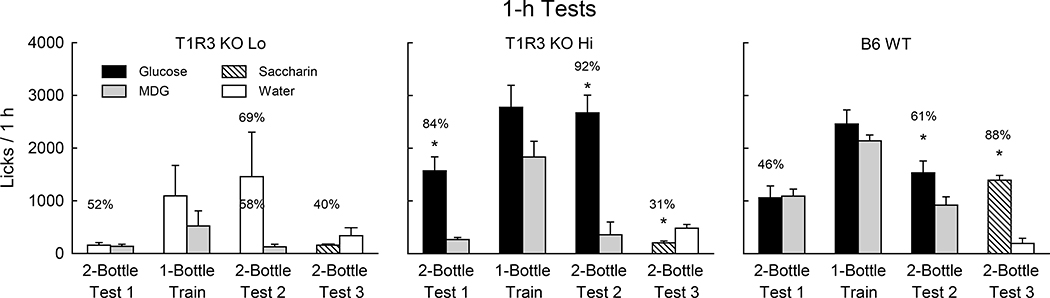
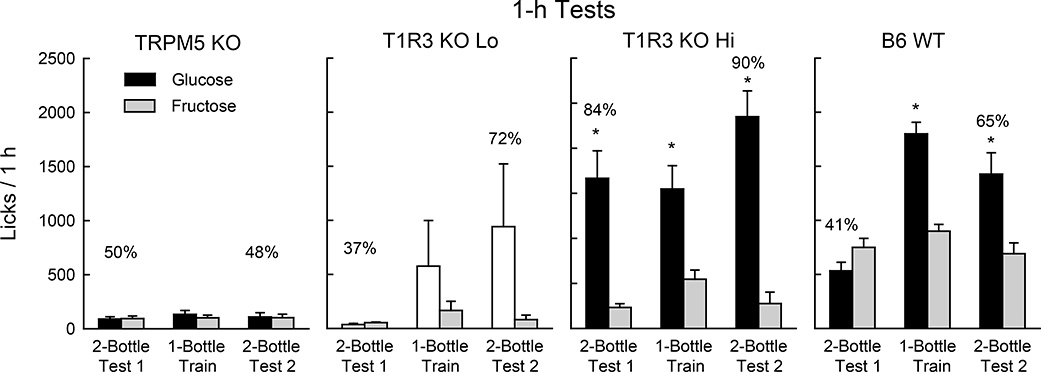
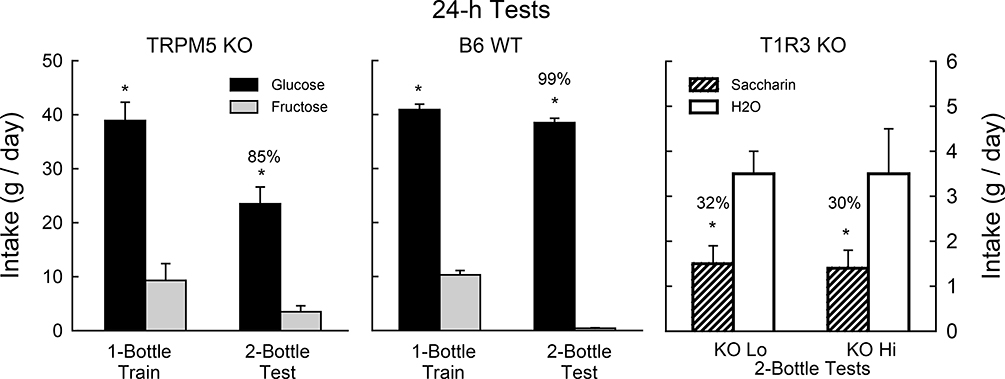
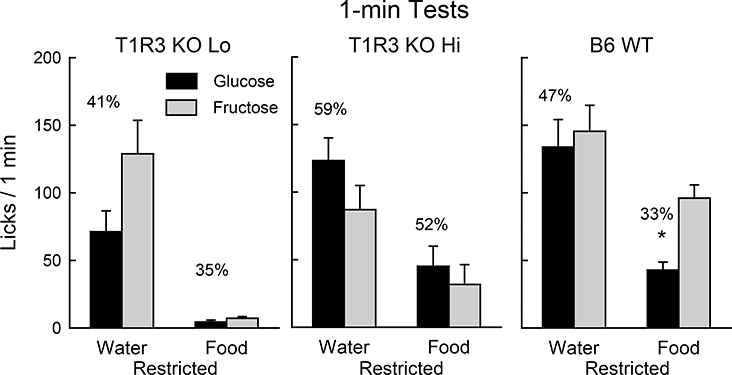
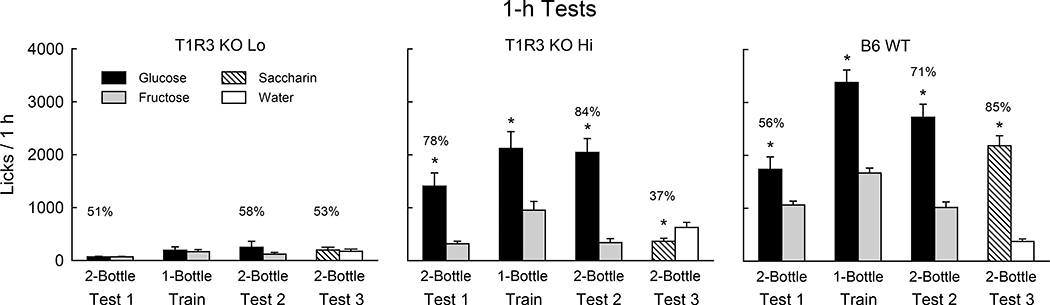
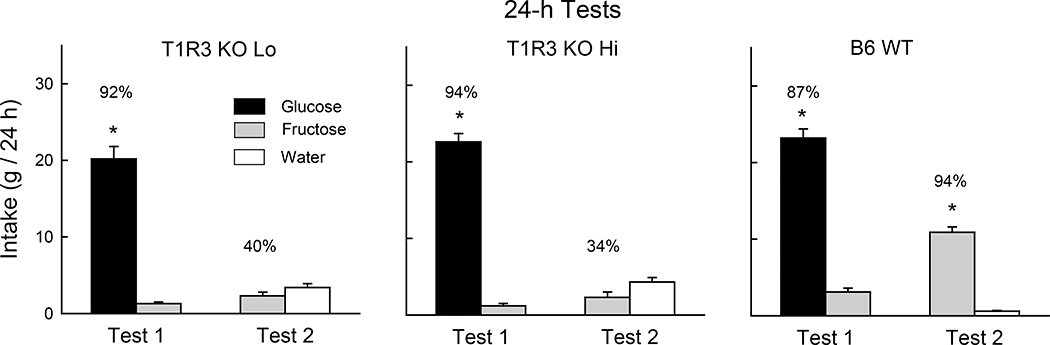
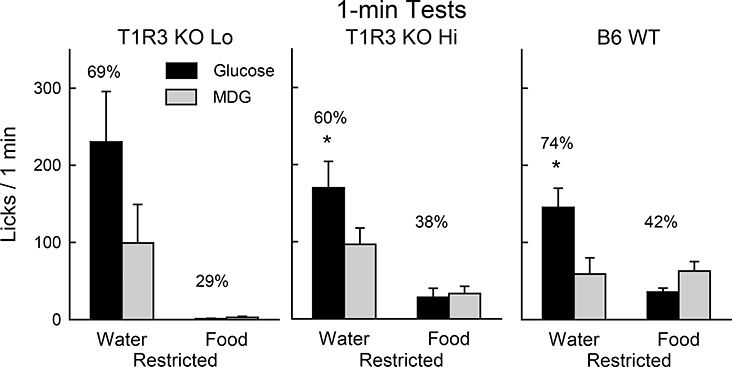
Knockout (KO) mice missing the sweet taste receptor subunit T1R3 or the signaling protein TRPM5 have greatly attenuated sweetener preferences. Yet both types of KO mice develop preferences for glucose but not fructose in 24-h tests, which has been attributed to the postoral reinforcing actions of glucose. Here we probed for residual sugar taste sensitivity in KO mice. Unlike wildtype (WT) mice, food-restricted T1R3 KO and TRPM5 KO mice displayed little attraction for 8% glucose and 8% fructose in 1-min, two-bottle choice tests. However, in 1-h tests about half of the T1R3 KO mice displayed a significant preference for glucose over fructose (78-84%), while WT mice showed either no or weak preferences (41-56%) for glucose. Following one-bottle training sessions, WT mice display greater glucose preferences although still weaker than those observed in T1R3 KO mice. In contrast, TRPM5 KO mice were indifferent to sugars in 1-h tests but developed a strong preference for glucose over fructose in 24-h tests. T1R3 taste cells contain the sodium glucose cotransporter 1 (SGLT1) and the ATP-gated K+ (K) metabolic sensor, which may mediate the unlearned glucose preference displayed by T1R3 KO mice. Unlike WT mice, many T1R3 KO mice strongly preferred glucose to a non-metabolizable glucose analog (α-methyl-D-glucopyranoside, MDG) in initial 1-h choice tests. Glucose and MDG are both ligands for SGLT1 which indicates that SGLT1 sensing does not mediate the glucose preference of T1R3 KO mice. Instead, K sensing and/or other oral sensors are implicated. The MDG findings also argue against postoral sensing as the primary source of the initial glucose preference displayed by T1R3 KO mice. Why only half of the T1R3 KO mice showed this preference in 1-h tests remains to be determined. All T1R3 KO mice preferred glucose to fructose in 24-h tests, which appears to be due to both oral and postoral glucose sensing.
敲除(KO)缺失甜味受体亚基 T1R3 或信号蛋白 TRPM5 的小鼠对甜味剂的偏好大大降低。然而,这两种类型的 KO 小鼠在 24 小时测试中都表现出对葡萄糖的偏好,但对果糖没有偏好,这归因于葡萄糖的口腔后强化作用。在这里,我们探究了 KO 小鼠对残余糖味觉的敏感性。与野生型(WT)小鼠不同,限制食物摄入的 T1R3 KO 和 TRPM5 KO 小鼠在 1 分钟、双瓶选择测试中对 8%葡萄糖和 8%果糖几乎没有吸引力。然而,在 1 小时测试中,大约一半的 T1R3 KO 小鼠对葡萄糖的偏好明显高于果糖(78-84%),而 WT 小鼠对葡萄糖的偏好要么没有,要么很弱(41-56%)。在单瓶训练后,WT 小鼠表现出更强的葡萄糖偏好,尽管仍然比 T1R3 KO 小鼠弱。相比之下,TRPM5 KO 小鼠在 1 小时测试中对糖漠不关心,但在 24 小时测试中对葡萄糖表现出强烈的偏好。T1R3 味觉细胞包含钠葡萄糖协同转运蛋白 1(SGLT1)和 ATP 门控 K+(K)代谢传感器,这可能介导 T1R3 KO 小鼠未学习的葡萄糖偏好。与 WT 小鼠不同,许多 T1R3 KO 小鼠在初始 1 小时选择测试中强烈偏爱葡萄糖而不是非代谢性葡萄糖类似物(α-甲基-D-吡喃葡萄糖苷,MDG)。葡萄糖和 MDG 都是 SGLT1 的配体,这表明 SGLT1 检测不能介导 T1R3 KO 小鼠的葡萄糖偏好。相反,K 检测和/或其他口腔传感器可能涉及其中。MDG 的发现也反对口腔后感觉是 T1R3 KO 小鼠最初葡萄糖偏好的主要来源。为什么只有一半的 T1R3 KO 小鼠在 1 小时测试中表现出这种偏好仍有待确定。所有 T1R3 KO 小鼠在 24 小时测试中都更喜欢葡萄糖而不是果糖,这似乎是由于口腔和口腔后葡萄糖的感知。