Department of Nutritional Sciences, Rutgers University, New Brunswick, NJ, United States of America.
Monell Chemical Senses Center, Philadelphia, PA, United States of America.
PLoS One. 2021 Oct 6;16(10):e0256989. doi: 10.1371/journal.pone.0256989. eCollection 2021.
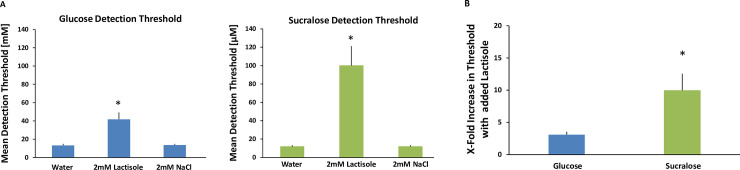
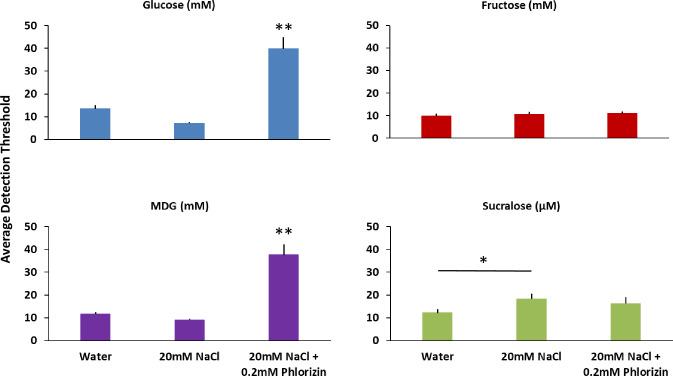
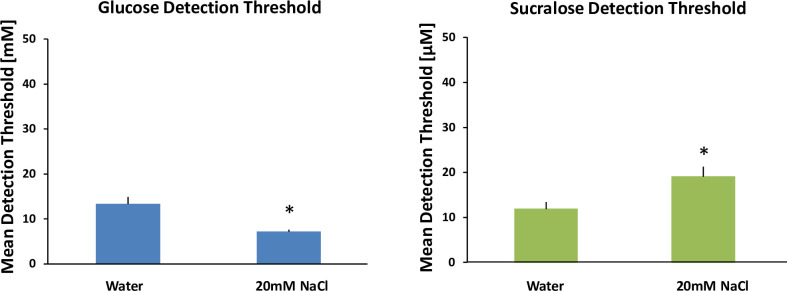
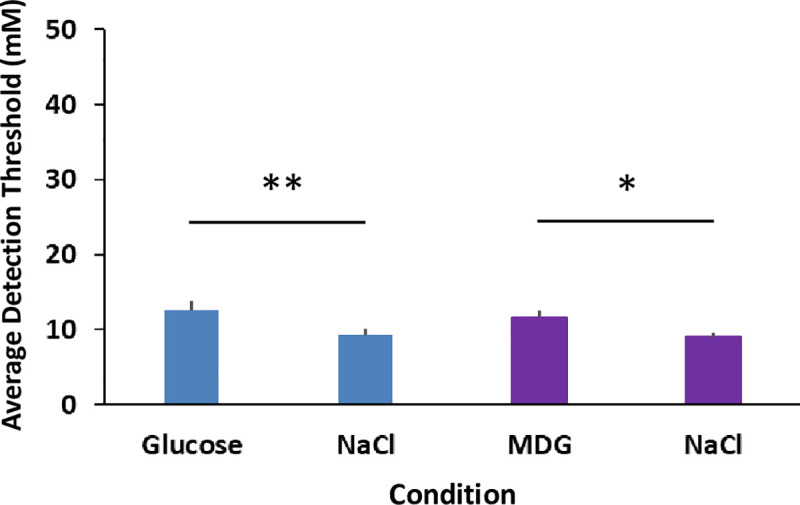
The taste stimulus glucose comprises approximately half of the commercial sugar sweeteners used today, whether in the form of the di-saccharide sucrose (glucose-fructose) or half of high-fructose corn syrup (HFCS). Therefore, oral glucose has been presumed to contribute to the sweet taste of foods when combined with fructose. In light of recent rodent data on the role of oral metabolic glucose signaling, we examined psychopharmacologically whether oral glucose detection may also involve an additional pathway in humans to the traditional sweet taste transduction via the class 1 taste receptors T1R2/T1R3. In a series of experiments, we first compared oral glucose detection thresholds to sucralose thresholds without and with addition of the T1R receptor inhibitor Na-lactisole. Next, we compared oral detection thresholds of glucose to sucralose and to the non-metabolizable glucose analog, α-methyl-D-glucopyranoside (MDG) without and with the addition of the glucose co-transport component sodium (NaCl). Finally, we compared oral detection thresholds for glucose, MDG, fructose, and sucralose without and with the sodium-glucose co-transporter (SGLT) inhibitor phlorizin. In each experiment, psychopharmacological data were consistent with glucose engaging an additional signaling pathway to the sweet taste receptor T1R2/T1R3 pathway. Na-lactisole addition impaired detection of the non-caloric sweetener sucralose much more than it did glucose, consistent with glucose using an additional signaling pathway. The addition of NaCl had a beneficial impact on the detection of glucose and its analog MDG and impaired sucralose detection, consistent with glucose utilizing a sodium-glucose co-transporter. The addition of the SGLT inhibitor phlorizin impaired detection of glucose and MDG more than it did sucralose, and had no effect on fructose, further evidence consistent with glucose utilizing a sodium-glucose co-transporter. Together, these results support the idea that oral detection of glucose engages two signaling pathways: one that is comprised of the T1R2/T1R3 sweet taste receptor and the other that utilizes an SGLT glucose transporter.
味觉刺激物葡萄糖约占当今商业使用的糖精的一半,无论是二糖蔗糖(葡萄糖-果糖)的形式还是部分高果糖玉米糖浆(HFCS)的形式。因此,当与果糖结合时,人们认为口服葡萄糖会增加食物的甜味。鉴于最近有关口腔代谢葡萄糖信号在啮齿动物中的作用的数据,我们用精神药理学的方法检查了口服葡萄糖的检测是否也涉及人类的另一种途径,即通过 1 类味觉受体 T1R2/T1R3 以外的途径来进行传统的甜味转导。在一系列实验中,我们首先比较了口服葡萄糖检测阈值与蔗糖素阈值,同时加入了 T1R 受体抑制剂 Na-lactisole。接下来,我们比较了葡萄糖的口服检测阈值与蔗糖素和非代谢性葡萄糖类似物α-甲基-D-吡喃葡萄糖苷(MDG),同时加入了葡萄糖协同转运成分钠(NaCl)。最后,我们比较了葡萄糖、MDG、果糖和蔗糖素的口服检测阈值,同时加入了葡萄糖-钠协同转运蛋白(SGLT)抑制剂根皮苷。在每个实验中,精神药理学数据均表明葡萄糖与甜味受体 T1R2/T1R3 途径结合了另一种信号通路。添加 Na-lactisole 会大大降低对非热量甜味剂蔗糖素的检测能力,而对葡萄糖的检测能力影响较小,这与葡萄糖使用另一种信号通路一致。添加 NaCl 对葡萄糖及其类似物 MDG 的检测有益,而对蔗糖素的检测则有害,这与葡萄糖利用钠-葡萄糖协同转运蛋白一致。添加 SGLT 抑制剂根皮苷会降低对葡萄糖和 MDG 的检测能力,而对蔗糖素的检测能力影响较小,对果糖则没有影响,这进一步证明了葡萄糖利用钠-葡萄糖协同转运蛋白。综上所述,这些结果支持了这样一种观点,即口服葡萄糖的检测涉及两种信号通路:一种是由 T1R2/T1R3 甜味受体组成,另一种是利用 SGLT 葡萄糖转运蛋白。