Porwol Luzian, Kowalski Daniel J, Henson Alon, Long De-Liang, Bell Nicola L, Cronin Leroy
School of Chemistry, The University of Glasgow, Glasgow, G12 8QQ, UK.
Angew Chem Int Ed Engl. 2020 Jul 6;59(28):11256-11261. doi: 10.1002/anie.202000329. Epub 2020 May 18.
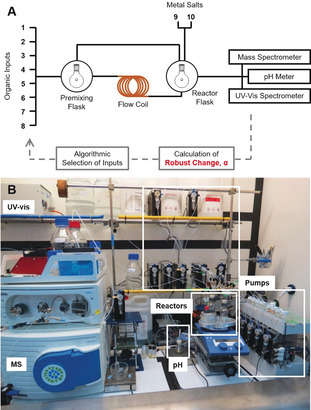
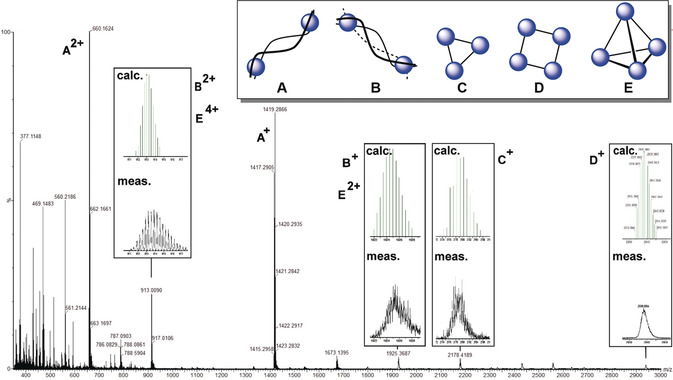
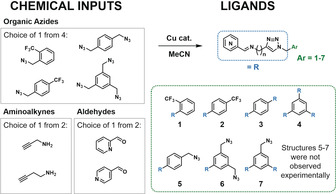
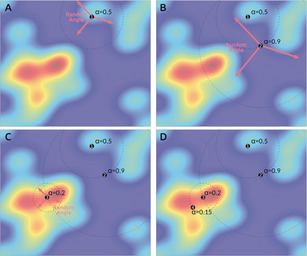
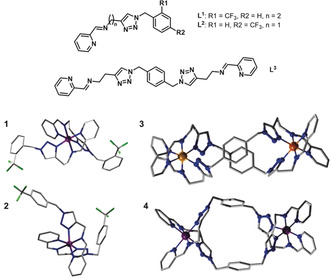
We present a chemical discovery robot for the efficient and reliable discovery of supramolecular architectures through the exploration of a huge reaction space exceeding ten billion combinations. The system was designed to search for areas of reactivity found through autonomous selection of the reagent types, amounts, and reaction conditions aiming for combinations that are reactive. The process consists of two parts where reagents are mixed together, choosing from one type of aldehyde, one amine and one azide (from a possible family of two amines, two aldehydes and four azides) with different volumes, ratios, reaction times, and temperatures, whereby the reagents are passed through a copper coil reactor. Next, either cobalt or iron is added, again from a large number of possible quantities. The reactivity was determined by evaluating differences in pH, UV-Vis, and mass spectra before and after the search was started. The algorithm was focused on the exploration of interesting regions, as defined by the outputs from the sensors, and this led to the discovery of a range of 1-benzyl-(1,2,3-triazol-4-yl)-N-alkyl-(2-pyridinemethanimine) ligands and new complexes: Fe(L ) (1); Fe(L ) (2); Co (L ) (3); Fe (L ) (4), which were crystallised and their structure confirmed by single-crystal X-ray diffraction determination, as well as a range of new supramolecular clusters discovered in solution using high-resolution mass spectrometry.
我们展示了一种化学发现机器人,用于通过探索超过一百亿种组合的巨大反应空间,高效且可靠地发现超分子结构。该系统旨在通过自主选择试剂类型、用量和反应条件来寻找反应活性区域,以实现具有反应活性的组合。该过程由两部分组成,将试剂混合在一起,从一种醛、一种胺和一种叠氮化物(从两种胺、两种醛和四种叠氮化物的可能组合中选择)中选择不同体积、比例、反应时间和温度,然后使试剂通过铜线圈反应器。接下来,再从大量可能的用量中添加钴或铁。通过评估搜索开始前后pH值、紫外可见光谱和质谱的差异来确定反应活性。该算法专注于探索由传感器输出定义的有趣区域,这导致发现了一系列1-苄基-(1,2,3-三唑-4-基)-N-烷基-(2-吡啶甲亚胺)配体和新的配合物:Fe(L ) (1);Fe(L ) (2);Co (L ) (3);Fe (L ) (4),它们通过单晶X射线衍射测定进行了结晶和结构确认,以及使用高分辨率质谱在溶液中发现的一系列新的超分子簇。