Chen Yegang, Cai Qiliang, Pan Jiancheng, Zhang Dingrong, Wang Jiang, Guan Ruili, Tian Wenjie, Lei Hongen, Niu Yuanjie, Guo Yinglu, Quan Changyi, Xin Zhongcheng
Department of Urology, the Second Hospital of Tianjin Medical University, Tianjin Institute of Urology, Tianjin 300211, China.
Molecular Biology Laboratory of Andrology Center, Peking University First Hospital, Peking University, Beijing 100034, China.
Transl Androl Urol. 2020 Apr;9(2):690-701. doi: 10.21037/tau.2020.02.25.
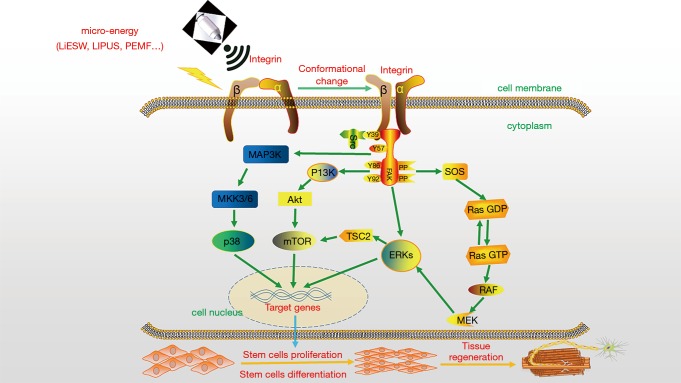
With the continuous integration and intersection of life sciences, engineering and physics, the application for micro-energy in the basic and clinical research of regenerative medicine (RM) has made great progress. As a key target in the field of RM, stem cells have been widely used in the studies of regeneration. Recent studies have shown that micro-energy can regulate the biological behavior of stem cells to repair and regenerate injured organs and tissues by mechanical stimulation with appropriate intensity. Integrins-mediated related signaling pathways may play important roles in transducing mechanical force about micro-energy. However, the complete mechanism of mechanical force transduction needs further research. The purpose of this article is to review the biological effect and mechanism of micro-energy treatment on stem cells, to provide reference for further research.
随着生命科学、工程学和物理学的不断融合与交叉,微能量在再生医学基础及临床研究中的应用取得了长足进展。干细胞作为再生医学领域的关键靶点,已广泛应用于再生研究。近期研究表明,微能量可通过适当强度的机械刺激调节干细胞的生物学行为,以修复和再生受损器官及组织。整合素介导的相关信号通路可能在微能量的机械力转导中发挥重要作用。然而,机械力转导的完整机制仍需进一步研究。本文旨在综述微能量处理对干细胞的生物学效应及机制,为进一步研究提供参考。