Magro Giuseppe
Department of Medical and Surgical Sciences, University "Magna Græcia" of Catanzaro, Italy.
Cytokine X. 2020 Jun;2(2):100029. doi: 10.1016/j.cytox.2020.100029. Epub 2020 May 14.
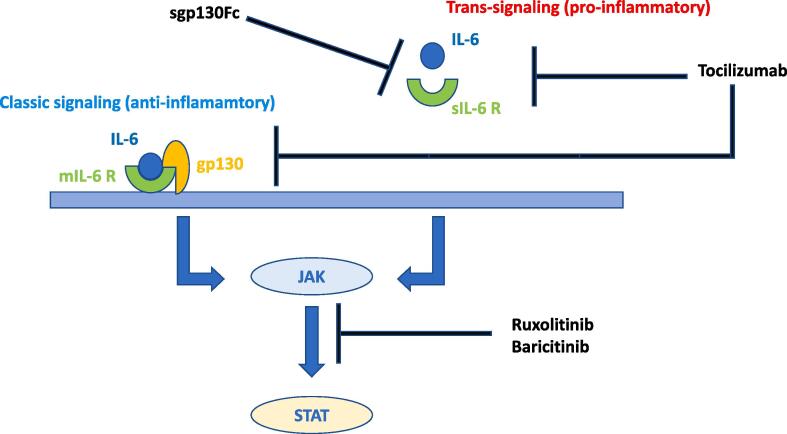
Since the outbreak of COVID-19 many studies have been published showing possible therapies, here the author discusses the end of stage disease related drugs, like Tocilizumab which is currently being used in ARDS patients. In some patients, disease progression leads to an enormous secretion of cytokines, known as cytokine storm, among those cytokines IL-6 plays an important role. Here the author shows how IL-6 has both pro and anti-inflammatory properties, depending on the pathway of transduction: soluble (trans-signaling) or membrane-related (classic signaling), and suggests how targeting only the pro-inflammatory pathway, with SGP130Fc, could be a better option then targeting them both. Other possible IL-6 pathway inhibitors such as Ruxolitinib and Baricinitib are then analyzed, underlying how they lack the benefit of targeting only the pro-inflammatory pathway.
自新冠疫情爆发以来,已有许多研究发表,展示了可能的治疗方法。在此,作者讨论了终末期疾病相关药物,如目前用于急性呼吸窘迫综合征(ARDS)患者的托珠单抗。在一些患者中,疾病进展会导致细胞因子大量分泌,即所谓的细胞因子风暴,其中白细胞介素-6(IL-6)发挥着重要作用。作者在此展示了IL-6如何根据转导途径(可溶性(转信号)或膜相关(经典信号))同时具有促炎和抗炎特性,并提出与同时靶向两者相比,仅用SGP130Fc靶向促炎途径可能是更好的选择。随后分析了其他可能的IL-6途径抑制剂,如鲁索替尼和巴瑞替尼,强调了它们缺乏仅靶向促炎途径的益处。