Neurological Institute, Chief Research Information Officer, Cleveland Clinic, Cleveland, Ohio, United States of America.
Quantitative Health Science Department, Lerner Research Institute Cleveland Clinic, Cleveland, Ohio, United States of America.
PLoS One. 2020 Aug 11;15(8):e0237419. doi: 10.1371/journal.pone.0237419. eCollection 2020.
Coronavirus Disease 2019 is a pandemic that is straining healthcare resources, mainly hospital beds. Multiple risk factors of disease progression requiring hospitalization have been identified, but medical decision-making remains complex.
To characterize a large cohort of patients hospitalized with COVID-19, their outcomes, develop and validate a statistical model that allows individualized prediction of future hospitalization risk for a patient newly diagnosed with COVID-19.
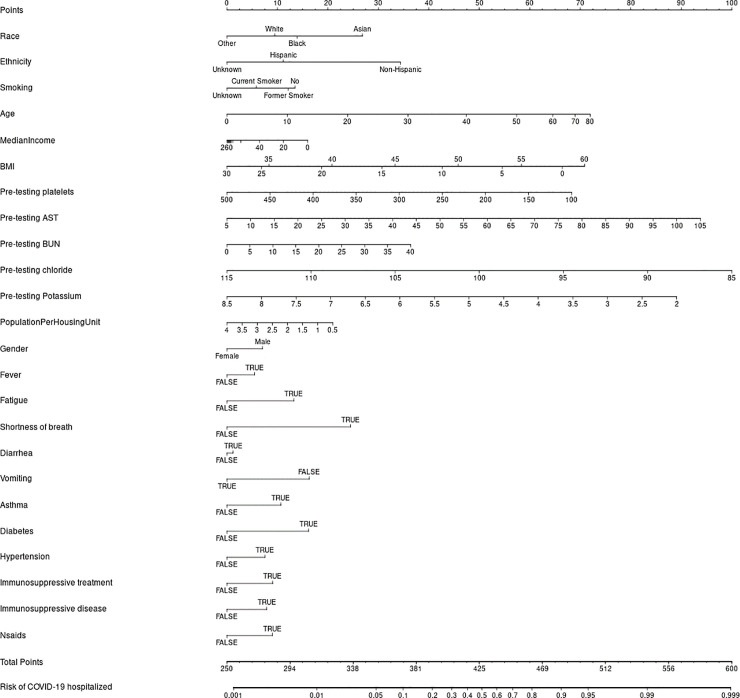
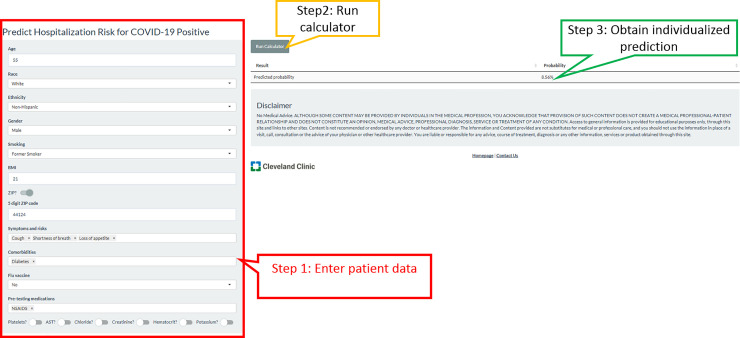
Retrospective cohort study of patients with COVID-19 applying a least absolute shrinkage and selection operator (LASSO) logistic regression algorithm to retain the most predictive features for hospitalization risk, followed by validation in a temporally distinct patient cohort. The final model was displayed as a nomogram and programmed into an online risk calculator.
One healthcare system in Ohio and Florida.
All patients infected with SARS-CoV-2 between March 8, 2020 and June 5, 2020. Those tested before May 1 were included in the development cohort, while those tested May 1 and later comprised the validation cohort.
Demographic, clinical, social influencers of health, exposure risk, medical co-morbidities, vaccination history, presenting symptoms, medications, and laboratory values were collected on all patients, and considered in our model development.
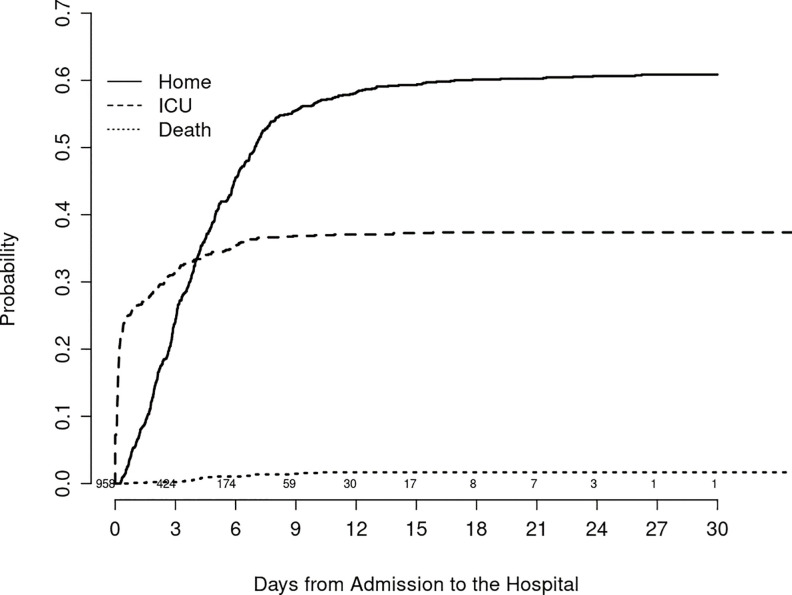
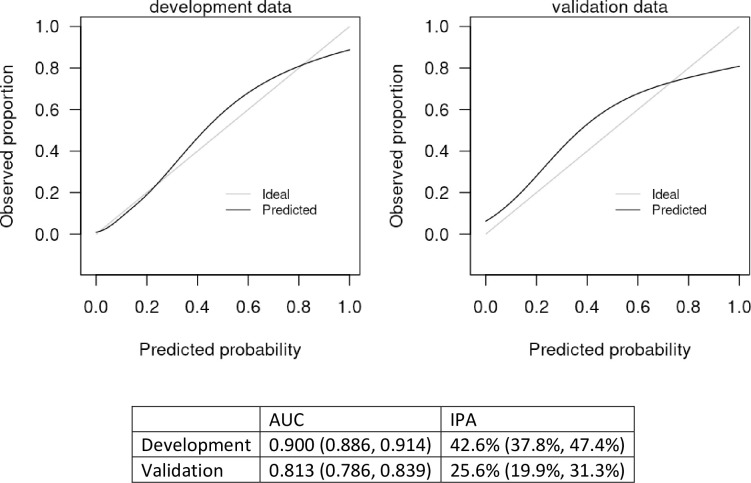
4,536 patients tested positive for SARS-CoV-2 during the study period. Of those, 958 (21.1%) required hospitalization. By day 3 of hospitalization, 24% of patients were transferred to the intensive care unit, and around half of the remaining patients were discharged home. Ten patients died. Hospitalization risk was increased with older age, black race, male sex, former smoking history, diabetes, hypertension, chronic lung disease, poor socioeconomic status, shortness of breath, diarrhea, and certain medications (NSAIDs, immunosuppressive treatment). Hospitalization risk was reduced with prior flu vaccination. Model discrimination was excellent with an area under the curve of 0.900 (95% confidence interval of 0.886-0.914) in the development cohort, and 0.813 (0.786, 0.839) in the validation cohort. The scaled Brier score was 42.6% (95% CI 37.8%, 47.4%) in the development cohort and 25.6% (19.9%, 31.3%) in the validation cohort. Calibration was very good. The online risk calculator is freely available and found at https://riskcalc.org/COVID19Hospitalization/.
Retrospective cohort design.
Our study crystallizes published risk factors of COVID-19 progression, but also provides new data on the role of social influencers of health, race, and influenza vaccination. In a context of a pandemic and limited healthcare resources, individualized outcome prediction through this nomogram or online risk calculator can facilitate complex medical decision-making.
2019 年冠状病毒病是一种大流行疾病,正在严重消耗医疗资源,尤其是医院床位。目前已经确定了多种需要住院治疗的疾病进展的风险因素,但医疗决策仍然很复杂。
描述一组因 COVID-19 住院的大量患者及其结局,开发并验证一种统计模型,以便对新诊断为 COVID-19 的患者的未来住院风险进行个体化预测。
对 2020 年 3 月 8 日至 6 月 5 日期间感染 SARS-CoV-2 的患者进行回顾性队列研究,应用最小绝对收缩和选择算子(LASSO)逻辑回归算法保留与住院风险相关的最具预测性特征,然后在时间上不同的患者队列中进行验证。最终模型以诺模图的形式呈现,并编程为在线风险计算器。
俄亥俄州和佛罗里达州的一个医疗系统。
2020 年 3 月 8 日至 6 月 5 日期间所有 SARS-CoV-2 检测呈阳性的患者。在 5 月 1 日之前接受检测的患者被纳入开发队列,而在 5 月 1 日及之后接受检测的患者被纳入验证队列。
收集所有患者的人口统计学、临床、健康社会影响因素、暴露风险、合并症、疫苗接种史、症状、药物和实验室值,并在模型开发中进行考虑。
在研究期间,有 4536 名患者的 SARS-CoV-2 检测呈阳性。其中,958 人(21.1%)需要住院治疗。住院第 3 天,24%的患者转入重症监护病房,其余患者中约有一半出院回家。有 10 名患者死亡。年龄较大、黑人、男性、吸烟史、糖尿病、高血压、慢性肺部疾病、较差的社会经济地位、呼吸急促、腹泻以及某些药物(非甾体抗炎药、免疫抑制治疗)会增加住院风险。流感疫苗接种可降低住院风险。在开发队列中,该模型的区分度非常好,曲线下面积为 0.900(95%置信区间为 0.886-0.914),在验证队列中为 0.813(0.786,0.839)。开发队列中的缩放 Brier 评分(衡量模型准确性的指标)为 42.6%(95%置信区间为 37.8%,47.4%),验证队列为 25.6%(19.9%,31.3%)。校准效果非常好。在线风险计算器可免费使用,并可在 https://riskcalc.org/COVID19Hospitalization/ 找到。
回顾性队列设计。
我们的研究明确了 COVID-19 进展的已发表风险因素,但也提供了有关健康、种族和流感疫苗接种的社会影响因素的新数据。在大流行和有限的医疗资源背景下,通过该诺模图或在线风险计算器进行个体化预后预测,可以帮助进行复杂的医疗决策。