Department of Soil, Crop and Climate Sciences, University of the Free State, Bloemfontein, Republic of South Africa.
EcoHealth Alliance, New York City, New York, United States of America.
PLoS One. 2020 May 18;15(5):e0232481. doi: 10.1371/journal.pone.0232481. eCollection 2020.
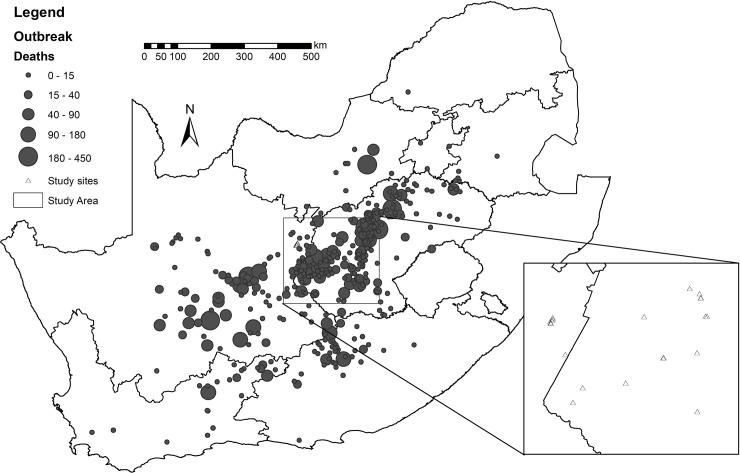
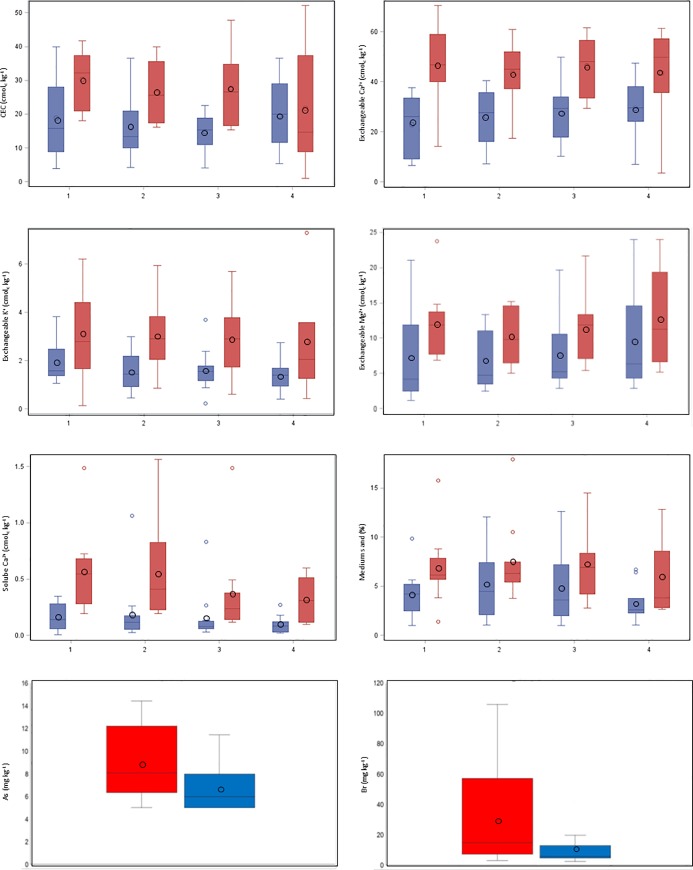
Outbreaks of Rift Valley fever have devastating impacts on ruminants, humans, as well as on regional and national economies. Although numerous studies on the impact and outbreak of Rift Valley fever exist, relatively little is known about the role of environmental factors, especially soil, on the aestivation of the virus. This study thus selected 22 sites for study in central South Africa, known to be the recurrent epicenter of widespread Rift Valley fever outbreaks in Southern Africa. Soils were described, sampled and analyzed in detail at each site. Of all the soil variables analyzed for, only eight (cation exchange capacity, exchangeable Ca2+, exchangeable K+, exchangeable Mg2+, soluble Ca2+, medium sand, As, and Br) were statistically identified to be potential indicators of sites with reported Rift Valley fever mortalities, as reported for the 2009-2010 Rift Valley fever outbreak. Four soil characteristics (exchangeable K+, exchangeable Mg2+, medium sand, and Br) were subsequently included in a discriminant function that could potentially be used to predict sites that had reported Rift Valley fever-associated mortalities in livestock. This study therefore constitutes an initial attempt to predict sites prone to Rift Valley fever livestock mortality from soil properties and thus serves as a basis for broader research on the interaction between soil, mosquitoes and Rift Valley fever virus. Future research should include other environmental components such as vegetation, climate, and water properties as well as correlating soil properties with floodwater Aedes spp. abundance and Rift Valley fever virus prevalence.
裂谷热疫情对反刍动物、人类以及区域和国家经济都造成了毁灭性的影响。尽管已经有许多关于裂谷热影响和爆发的研究,但对于环境因素,尤其是土壤,对病毒休眠的作用,人们的了解相对较少。因此,本研究在南非中部选择了 22 个地点进行研究,该地区已知是南部非洲广泛爆发裂谷热疫情的反复震中。在每个地点都详细描述、采样和分析了土壤。在所分析的所有土壤变量中,只有八项(阳离子交换能力、可交换 Ca2+、可交换 K+、可交换 Mg2+、可溶性 Ca2+、中砂、As 和 Br)被统计确定为报告有裂谷热死亡率的地点的潜在指标,这与 2009-2010 年裂谷热疫情报告一致。随后,有四个土壤特征(可交换 K+、可交换 Mg2+、中砂和 Br)被纳入一个判别函数,该函数可能用于预测报告有裂谷热相关牲畜死亡率的地点。因此,本研究首次尝试从土壤特性预测易发生裂谷热牲畜死亡的地点,为进一步研究土壤、蚊子和裂谷热病毒之间的相互作用奠定了基础。未来的研究应包括其他环境成分,如植被、气候和水特性,以及将土壤特性与洪水伊蚊属蚊的丰度和裂谷热病毒的流行率相关联。