School of Biomolecular and Biomedical Science, Conway Institute, University College Dublin, Belfield, Dublin 4, Ireland.
School of Medicine, Conway Institute, University College Dublin, Belfield, Dublin 4, Ireland.
Genome Res. 2020 May;30(5):684-696. doi: 10.1101/gr.257816.119. Epub 2020 May 18.
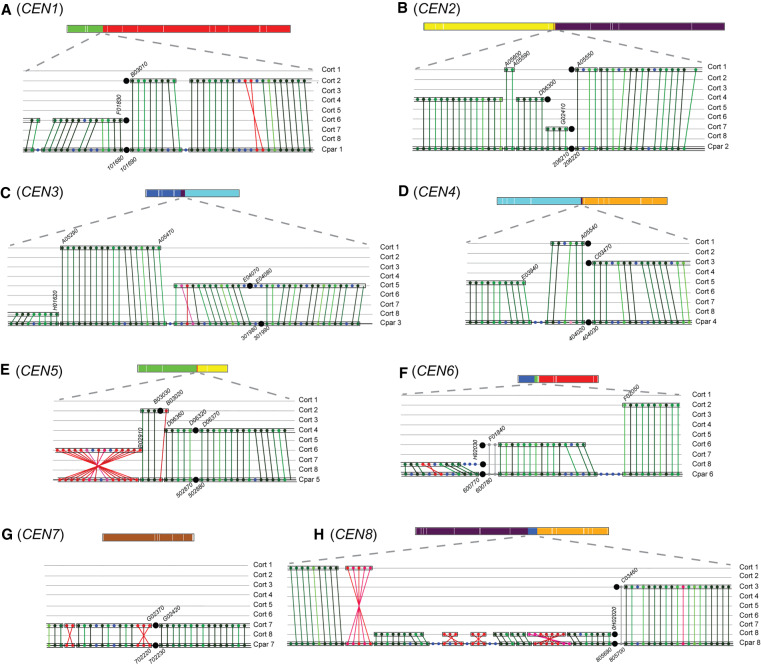
Centromeres pose an evolutionary paradox: strongly conserved in function but rapidly changing in sequence and structure. However, in the absence of damage, centromere locations are usually conserved within a species. We report here that isolates of the pathogenic yeast species show within-species polymorphism for the location of centromeres on two of its eight chromosomes. Its old centromeres have an inverted-repeat (IR) structure, whereas its new centromeres have no obvious structural features but are located within 30 kb of the old site. Centromeres can therefore move naturally from one chromosomal site to another, apparently spontaneously and in the absence of any significant changes in DNA sequence. Our observations are consistent with a model in which all centromeres are genetically determined, such as by the presence of short or long IRs or by the ability to form cruciforms. We also find that centromeres have been hotspots for genomic rearrangements in the clade.
在功能上高度保守,但在序列和结构上却迅速变化。然而,在没有损伤的情况下,着丝粒的位置通常在一个物种内是保守的。我们在这里报告,致病性酵母物种的分离株在其八个染色体中的两个上表现出着丝粒位置的种内多态性。其古老的着丝粒具有反向重复(IR)结构,而其新的着丝粒没有明显的结构特征,但位于旧位点的 30kb 内。因此,着丝粒可以自然地从一个染色体位置移动到另一个位置,显然是自发的,并且 DNA 序列没有任何显著变化。我们的观察结果与这样一种模型一致,即所有的着丝粒都是由遗传决定的,例如通过存在短或长的 IR 或形成十字结构的能力。我们还发现,在 进化枝中,着丝粒一直是基因组重排的热点。