Department of Head and Neck Oncology, HealthCare Global Enterprises Ltd, India.
Department of Head and Neck Oncology, HealthCare Global Enterprises Ltd, India.
Med Hypotheses. 2020 Oct;143:109845. doi: 10.1016/j.mehy.2020.109845. Epub 2020 May 18.
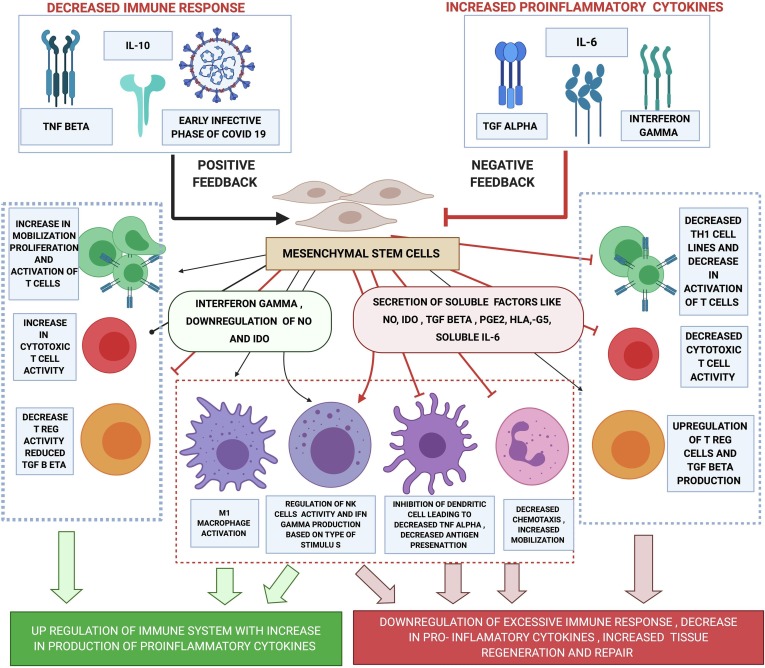
Majority of patients infected with the COVID 19 virus display a mild to moderate course of disease and spontaneously recover at 14-20 days. However, about 15% of patients progress to severe stages and 2.5% of these patients succumb to this illness. Most patients with severe disease belong to the elderly age group (<65 years of age) and have multiple associated co-morbidities. The immune responses induced by the COVID 19 virus, during the incubation and non-severe stages, requires the early initiation of a specific adaptive immune response to eliminate the virus and prevent the progress to severe stages. In patients with a dysfunctional bridge adaptive immunity, the innate immune response becomes exaggerated due to the lack of feedback from the adaptive immune cells. The resultant cytokine storm is responsible for the severe lung injury leading to acute respiratory distress syndrome seen in COVID 19 patients. Mesenchymal stem cells are known to suppress overactive immune responses as well as bring about tissue regeneration and repair. This immuno-modulatory effect of MSCs could hold potential to manage a patient with severe symptoms of COVID 19 infection due to a dysfunctional adaptive immune system.
大多数感染 COVID-19 病毒的患者表现为轻度至中度疾病,并在 14-20 天内自行康复。然而,约 15%的患者进展为重症,其中 2.5%的患者因此病去世。大多数重症患者属于老年人群(<65 岁),并伴有多种合并症。COVID-19 病毒在潜伏期和非重症阶段诱导的免疫反应需要早期启动特异性适应性免疫反应以消除病毒并防止进展为重症。在桥接适应性免疫功能障碍的患者中,由于缺乏适应性免疫细胞的反馈,固有免疫反应会过度增强。由此产生的细胞因子风暴是导致 COVID-19 患者出现严重肺部损伤和急性呼吸窘迫综合征的原因。间充质干细胞已被证实可以抑制过度活跃的免疫反应,同时促进组织再生和修复。间充质干细胞的这种免疫调节作用可能有助于管理因适应性免疫系统功能障碍而出现严重 COVID-19 感染症状的患者。