Rettig Erica M, Fick Stephen E, Hijmans Robert J
Department of Environmental Science and Policy, University of California, Davis, CA 95616, USA.
Department of Plant and Environmental Sciences, New Mexico State University, Las Cruces, NM 88003, USA.
Heliyon. 2020 May 13;6(5):e03829. doi: 10.1016/j.heliyon.2020.e03829. eCollection 2020 May.
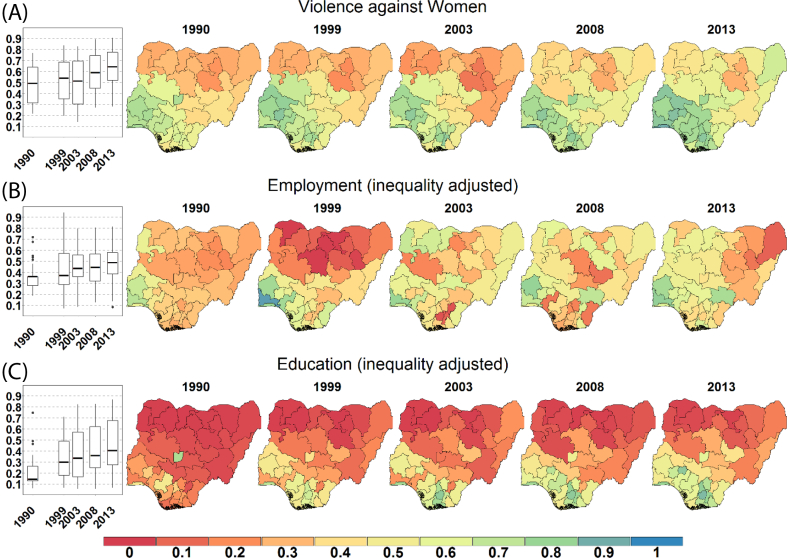
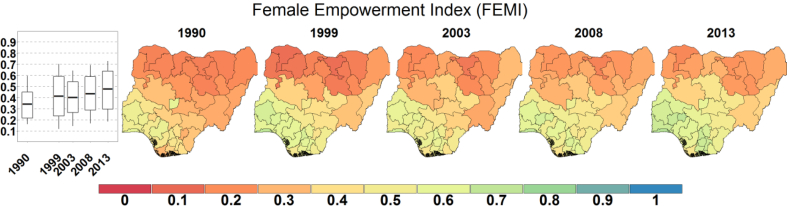
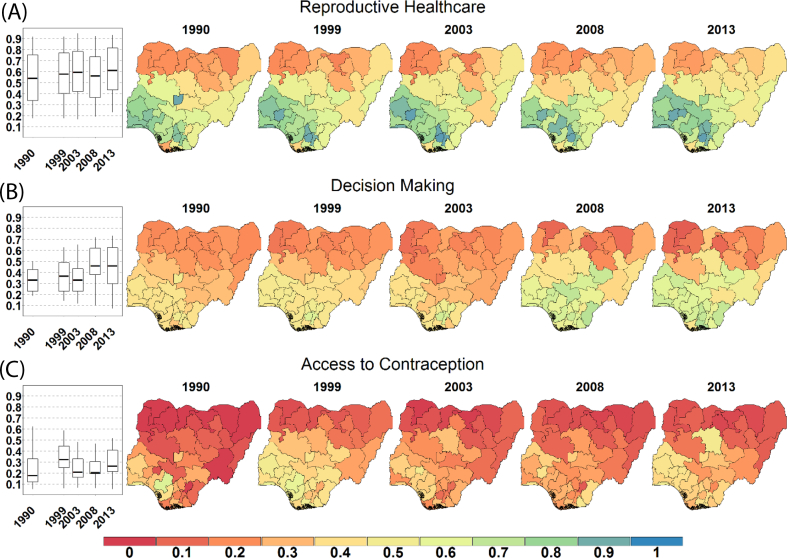
Improving female empowerment is an important human rights and development goal that needs better monitoring. A number of indices have been developed to track female empowerment at the national level, but these are incomplete and may obscure important sub-national variation. We developed the Female Empowerment Index (FEMI) to track multiple domains of women's empowerment at the sub-national level. The index is based on six categories of empowerment: violence against women, employment, education, reproductive healthcare, decision making, and access to contraceptives. The FEMI has a range of zero to one (low to high empowerment), and it is calculated as the mean proportion of positive outcomes in the six categories. To provide a proof of concept, we computed the FEMI for Nigeria and its 36 states from five Demographic and Health Surveys between the years of 1990 and 2013, using questions asked to 98,542 women between 15 and 49 years old. At the national level, the FEMI increased from 0.34 to 0.48. However, there was substantial sub-national variation, with state-level values ranging from 0.16-0.60 in 1990 to 0.19-0.73 in 2013. Our findings thus illustrate the importance of considering sub-national variation in female empowerment. The FEMI can be readily computed for other countries, and its ability to track spatial and temporal variation in woman's empowerment across a broad set of categories may make it more useful than existing approaches.
提高女性赋权是一项重要的人权和发展目标,需要更好的监测。已经制定了一些指数来跟踪国家层面的女性赋权情况,但这些指数并不完整,可能会掩盖重要的国家以下层面的差异。我们开发了女性赋权指数(FEMI)来跟踪国家以下层面女性赋权的多个领域。该指数基于六个赋权类别:针对妇女的暴力、就业、教育、生殖健康护理、决策以及获得避孕药具的情况。FEMI的范围是0到1(赋权程度从低到高),它是六个类别中积极结果的平均比例。为了提供概念验证,我们利用对1990年至2013年间98542名15至49岁女性所提的问题,根据五次人口与健康调查计算了尼日利亚及其36个州的FEMI。在国家层面,FEMI从0.34提高到了0.48。然而,国家以下层面存在很大差异,州级数值在1990年为0.16 - 0.60,在2013年为0.19 - 0.73。因此,我们的研究结果说明了考虑国家以下层面女性赋权差异的重要性。FEMI可以很容易地为其他国家计算,并且它在广泛类别中跟踪女性赋权的空间和时间差异的能力可能使其比现有方法更有用。