Fong Raymond, Ward Elizabeth C, Rumbach Anna F
The University of Queensland, School of Health and Rehabilitation Sciences, Brisbane, Queensland, Australia.
Division of Speech Therapy, Department of Otorhinolaryngology, Head and Neck Surgery, Faculty of Medicine, The Chinese University of Hong Kong, Hong Kong, China.
World J Otorhinolaryngol Head Neck Surg. 2020 Apr 10;6(1):10-24. doi: 10.1016/j.wjorl.2020.02.005. eCollection 2020 Mar.
Nasopharyngeal cancer (NPC) has distinct characteristics regarding its global prevalence, initial presentation, management and patient outcomes compared to other subtypes of head and neck cancer (HNC). The mainstay of NPC treatment is chemo-radiation (C/RT) and while dysphagia is a known early and late toxicity of C/RT treatment, the nature of dysphagia post NPC treatment has had limited investigation. The objective of this review is to summarise the existing evidence regarding dysphagia following NPC to inform the future research agenda for this population. Dysphagia incidence, characteristic deficits observed across the phases of swallowing, efficacy of current dysphagia interventions, and effect on quality of life will be explored.
Databases including MEDLINE, CINAHL, Embase, Scopus and Web of Science were included.
A scoping review was conducted according to PRISMA-ScR guidelines. Two independent reviewers screened selected full text articles.
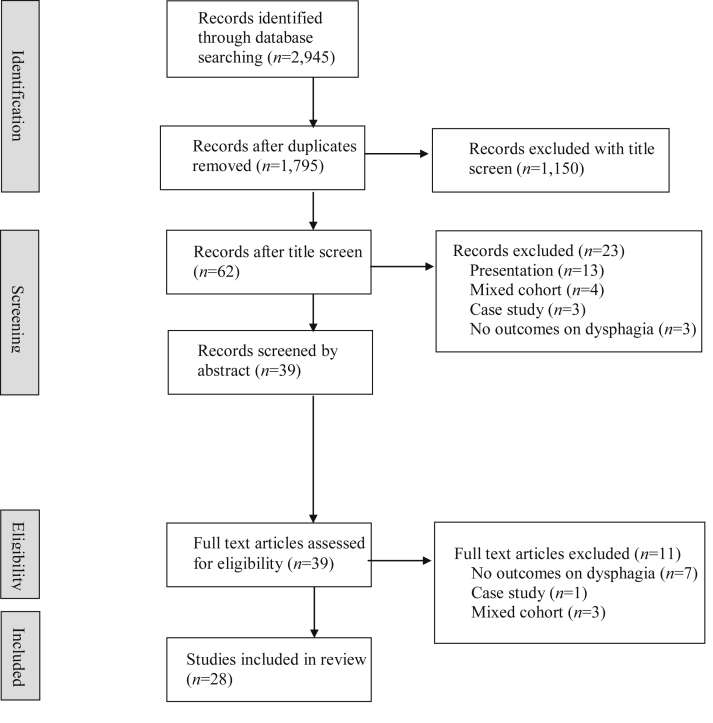
Of the initial 2495 articles found, 28 articles were included. Reports of penetration and aspiration varied widely (0%-91.6%), with high rates of silent aspiration identified in 2 studies (42%, 66%). Oral, pharyngeal and upper esophageal phase impairments were reported. Of these, upper esophageal stasis and multiple pharyngeal stage deficits were most prevalent. The pharyngeal constrictors were found to have a significant dose-effect relationship and shielding to the anterior neck field was effective to preserve swallowing function. Six treatment studies were identified with limited evidence supporting the use of neuromuscular electrical stimulation, dilatation and swallowing exercises. Quality of life was adversely affected.
Dysphagia is a prevalent early and late problem post NPC treatment, with impairments across all phases of the swallow. Studies on preventing dysphagia and treatment efficacy remain limited. More systematic study of the nature of dysphagia and the efficacy of treatment in this population is warranted.
与其他头颈部癌症(HNC)亚型相比,鼻咽癌(NPC)在全球患病率、初始表现、治疗及患者预后方面具有显著特征。NPC治疗的主要方法是放化疗(C/RT),虽然吞咽困难是C/RT治疗已知的早、晚期毒性反应,但NPC治疗后吞咽困难的本质却鲜有研究。本综述的目的是总结NPC治疗后吞咽困难的现有证据,为该人群的未来研究议程提供参考。将探讨吞咽困难的发生率、吞咽各阶段观察到的特征性缺陷、当前吞咽困难干预措施的疗效以及对生活质量的影响。
纳入了包括MEDLINE、CINAHL、Embase、Scopus和Web of Science在内的数据库。
根据PRISMA-ScR指南进行了一项范围综述。两名独立评审员筛选了选定的全文文章。
在最初找到的2495篇文章中,纳入了28篇。穿透和误吸的报告差异很大(0%-91.6%),两项研究中发现隐匿性误吸的发生率较高(42%,66%)。报告了口腔、咽和食管上段的功能障碍。其中,食管上段淤滞和多个咽期缺陷最为常见。发现咽缩肌存在显著的剂量效应关系,对颈前野进行屏蔽可有效保留吞咽功能。确定了六项治疗研究,证据有限,支持使用神经肌肉电刺激、扩张术和吞咽练习。生活质量受到不利影响。
吞咽困难是NPC治疗后普遍存在的早、晚期问题,吞咽各阶段均有功能障碍。关于预防吞咽困难和治疗效果的研究仍然有限。有必要对该人群吞咽困难的本质和治疗效果进行更系统的研究。