Department of Health Economics and Health Services Research, Hamburg Center for Health Economics, University Medical-Centre Hamburg-Eppendorf, Hamburg, Germany.
Department of Clinical Gerontology and Rehabilitation, Robert-Bosch-Hospital, Stuttgart, Germany.
PLoS One. 2020 May 19;15(5):e0232969. doi: 10.1371/journal.pone.0232969. eCollection 2020.
Hip fractures are among the most frequently occurring fragility fractures in older adults, associated with a loss of quality of life, high mortality, and high use of healthcare resources. The aim was to apply the superlearner method to predict osteoporotic hip fractures using administrative claims data and to compare its performance to established methods.
We devided claims data of 288,086 individuals aged 65 years and older without care level into a training (80%) and a validation set (20%). Subsequently, we trained a superlearner algorithm that considered both regression and machine learning algorithms (e.g., support vector machines, RUSBoost) on a large set of clinical risk factors. Mean squared error and measures of discrimination and calibration were employed to assess prediction performance.
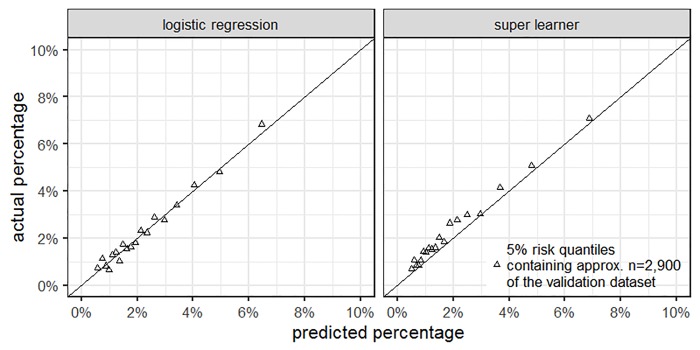
All algorithms used in the analysis showed similar performance with an AUC ranging from 0.66 to 0.72 in the training and 0.65 to 0.70 in the validation set. Superlearner showed good discrimination in the training set but poorer discrimination and calibration in the validation set.
The superlearner achieved similar predictive performance compared to the individual algorithms included. Nevertheless, in the presence of non-linearity and complex interactions, this method might be a flexible alternative to be considered for risk prediction in large datasets.
髋部骨折是老年人中最常见的脆性骨折之一,与生活质量下降、死亡率高和高医疗资源利用率有关。本研究旨在应用超级学习器方法利用管理性索赔数据预测骨质疏松性髋部骨折,并将其性能与已建立的方法进行比较。
我们将 288086 名年龄在 65 岁及以上且无护理级别的索赔数据分为 80%的训练集和 20%的验证集。随后,我们在一组大型临床危险因素上训练了一个超级学习器算法,该算法同时考虑了回归和机器学习算法(例如支持向量机、RUSBoost)。采用均方误差和判别及校准测量来评估预测性能。
在训练集中,所有分析中使用的算法表现相似,AUC 范围为 0.66 至 0.72,在验证集中,AUC 范围为 0.65 至 0.70。超级学习器在训练集中具有良好的判别能力,但在验证集中判别能力和校准能力较差。
超级学习器与所包括的个别算法相比具有相似的预测性能。然而,在存在非线性和复杂相互作用的情况下,该方法可能是用于大型数据集风险预测的一种灵活替代方法。