Zhu Hongyi, Jin Hanqiang, Zhang Changqing, Yuan Ting
Department of Orthopaedic Surgery, Shanghai Jiaotong University Affiliated Sixth People's Hospital, Shanghai, China; Institute of Microsurgery on Extremities, Shanghai Jiaotong University Affiliated Sixth People's Hospital, Shanghai, China.
Bone Joint Res. 2020 May 16;9(4):152-161. doi: 10.1302/2046-3758.94.BJR-2019-0205.R1. eCollection 2020 Apr.
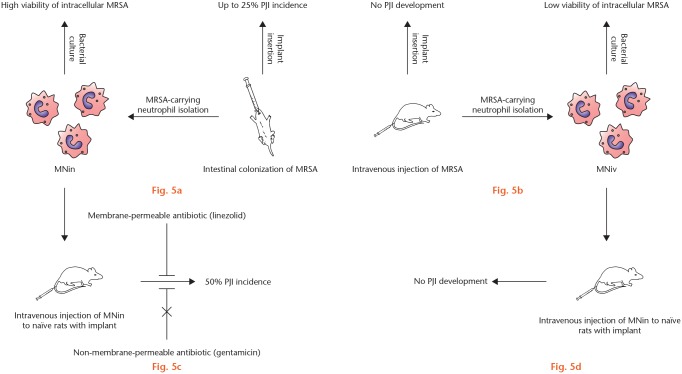
Methicillin-resistant (MRSA) can cause wound infections via a 'Trojan Horse' mechanism, in which neutrophils engulf intestinal MRSA and travel to the wound, releasing MRSA after apoptosis. The possible role of intestinal MRSA in prosthetic joint infection (PJI) is unknown.
Rats underwent intestinal colonization with green fluorescent protein (GFP)-tagged MRSA by gavage and an intra-articular wire was then surgically implanted. After ten days, the presence of PJI was determined by bacterial cultures of the distal femur, joint capsule, and implant. We excluded several other possibilities for PJI development. Intraoperative contamination was excluded by culturing the specimen obtained from surgical site. Extracellular bacteraemia-associated PJI was excluded by comparing with the infection rate after intravenous injection of MRSA or MRSA-carrying neutrophils. To further support this theory, we tested the efficacy of prophylactic membrane-permeable and non-membrane-permeable antibiotics in this model.
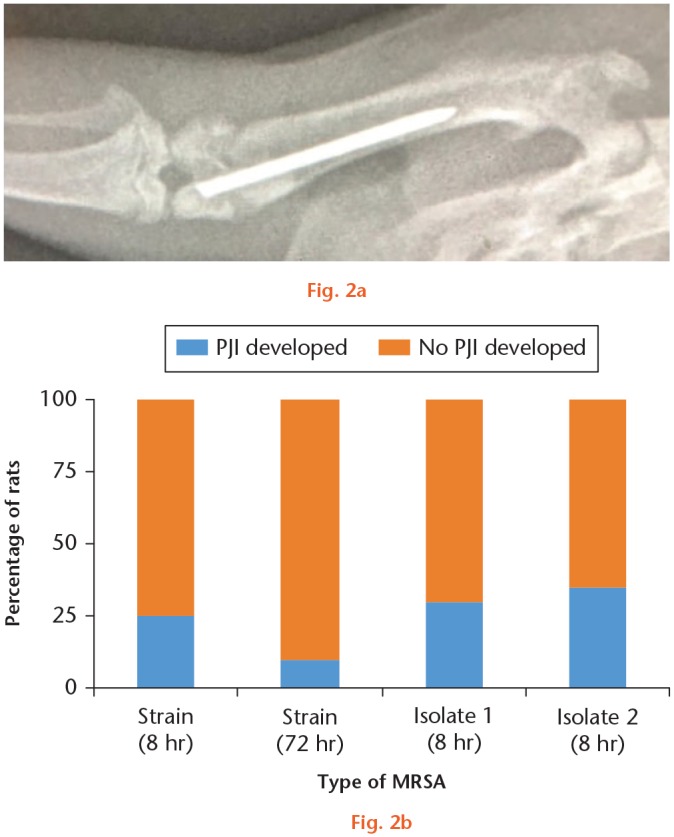
After undergoing knee surgery eight or 72 hours after colonization, five out of 20 rats (25.0%) and two out of 20 rats (10.0%) developed PJI, respectively. Strikingly, 11 out of 20 rats (55.0%) developed PJI after intravenous injection of MRSA-carrying neutrophils that were isolated from rats with intestinal MRSA colonization. None of the rats receiving intravenous injections of MRSA developed PJI. These results suggest that intestinal MRSA carried by neutrophils could cause PJI in our rat model. Ten out of 20 (50.0%) rats treated with non-membrane-permeable gentamicin developed PJI, whereas only one out of 20 (5.0%) rats treated with membrane-permeable linezolid developed PJI.
Neutrophils as carriers of intestinal MRSA may play an important role in PJI development. 2020;9(4):152-161.
耐甲氧西林金黄色葡萄球菌(MRSA)可通过“特洛伊木马”机制导致伤口感染,即中性粒细胞吞噬肠道中的MRSA并转移至伤口,在凋亡后释放MRSA。肠道MRSA在人工关节感染(PJI)中的潜在作用尚不清楚。
通过灌胃使大鼠肠道定植绿色荧光蛋白(GFP)标记的MRSA,然后手术植入关节内金属丝。10天后,通过对股骨远端、关节囊和植入物进行细菌培养来确定是否存在PJI。我们排除了PJI发生的其他几种可能性。通过对手术部位获取的标本进行培养排除术中污染。通过与静脉注射MRSA或携带MRSA的中性粒细胞后的感染率进行比较,排除与细胞外菌血症相关的PJI。为进一步支持该理论,我们在该模型中测试了预防性使用膜通透性和非膜通透性抗生素的效果。
在定植后8小时或72小时进行膝关节手术后,20只大鼠中有5只(25.0%)和2只(10.0%)分别发生了PJI。令人惊讶的是,在静脉注射从肠道MRSA定植大鼠中分离出的携带MRSA的中性粒细胞后,20只大鼠中有11只(55.0%)发生了PJI。接受静脉注射MRSA的大鼠均未发生PJI。这些结果表明,中性粒细胞携带的肠道MRSA可在我们的大鼠模型中导致PJI。接受非膜通透性庆大霉素治疗的20只大鼠中有10只(50.0%)发生了PJI,而接受膜通透性利奈唑胺治疗的20只大鼠中只有1只(5.0%)发生了PJI。
中性粒细胞作为肠道MRSA的载体可能在PJI的发生中起重要作用。2020;9(4):152 - 161。