
通过自旋控制从碳化硅中的硅空位中心产生不可区分和可区分的光子。
Spin-controlled generation of indistinguishable and distinguishable photons from silicon vacancy centres in silicon carbide.
作者信息
Morioka Naoya, Babin Charles, Nagy Roland, Gediz Izel, Hesselmeier Erik, Liu Di, Joliffe Matthew, Niethammer Matthias, Dasari Durga, Vorobyov Vadim, Kolesov Roman, Stöhr Rainer, Ul-Hassan Jawad, Son Nguyen Tien, Ohshima Takeshi, Udvarhelyi Péter, Thiering Gergő, Gali Adam, Wrachtrup Jörg, Kaiser Florian
机构信息
3rd Institute of Physics, University of Stuttgart and Institute for Quantum Science and Technology IQST, 70569, Stuttgart, Germany.
Advanced Research and Innovation Center, DENSO CORPORATION, Nisshin, 470-0111, Japan.
出版信息
Nat Commun. 2020 May 20;11(1):2516. doi: 10.1038/s41467-020-16330-5.
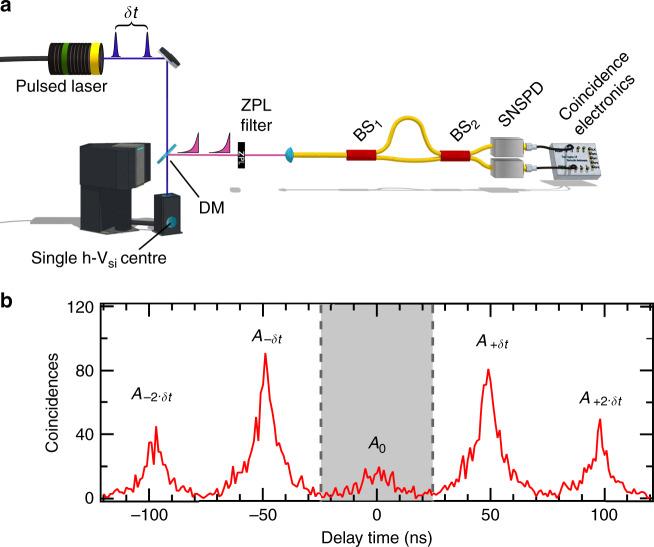
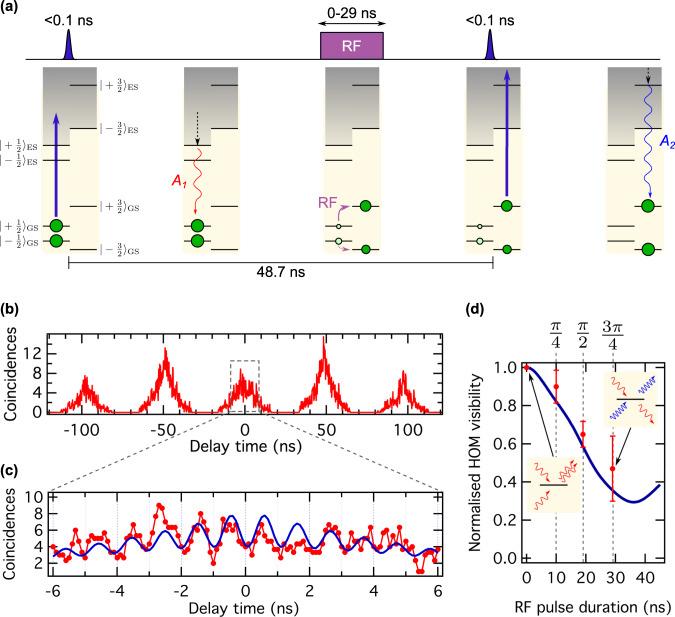
Quantum systems combining indistinguishable photon generation and spin-based quantum information processing are essential for remote quantum applications and networking. However, identification of suitable systems in scalable platforms remains a challenge. Here, we investigate the silicon vacancy centre in silicon carbide and demonstrate controlled emission of indistinguishable and distinguishable photons via coherent spin manipulation. Using strong off-resonant excitation and collecting zero-phonon line photons, we show a two-photon interference contrast close to 90% in Hong-Ou-Mandel type experiments. Further, we exploit the system's intimate spin-photon relation to spin-control the colour and indistinguishability of consecutively emitted photons. Our results provide a deep insight into the system's spin-phonon-photon physics and underline the potential of the industrially compatible silicon carbide platform for measurement-based entanglement distribution and photonic cluster state generation. Additional coupling to quantum registers based on individual nuclear spins would further allow for high-level network-relevant quantum information processing, such as error correction and entanglement purification.
将不可区分光子产生与基于自旋的量子信息处理相结合的量子系统对于远程量子应用和网络至关重要。然而,在可扩展平台中识别合适的系统仍然是一项挑战。在此,我们研究了碳化硅中的硅空位中心,并通过相干自旋操纵展示了不可区分和可区分光子的受控发射。利用强非共振激发并收集零声子线光子,我们在Hong-Ou-Mandel型实验中展示了接近90%的双光子干涉对比度。此外,我们利用该系统紧密的自旋-光子关系来自旋控制连续发射光子的颜色和不可区分性。我们的结果深入洞察了该系统的自旋-声子-光子物理,并强调了工业兼容的碳化硅平台在基于测量的纠缠分布和光子簇态生成方面的潜力。与基于单个核自旋的量子寄存器的额外耦合将进一步允许进行与网络相关的高级量子信息处理,例如纠错和纠缠纯化。


 Zotero 插件