Egeberg Alexander, See Kyoungah, Garrelts Alyssa, Burge Russel
Department of Dermatology and Allergy, Herlev and Gentofte Hospital, University of Copenhagen, Kildegårdsvej 28, 2900, Hellerup, Denmark.
Eli Lilly and Company, Indianapolis, Indiana, USA.
BMC Dermatol. 2020 May 20;20(1):3. doi: 10.1186/s12895-020-00099-7.
Having psoriasis in hard-to-treat areas, i.e. the scalp, face, palms, soles, nails, and genitals, respectively, can impair patients' quality of life. We investigated the prevalence of hard-to-treat body locations of psoriasis, and described patients' clinical and demographic characteristics, and quality of life impacts in a population-based cohort.
We performed a cross-sectional study using a total of 4016 adults (≥18 years) with psoriasis from the Danish Skin Cohort. Groups were compared to patients without involvement of hard-to-treat areas.
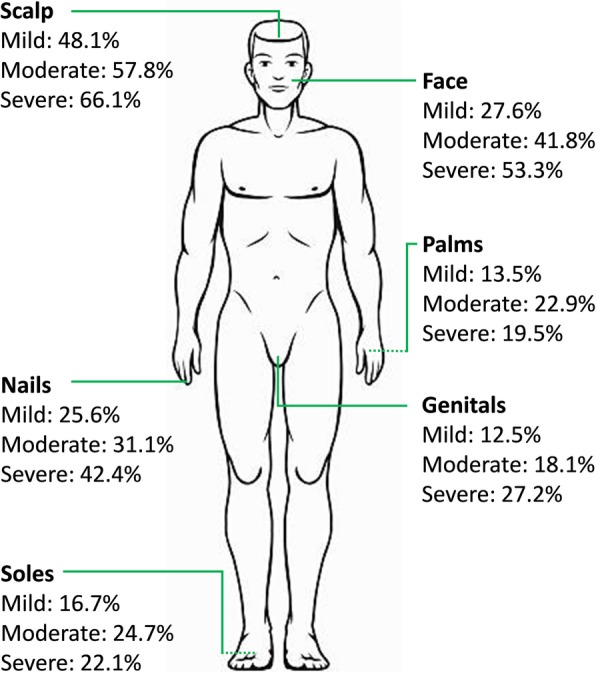
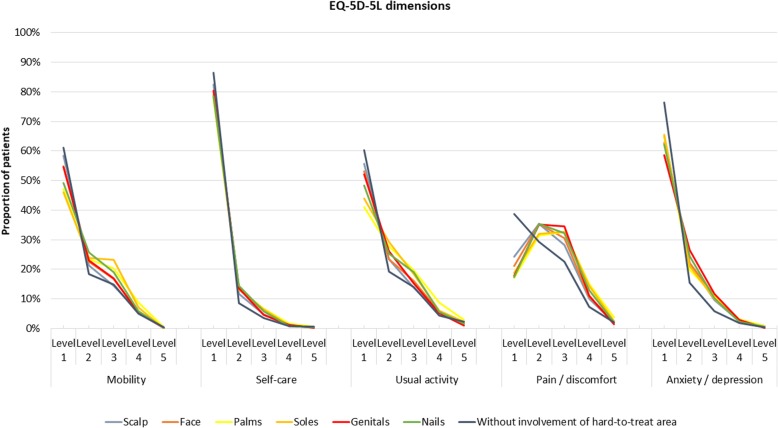
The most frequently affected hard-to-treat area was the scalp (43.0%), followed by the face (29.9%), nails (24.5%), soles (15.6%), genitals (14.1%), and palms (13.7%), respectively. Higher prevalence was generally seen with increasing psoriasis severity. Among all patients 64.8, 42.4, and 21.9% of patients had involvement of ≥1, ≥2, or ≥ 3 hard-to-treat areas. Those with involvement of certain hard-to-treat areas such as hands, feet, and genitals had clinically relevant DLQI impairments. Having involvement of one hard-to-treat area was significantly associated with other hard-to-treat areas affected even after adjusting for age, sex, and psoriasis severity.
Psoriasis commonly affects hard-to-treat locations, even in patients with mild disease. For some of these areas, patient-reported disease burden, e.g. as measured by DLQI, is impaired.
银屑病出现在难以治疗的部位,即头皮、面部、手掌、脚底、指甲和生殖器,会损害患者的生活质量。我们调查了银屑病难以治疗的身体部位的患病率,并描述了基于人群队列中患者的临床和人口统计学特征以及对生活质量的影响。
我们使用丹麦皮肤队列中总共4016名成年(≥18岁)银屑病患者进行了一项横断面研究。将这些组与未累及难以治疗部位的患者进行比较。
最常受累的难以治疗的部位是头皮(43.0%),其次是面部(29.9%)、指甲(24.5%)、脚底(15.6%)、生殖器(14.1%)和手掌(13.7%)。随着银屑病严重程度的增加,患病率通常更高。在所有患者中,分别有64.8%、42.4%和21.9%的患者累及≥1个、≥2个或≥3个难以治疗的部位。累及某些难以治疗部位(如手、脚和生殖器)患者的皮肤病生活质量指数(DLQI)有临床相关损害。即使在调整年龄、性别和银屑病严重程度后,累及一个难以治疗的部位也与其他受影响的难以治疗的部位显著相关。
银屑病通常会影响难以治疗的部位,即使是轻度疾病患者。对于其中一些部位,患者报告的疾病负担(例如通过DLQI测量)会受到损害。