Kuzajewska Danuta, Wszołek Agata, Żwierełło Wojciech, Kirczuk Lucyna, Maruszewska Agnieszka
Institute of Biology, University of Szczecin, Felczaka 3c St, 71-412 Szczecin, Poland.
Department of Medical Chemistry, Pomeranian Medical University, Powstańców Wlkp. 71 St, 70-111 Szczecin, Poland.
Biology (Basel). 2020 May 19;9(5):102. doi: 10.3390/biology9050102.
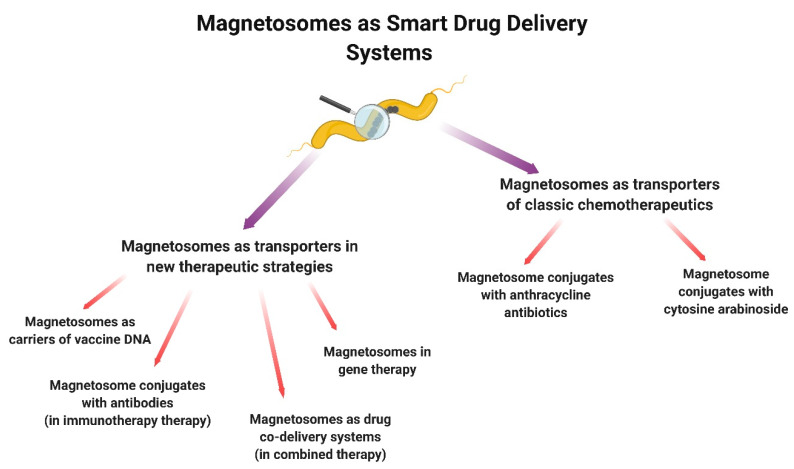
An important direction of research in increasing the effectiveness of cancer therapies is the design of effective drug distribution systems in the body. The development of the new strategies is primarily aimed at improving the stability of the drug after administration and increasing the precision of drug delivery to the destination. Due to the characteristic features of cancer cells, distributing chemotherapeutics exactly to the microenvironment of the tumor while sparing the healthy tissues is an important issue here. One of the promising solutions that would meet the above requirements is the use of bacteria (MTBs) and their organelles, called magnetosomes (BMs). MTBs are commonly found in water reservoirs, and BMs that contain ferromagnetic crystals condition the magnetotaxis of these microorganisms. The presented work is a review of the current state of knowledge on the potential use of MTBs and BMs as nanocarriers in the therapy of cancer. The growing amount of literature data indicates that MTBs and BMs may be used as natural nanocarriers for chemotherapeutics, such as classic anti-cancer drugs, antibodies, vaccine DNA, and siRNA. Their use as transporters increases the stability of chemotherapeutics and allows the transfer of individual ligands or their combinations precisely to cancerous tumors, which, in turn, enables the drugs to reach molecular targets more effectively.
提高癌症治疗效果的一个重要研究方向是设计体内有效的药物递送系统。新策略的开发主要旨在提高给药后药物的稳定性,并提高药物递送至目标部位的精准度。由于癌细胞的特征,将化疗药物精确递送至肿瘤微环境同时避免健康组织受到影响是一个重要问题。满足上述要求的一个有前景的解决方案是利用细菌(结核分枝杆菌,MTBs)及其细胞器磁小体(BMs)。MTBs常见于水库中,含有铁磁晶体的BMs决定了这些微生物的趋磁性。本文是对MTBs和BMs作为纳米载体在癌症治疗中的潜在应用的当前知识状态的综述。越来越多的文献数据表明,MTBs和BMs可用作化疗药物的天然纳米载体,如经典抗癌药物、抗体、疫苗DNA和小干扰RNA。将它们用作转运体可提高化疗药物的稳定性,并使单个配体或其组合精确地转移至癌性肿瘤,进而使药物更有效地到达分子靶点。