Department of Mechanical Engineering and Utah Robotics Center, University of Utah, Salt Lake City, UT, USA.
Department of Physical Therapy and Athletic Training, University of Utah, Salt Lake City, UT, USA.
Sci Data. 2020 May 21;7(1):150. doi: 10.1038/s41597-020-0494-7.
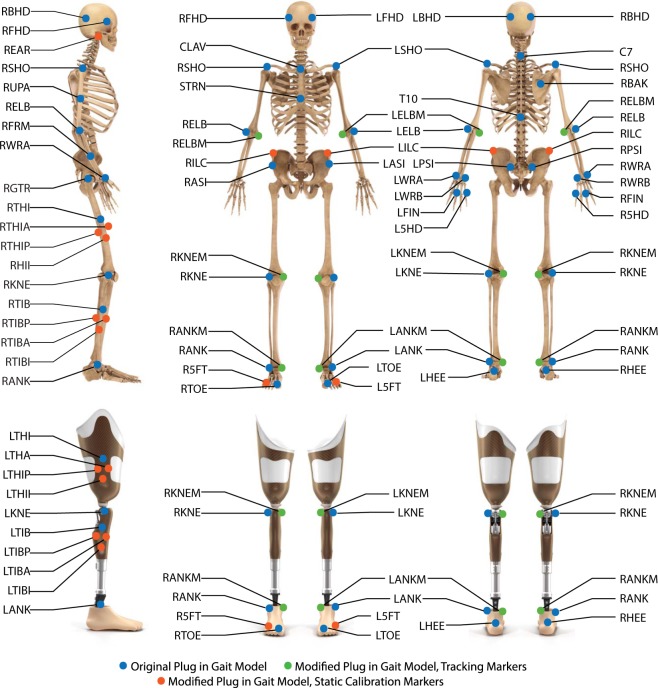
Motion capture is necessary to quantify gait deviations in individuals with lower-limb amputations. However, access to the patient population and the necessary equipment is limited. Here we present the first open biomechanics dataset for 18 individuals with unilateral above-knee amputations walking at different speeds. Based on their ability to comfortably walk at 0.8 m/s, subjects were divided into two groups, namely K2 and K3. The K2 group walked at [0.4, 0.5, 0.6, 0.7, 0.8] m/s; the K3 group walked at [0.6, 0.8, 1.0, 1.2, 1.4] m/s. Full-body biomechanics was collected using a 10-camera motion capture system and a fully instrumented treadmill. The presented open dataset will enable (i) clinicians to understand the biomechanical demand required to walk with a knee and ankle prosthesis at various speeds, (ii) researchers in biomechanics to gain new insights into the gait deviations of individuals with above-knee amputations, and (iii) engineers to improve prosthesis design and function.
运动捕捉对于量化下肢截肢患者的步态偏差是必要的。然而,患者人群和必要设备的获取是有限的。在这里,我们提出了第一个针对 18 名单侧膝上截肢者以不同速度行走的开放式生物力学数据集。基于他们以 0.8m/s 的舒适速度行走的能力,将受试者分为 K2 和 K3 两组。K2 组以[0.4、0.5、0.6、0.7、0.8]m/s 的速度行走;K3 组以[0.6、0.8、1.0、1.2、1.4]m/s 的速度行走。全身生物力学使用 10 个摄像头运动捕捉系统和全仪器化跑步机进行采集。所提出的开放式数据集将使(i)临床医生能够了解在不同速度下使用膝踝假肢行走所需的生物力学要求,(ii)生物力学研究人员能够深入了解膝上截肢者的步态偏差,(iii)工程师能够改进假肢设计和功能。