Liaw Kevin, Zhang Fan, Mangraviti Antonella, Kannan Sujatha, Tyler Betty, Kannan Rangaramanujam M
Center for Nanomedicine Wilmer Eye Institute, Johns Hopkins School of Medicine Baltimore Maryland USA.
Department of Chemical and Biomolecular Engineering Johns Hopkins University Baltimore Maryland USA.
Bioeng Transl Med. 2020 Apr 14;5(2):e10160. doi: 10.1002/btm2.10160. eCollection 2020 May.
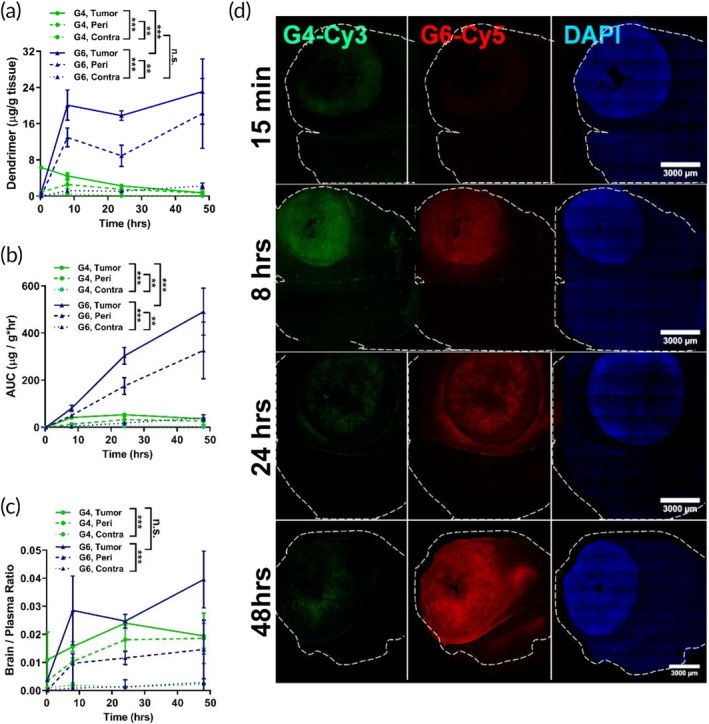
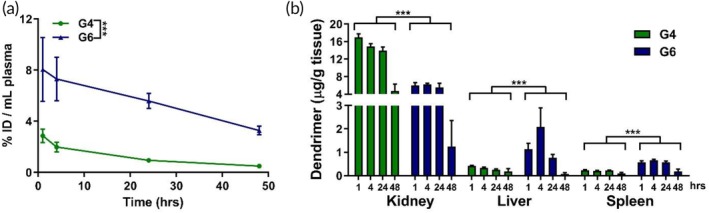
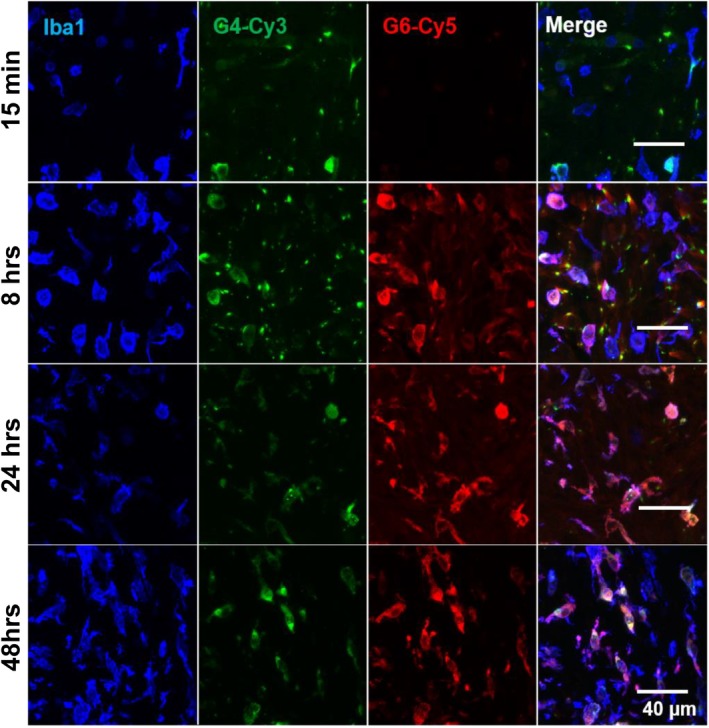
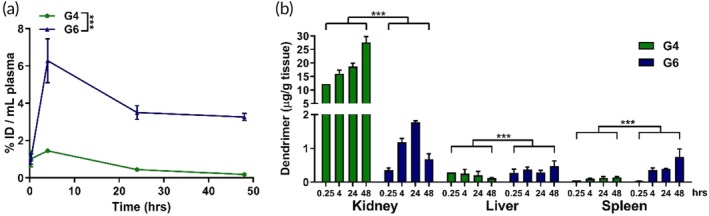
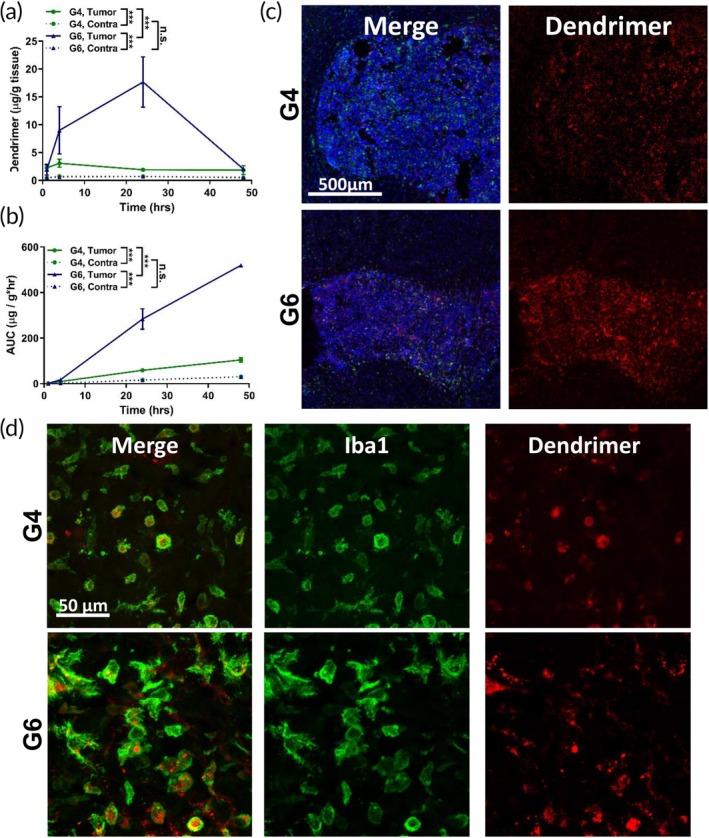
Malignant gliomas are the most common and aggressive form of primary brain tumors, with a median survival of 15-20 months for patients receiving maximal interventions. Advances in nanomedicine have provided tumor-specific delivery of chemotherapeutics to potentially overcome their off-target toxicities. Recent advances in dendrimer-based nanomedicines have established that hydroxyl-terminated poly(amidoamine) dendrimers can intrinsically target neuroinflammation and brain tumors from systemic administration without the need for targeting moieties. The size of nanocarriers is a critical parameter that determines their tumor-targeting efficiency, intratumor distribution, and clearance mechanism. In this study, we explore the dendrimer size effects on brain tumor targeting capability in two clinically relevant orthotopic brain tumor models, the 9L rat and GL261 mouse models, which capture differing aspects of gliomas. We show that increasing dendrimers from Generation 4 to Generation 6 significantly enhances their tumor accumulation (10-fold greater at 24 hr), tumor specificity (2-3 fold higher), and tumor retention. The superior tumor targeting effect of G6 dendrimers is associated with its reduced renal clearance rate, resulting in longer circulation time compared to G4 dendrimers. Additionally, the increase in dendrimer generation does not compromise its homogeneous tumor distribution and intrinsic targeting of tumor-associated macrophages. These results validate the potential for these dendrimers as an effective, clinically translatable platform for effectively targeting tumor-associated macrophages in malignant gliomas.
恶性胶质瘤是原发性脑肿瘤中最常见且侵袭性最强的类型,接受最大程度干预的患者中位生存期为15 - 20个月。纳米医学的进展为化疗药物提供了肿瘤特异性递送,有可能克服其脱靶毒性。基于树枝状大分子的纳米药物的最新进展表明,羟基封端的聚(酰胺胺)树枝状大分子可从全身给药内在地靶向神经炎症和脑肿瘤,而无需靶向部分。纳米载体的大小是决定其肿瘤靶向效率、肿瘤内分布和清除机制的关键参数。在本研究中,我们在两种临床相关的原位脑肿瘤模型(9L大鼠和GL261小鼠模型)中探索树枝状大分子大小对脑肿瘤靶向能力的影响,这两种模型体现了胶质瘤的不同方面。我们表明,将树枝状大分子从第4代增加到第6代可显著增强其肿瘤蓄积(24小时时增加约10倍)、肿瘤特异性(高约2 - 3倍)和肿瘤滞留。G6树枝状大分子卓越的肿瘤靶向效果与其降低的肾清除率相关,导致与G4树枝状大分子相比循环时间更长。此外,树枝状大分子代数的增加并不影响其在肿瘤内的均匀分布以及对肿瘤相关巨噬细胞的内在靶向。这些结果证实了这些树枝状大分子作为有效靶向恶性胶质瘤中肿瘤相关巨噬细胞的有效、可临床转化平台的潜力。