School of Mathematical Sciences, Queensland University of Technology, Brisbane, QLD 4000, Australia.
Australian Research Council Centre of Excellence for Mathematical and Statistical Frontiers, Queensland University of Technology, Brisbane, QLD 4000, Australia.
Viruses. 2020 May 18;12(5):558. doi: 10.3390/v12050558.
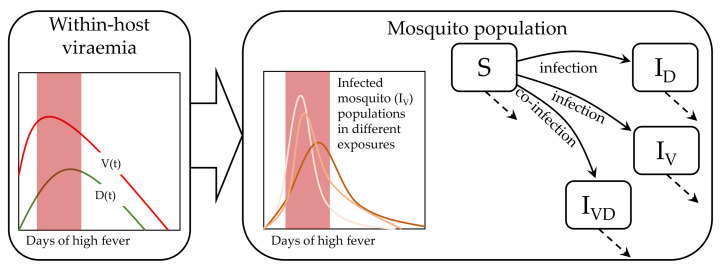
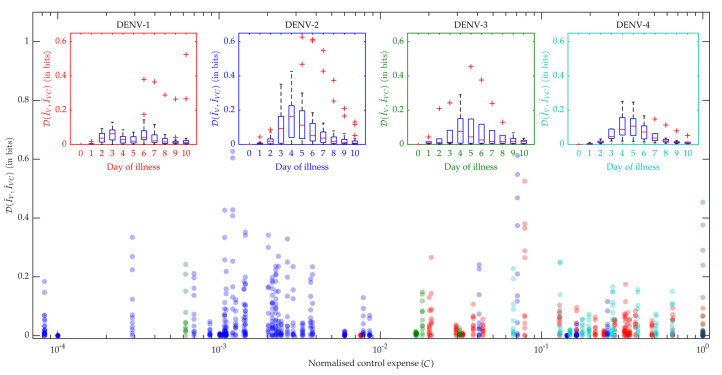
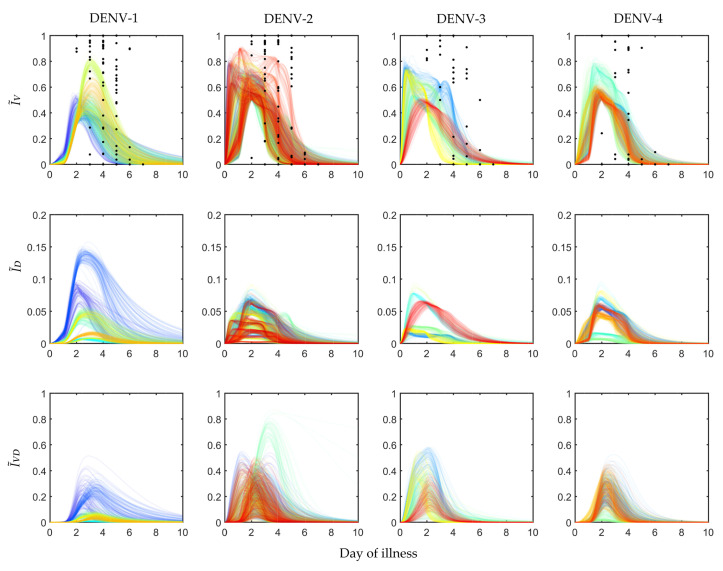
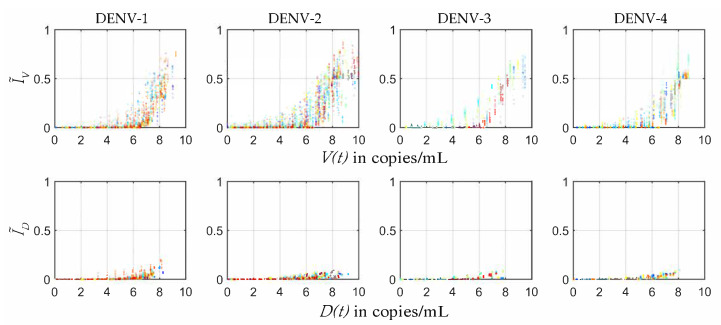
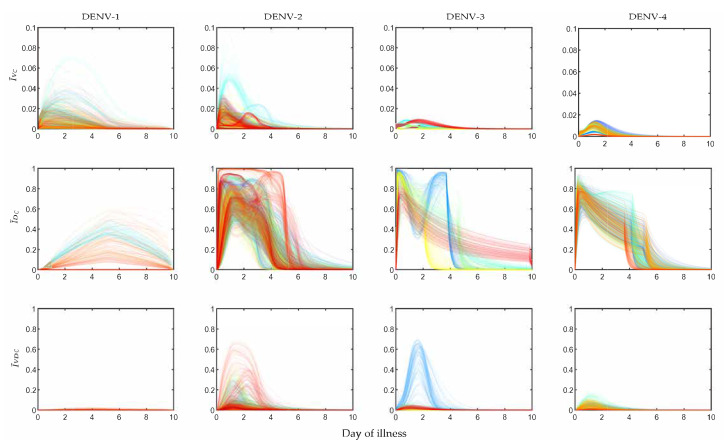
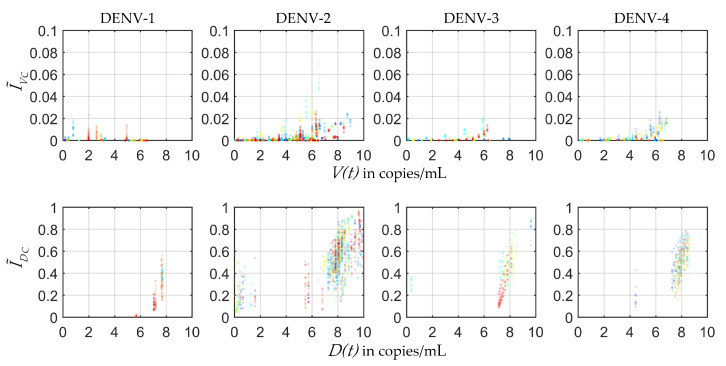
The host-vector shuttle and the bottleneck in dengue transmission is a significant aspect with regard to the study of dengue outbreaks. As mosquitoes require 100-1000 times more virus to become infected than human, the transmission of dengue virus from human to mosquito is a vulnerability that can be targeted to improve disease control. In order to capture the heterogeneity in the infectiousness of an infected patient population towards the mosquito population, we calibrate a population of host-to-vector virus transmission models based on an experimentally quantified infected fraction of a mosquito population. Once the population of models is well-calibrated, we deploy a population of controls that helps to inhibit the human-to-mosquito transmission of the dengue virus indirectly by reducing the viral load in the patient body fluid. We use an optimal bang-bang control on the administration of the defective virus (transmissible interfering particles (TIPs)) to symptomatic patients in the course of their febrile period and observe the dynamics in successful reduction of dengue spread into mosquitoes.
宿主-载体穿梭和登革热传播的瓶颈是登革热爆发研究的一个重要方面。由于蚊子感染所需的病毒量比人类多 100-1000 倍,因此可以针对从人类到蚊子的登革热病毒传播的脆弱性来改善疾病控制。为了捕捉感染人群对蚊子种群的传染性异质性,我们基于定量实验确定的蚊子种群中感染个体的比例,对宿主-载体病毒传播模型进行了标定。一旦模型群体得到良好的标定,我们就会部署一个控制群体,通过降低病人体液中的病毒载量,间接地抑制登革热病毒从人类到蚊子的传播。我们在发热期对症状患者使用缺陷病毒(传染性干扰颗粒 (TIPs))进行最佳的“bang-bang”控制,并观察成功减少登革热传播到蚊子的动态。