Henry Warembourg Medicine School, Lille University, 59000 Lille, France.
NexGen Analytics, 82801 Sheridan, WY, United States.
Med Hypotheses. 2020 Sep;142:109827. doi: 10.1016/j.mehy.2020.109827. Epub 2020 May 12.
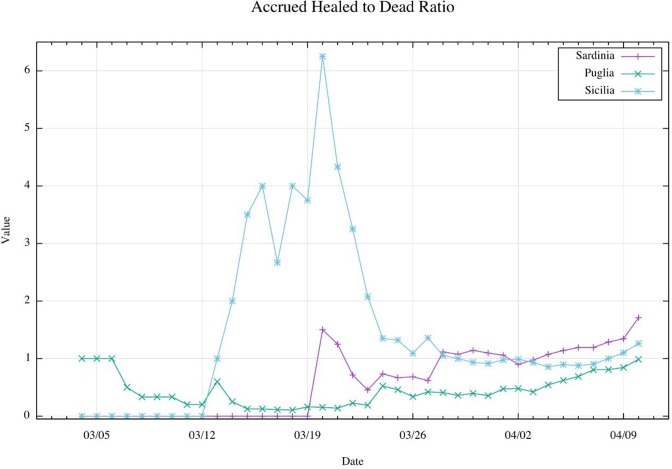
The novel coronavirus pneumonia (COVID-19) is a contagious acute respiratory infectious disease whose causative agent has been demonstrated to be a novel virus of the coronavirus family, SARSCoV-2. A recent PRE-print study has showed a heme attack on the 1-beta chain of hemoglobin by COVID19. Beta-thalassemia results of a default in the hemoglobin beta-chain synthesis. 1,5% global population are heterozygotes for this disease. In this study, by a multiple linear regression, we have analyzed the evolution of COVID-19 infection in three Italian regions (Puglia, Sardinia, Sicilia) with different beta-thalassemic prevalences, in order to search a link. The results have showed that betathalassemic heterozygote population prevalence is correlated to immunity against COVID-19, by a regression. This paper is only for academic discussion, the hypotheses and conclusions needs to be confirmed by further research.
新型冠状病毒肺炎(COVID-19)是一种传染性急性呼吸道传染病,其病原体已被证明是冠状病毒家族的一种新型病毒,即 SARS-CoV-2。最近的一项预印本研究表明,COVID19 对血红蛋白的 1-β 链进行了血红素攻击。β-地中海贫血症是由于血红蛋白β-链合成的默认而导致的。全球有 1.5%的人口是这种疾病的杂合子。在这项研究中,我们通过多元线性回归分析了 COVID-19 在意大利三个地区(普利亚、撒丁岛、西西里岛)的感染情况,这三个地区的β-地中海贫血患病率不同,以寻找一种联系。结果表明,β-地中海贫血症杂合子人群的患病率与 COVID-19 的免疫力呈负相关,这是通过回归分析得出的。本文仅供学术讨论,假设和结论需要通过进一步研究来证实。