Centre for Ophthalmology and Visual Sciences, Lions Eye Institute, University of Western Australia, 2 Verdun St, Nedlands WA, Perth, 6009, Australia.
Telethon Kids Institute, University of Western Australia, Perth, Australia.
BMC Med Res Methodol. 2020 May 24;20(1):127. doi: 10.1186/s12874-020-00996-y.
Recent changes in communication technologies, including increased reliance on mobile phones and the internet, may present challenges and/or opportunities to re-engaging inactive study cohorts. We evaluate our ability to recruit participants for the Kidskin Young Adult Myopia Study (KYAMS), a follow-up of the Kidskin Study.
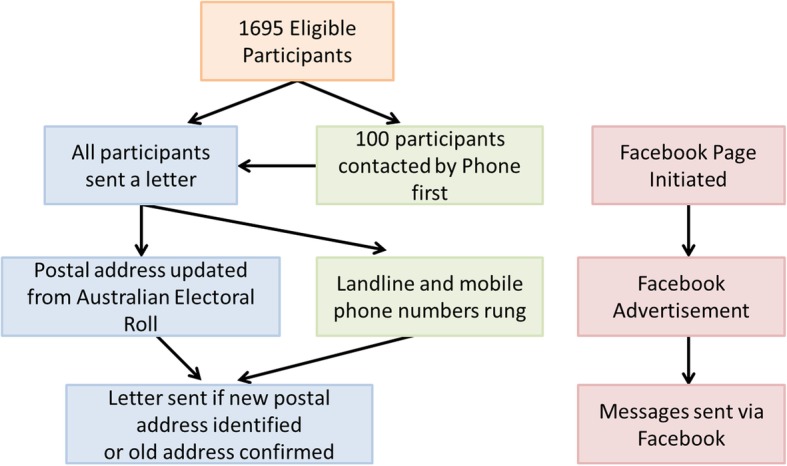
KYAMS participants were recruited from the Kidskin Study, a sun exposure-intervention study for 5-6 year-olds running from 1995 to 1999 with most recent follow-up in 2005. From 2015 to 2019, the KYAMS used mail-outs, phone calls and social media to contact Kidskin Study participants. Multivariable logistic regression was used to identify variables associated with successful contact of a Kidskin Study participant or family member and KYAMS participation.
Of 1695 eligible participants, 599 (35.5%) participants (or a family member) were contacted and 303 (17.9%) participated in the KYAMS. KYAMS participation was more likely in those who participated in the 2005 follow-up (odds ratio [OR] = 5.09, 95% confidence interval [CI]: 3.67-7.06) and had a mobile phone number on record (OR = 2.25, CI: 1.57-3.23). Of those contacted, participants who were the first point of contact (OR = 4.84, CI: 2.89-8.10) and who were contacted by letter in the first (OR = 6.53, CI: 3.35-12.75) or second (OR = 5.77, CI: 2.85-11.67) round were more likely to participate in the KYAMS, compared to contact by landline phone.
We recruited approximately one-fifth of Kidskin Study participants for the KYAMS. Participants were more likely to participate in the KYAMS if they were contacted directly, rather than through a family member, and if they were contacted by invitation letter.
ACTRN12617000812392.
通讯技术的最新变化,包括对手机和互联网的日益依赖,可能给重新接触不活跃的研究对象群体带来挑战和/或机遇。我们评估了我们为 Kidskin 青少年近视研究(KYAMS)招募参与者的能力,这是一项针对 5-6 岁儿童的阳光暴露干预研究的后续研究,该研究从 1995 年持续到 1999 年,最近一次随访是在 2005 年。从 2015 年到 2019 年,KYAMS 通过邮寄、电话和社交媒体联系 Kidskin 研究的参与者。多变量逻辑回归用于确定与成功联系 Kidskin 研究参与者或家庭成员以及 KYAMS 参与相关的变量。
KYAMS 的参与者是从 Kidskin 研究中招募的,这是一项针对 5-6 岁儿童的阳光暴露干预研究,从 1995 年持续到 1999 年,最近一次随访是在 2005 年。从 2015 年到 2019 年,KYAMS 通过邮寄、电话和社交媒体联系 Kidskin 研究的参与者。多变量逻辑回归用于确定与成功联系 Kidskin 研究参与者或家庭成员以及 KYAMS 参与相关的变量。
在 1695 名合格参与者中,有 599 名(35.5%)参与者(或其家庭成员)被联系,其中 303 名(17.9%)参与者参加了 KYAMS。那些参加了 2005 年随访的人(优势比[OR] = 5.09,95%置信区间[CI]:3.67-7.06)和有手机号码记录的人(OR = 2.25,CI:1.57-3.23)更有可能参加 KYAMS。在被联系的参与者中,作为第一联系点的参与者(OR = 4.84,CI:2.89-8.10)和首先通过信件联系的参与者(OR = 6.53,CI:3.35-12.75)或第二轮(OR = 5.77,CI:2.85-11.67)更有可能参加 KYAMS,而不是通过座机电话联系。
我们招募了 Kidskin 研究参与者的大约五分之一参加 KYAMS。如果参与者直接联系,而不是通过家庭成员联系,如果他们通过邀请函联系,他们更有可能参加 KYAMS。
ACTRN12617000812392。