G.B. Pant National Institute of Himalayan Environment, Kosi-Katarmal, Almora, Uttarakhand, 263 643, India.
Department of Forestry and Natural Resources, HNB Garhwal University, (Garhwal), Srinagar, Uttarakhand, 246174, India.
J Ethnobiol Ethnomed. 2020 May 24;16(1):29. doi: 10.1186/s13002-020-00381-5.
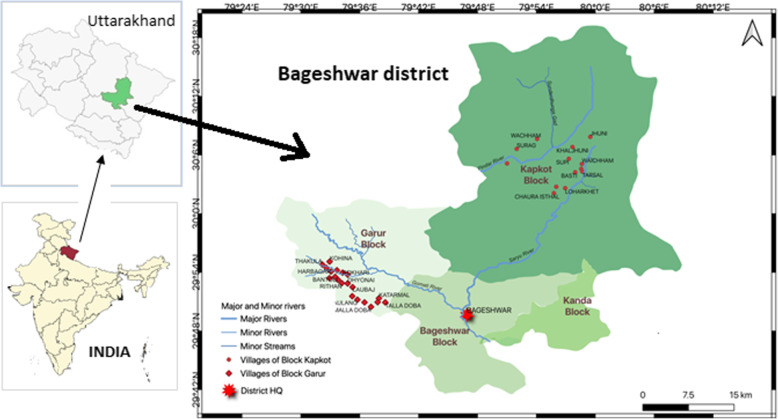
Indigenous communities use wild plants to cure human ailments since ancient times; such knowledge has significant potential for formulating new drugs and administering future health care. Considering this, the present study was undertaken to assess use value, diversity, and conservation concerns of medicinal plants used in traditional herbal care system of a marginal hill community in Bageshwar district of Uttarakhand in the Central Himalayan region of India.
Extensive surveys were made in 73 villages to gather information on the ethnomedicinal use of plant species used in the traditional herbal healing system. A total of 100 respondents were identified (30 herbal healers called Vaidyas and 70 non-healers/natives) and interviewed using semi-structured questionnaires, target interviews, and group discussion. Some important indices such as the use-value index (UV), relative frequency citation (RFC), cultural importance index (CI), and informant consensus factor (F) were calculated for the medicinal plants included in the present study.
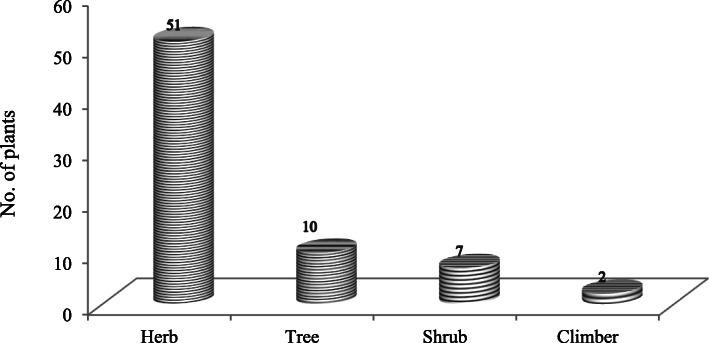
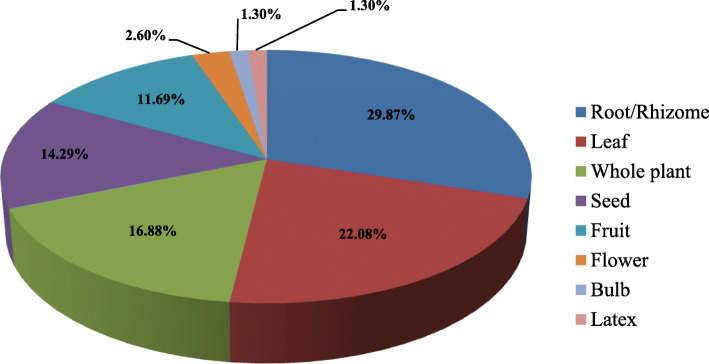
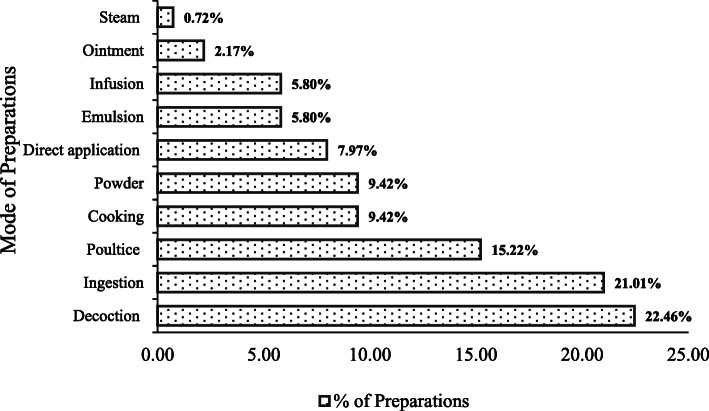
It was recorded that the community uses a total of 70 species with 64 genera and 35 families for curing various ailments. Family Lamiaceae recorded the maximum number of medicinal plants. Twenty-one species used most extensively in the traditional health care system. The major parts of the identified plants used for the treatment of various ailments were root/rhizome and leaf. The most common methods used for the preparation of these plants were decoction and infusion. Ocimum basilicum L., Cannabis sativa L., Citrus aurantifolia (Christm) Sw., Curcuma longa L., and Setaria italica L. had the highest rate of use report. RFC value ranged between 0.03 and 0.91 with highest values for Setaria italica, Zingiber officinale, Ocimum basilicum, and Raphanus sativus. The traditional knowledge is passed verbally to generations and needs to be preserved for the future bio-prospecting of plants that could be a potential cure to any future disease.
In recent years, the community has access to modern hospitals and medicinal facilities, although a considerable number still prefer medicinal plants for curing select ailments. It is suggested that these ethnomedicinal species need to be screened and evaluated further for their effectiveness for pharmacological activity. Also, significant efforts are required to conserve traditional knowledge and natural habitats of wild medicinal plants.
自古以来,土著社区就使用野生植物来治疗人类疾病;这种知识具有很大的潜力,可以用来开发新药和管理未来的医疗保健。有鉴于此,本研究旨在评估印度喜马拉雅中部地区北阿坎德邦巴杰斯瓦尔地区边缘山区社区传统草药护理系统中使用的药用植物的使用价值、多样性和保护问题。
在 73 个村庄进行了广泛调查,以收集有关用于传统草药治疗系统的植物物种的民族医学用途的信息。总共确定了 100 名受访者(30 名草药治疗师,称为 Vaidyas,70 名非治疗师/本地人),并使用半结构化问卷、目标访谈和小组讨论对他们进行了采访。为本研究包括的药用植物计算了使用价值指数 (UV)、相对频率引用 (RFC)、文化重要性指数 (CI) 和信息共识因子 (F) 等一些重要指标。
记录显示,该社区共使用 70 种植物,隶属于 64 属和 35 科,用于治疗各种疾病。薄荷科记录的药用植物数量最多。在传统保健系统中广泛使用的 21 种植物。用于治疗各种疾病的鉴定植物的主要部分是根/根茎和叶。用于制备这些植物的最常见方法是煎煮和浸泡。罗勒、大麻、酸橙、姜黄和狗尾草的使用报告率最高。RFC 值在 0.03 到 0.91 之间,最高的是狗尾草、生姜、罗勒和萝卜。传统知识是通过口口相传传给后代的,需要为未来对植物的生物勘探保存下来,这些植物可能是任何未来疾病的潜在治疗方法。
近年来,社区可以获得现代医院和医疗设施,尽管仍有相当一部分人选择药用植物来治疗特定疾病。建议进一步筛选和评估这些民族药用物种的有效性,以进行药理学活性研究。此外,还需要做出重大努力来保护传统知识和野生药用植物的自然栖息地。