Guangxi Key Laboratory of Functional Phytochemicals Research and Utilization, Guangxi Institute of Botany, Guangxi Zhuang Autonomous Region and Chinese Academy of Sciences, Guilin, 541006, China.
Guangxi Key Laboratory of Plant Conservation and Restoration Ecology in Karst Terrain, Guangxi Institute of Botany, Guangxi Zhuang Autonomous Region and Chinese Academy of Sciences, Guilin, 541006, China.
J Ethnobiol Ethnomed. 2022 Jun 21;18(1):49. doi: 10.1186/s13002-022-00544-6.
Gongcheng Yao Autonomous County (Gongcheng) is typical for the Yao people in northeastern Guangxi, southern China. The Yao people have a long history of using medicinal plants. In this study, we used ethnobotanical methods to collect traditional knowledge regarding herbal medicines in Gongcheng. Our study provides fundamental data for developing and applying local ethnic medicines and their protection.
Ethnobotanical data were collected from 103 villages in nine townships from 2014 to 2018 in Gongcheng. A total of 352 informants (279 male and 73 female) were interviewed through semi-structured interviews, key informant interviews, and guided field walks. All the informants were local inhabitants aged between 28 and 101 years of age, of which 40 key informants were selected based on the recommendations of knowledgeable elders and local medical institutions. The informant consensus factor (ICF) was used to evaluate the degree and importance of differences in medicinal plant species and calculated the relative frequencies of citation (RFC) for the recorded medicinal plants.
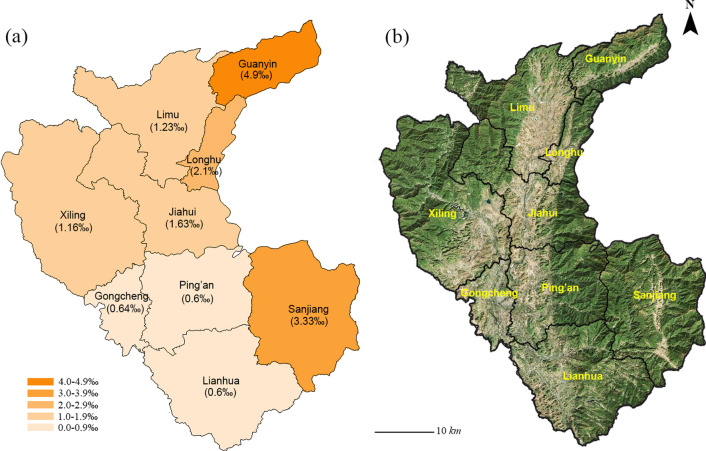
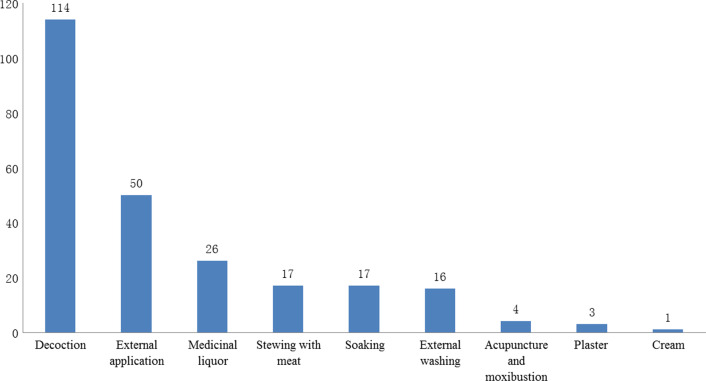
Data from 352 local healers were collected for the study. The Guanyin and Sanjiang townships had the highest distribution of per capita healers (Pch), while the Gongcheng, Lianhua, and Ping'an townships were relatively lower. Of the 352 local healers, more than half were older than 60 years of age and therefore faced the problem of suitable successors and potential loss of traditional medicinal knowledge. There are 12 types of diseases treated by local healers in the study area, and most of the types had a high ICF value. The highest ICF (0.80) was reported for digestive system disease, followed by urinary system disease (0.78) and nervous system disease (0.77). Traumatic injury and orthopedics, digestive system, and rheumatic disease are the most common ailments. The RFC value calculated in 33 medicinal plant species (with an FC of more than 5) ranged from 0.024 to 0.056. The higher RFC values included Kadsura longipedunculata, Schefflera heptaphylla, Plantago asiatica, etc. The most commonly used medicinal method was decoction; plasters, creams, and some form of moxibustion and cupping skills were locally practiced, but only rarely. The local healers used 306 medicinal plant species (116 families and 255 genera). Herbal plants were most commonly used among these, with whole plants and roots being favored.
The Yao people are highly skilled at using medicinal plants to treat various diseases in Gongcheng. Their treatment methods are varied, convenient, and efficient. Due to the impact of urbanization and economic development, knowledge of traditional medicine is under threat, with declining numbers of local healers and a lack of suitable successors. In order to protect and inherit Yao's traditional medicinal knowledge, it is necessary to educate young healers and to protect biodiversity.
恭城瑶族自治县(恭城)是中国南方桂东北地区典型的瑶族聚居地。瑶族有着悠久的药用植物使用历史。本研究采用民族植物学方法收集恭城瑶族传统草药知识。本研究为开发和应用当地民族药物及其保护提供了基础数据。
2014 年至 2018 年,我们在恭城县九个乡镇的 103 个村庄收集民族植物学数据。通过半结构式访谈、关键信息提供者访谈和实地引导,共采访了 352 名知情者(279 名男性和 73 名女性)。所有知情者均为年龄在 28 至 101 岁之间的当地居民,其中根据知识渊博的长辈和当地医疗机构的建议选择了 40 名关键信息提供者。使用药用植物种间共识因子(ICF)来评估药用植物种类的差异程度和重要性,并计算记录药用植物的相对引用频率(RFC)。
本研究共收集了 352 名当地治疗师的数据。观音乡和三江乡的人均治疗师人数(Pch)最高,而恭城县、莲花镇和平安乡则相对较低。在 352 名当地治疗师中,超过一半的人年龄超过 60 岁,因此面临合适的接班人问题和潜在的传统医药知识流失问题。研究地区的当地治疗师治疗 12 种类型的疾病,其中大多数类型的 ICF 值较高。消化系统疾病的 ICF 最高(0.80),其次是泌尿系统疾病(0.78)和神经系统疾病(0.77)。创伤和骨科、消化系统和风湿性疾病是最常见的疾病。33 种药用植物(FC 大于 5)的 RFC 值计算范围为 0.024 至 0.056。较高的 RFC 值包括长梗南五味子、鹅掌柴、车前草等。最常用的药用方法是煎剂;糊剂、霜剂和一些形式的艾灸和拔罐技术在当地也有应用,但很少见。当地治疗师使用了 306 种药用植物(116 科 255 属)。草药植物是最常用的,其中全草和根最受欢迎。
瑶族人民在恭城熟练地使用药用植物治疗各种疾病。他们的治疗方法多样、方便、高效。由于城市化和经济发展的影响,传统医学知识受到威胁,当地治疗师人数减少,缺乏合适的接班人。为了保护和传承瑶族传统医学知识,有必要教育年轻的治疗师并保护生物多样性。