High Altitude Plant Physiology Research Centre, H.N.B. Garhwal University, Post Box: 14, Srinagar Garhwal, Uttarakhand, 246174, India.
Practical Solutions, Kathmandu, Nepal.
J Ethnobiol Ethnomed. 2017 Aug 24;13(1):49. doi: 10.1186/s13002-017-0178-3.
Ethnomedicinal knowledge of the Indian Himalayas is very interesting because of the wide range of medicinal plants used in traditional medical practice. However, there is a danger of knowledge being lost because the knowledge sharing is very limited and passed on orally. The present study is the first ethnomedicinal study in Jakholi area of Rudraprayag district of Northwestern India. The aim of present study was to identify traditional medicinal plants used by the inhabitants to treat different ailments and document the associated knowledge of these medicinal plants.
An ethnomedicinal survey was carried out in 72 of 133 villages and alpine pastures of Jakholi block (800-4000 m asl). Door to door surveys and group discussions, applying semi-structured questionnaires were conducted with traditional healers and villagers in local language (Garhwali). Informant Consensus Factor (ICF) was computed to analyse collected ethnomedicinal data.
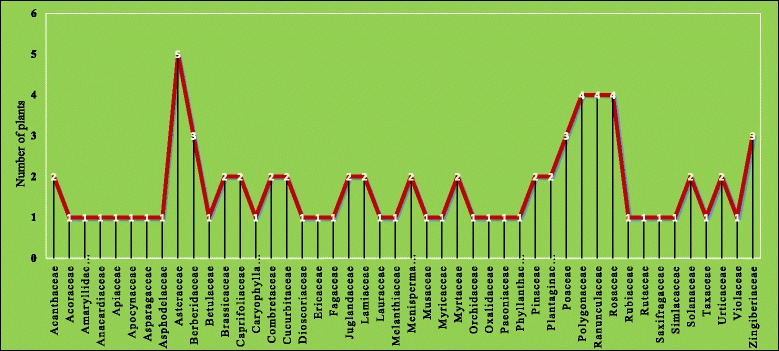
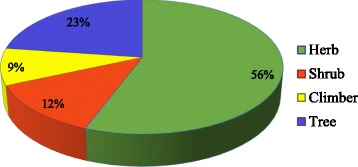
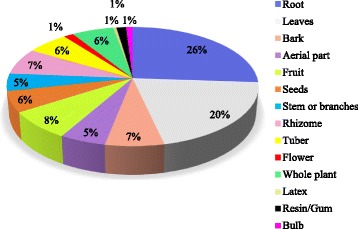
A total of 78 species (Gymnosperms 3 species, Monocotyledons 12 and 63 Dicotyledons) belonging to 73 genera in 46 families were identified to treat 14 different ailments categories. Most dominant family is Asteraceae (5 species). In disease treated categories, Diseases of the skin (DE) have the highest proportion (29.55%) followed by Gastro- intestinal disorder (GA) (25.89%). The most life form of plants used was herb (56%) followed by tree (23%) while root was the most frequently used part of the plants and the traditional preparation was mainly applied in the form of paste (37%). The highest ICF value (0.99) was found for hair ailments (HA) followed ophthalmologic complaints (OP) and mental afflictions (MA) (0.98).
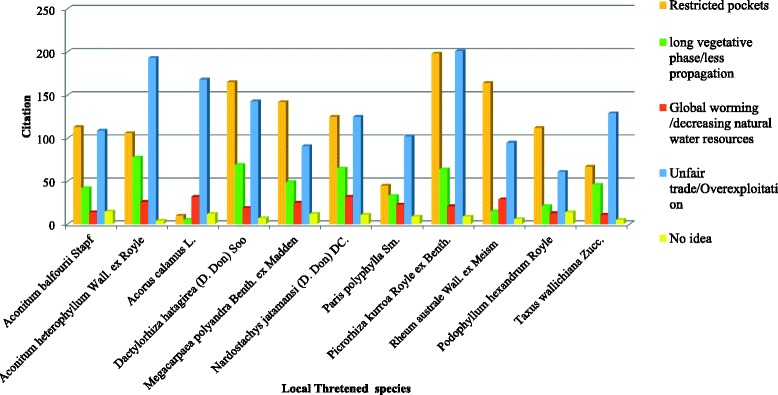
The present study provides valuable information about traditional knowledge of medicinal plants of Jakholi Block in the Northwestern Himalaya, India. Local communities still possess large traditional knowledge of plants and their therapeutic uses and that the link of that traditional knowledge to modern research could be of importance for the isolation of new phytotherapeutic compounds leading to the development of novel therapeutic active agents. Some of the ethnomedicinal plants are facing high threats and are becoming rare, and conservation initiatives are needed to conserve them for sustainable management in the region.
由于印度喜马拉雅地区在传统医学实践中使用了广泛的药用植物,因此其民族医学知识非常有趣。然而,由于知识共享非常有限且仅通过口头传授,因此存在知识流失的危险。本研究是印度西北部鲁德拉普拉亚格区 Jakholi 地区的第一项民族医学研究。本研究的目的是确定居民用来治疗不同疾病的传统药用植物,并记录这些药用植物的相关知识。
对 Jakholi 区块(海拔 800-4000 米)的 133 个村庄和高山牧场中的 72 个进行了民族医学调查。使用半结构式问卷,以当地语言(加瓦尔语)与传统治疗师和村民进行了逐户调查和小组讨论。计算了 informant consensus factor (ICF) 以分析收集到的民族医学数据。
共鉴定出 78 种(裸子植物 3 种,单子叶植物 12 种,双子叶植物 63 种),属于 46 科 73 属,用于治疗 14 种不同的疾病类别。最主要的科是菊科(5 种)。在所治疗的疾病类别中,皮肤疾病(DE)的比例最高(29.55%),其次是胃肠道疾病(GA)(25.89%)。使用最多的植物生活型是草本植物(56%),其次是乔木(23%),而植物的最常用部位是根,传统制剂主要以糊剂的形式应用(37%)。毛发疾病(HA)的 ICF 值最高(0.99),其次是眼科疾病(OP)和精神疾病(MA)(0.98)。
本研究提供了有关印度喜马拉雅西北部 Jakholi 区块药用植物传统知识的有价值的信息。当地社区仍然拥有大量关于植物及其治疗用途的传统知识,将这种传统知识与现代研究联系起来可能对分离新的植物疗法化合物、开发新的治疗活性物质具有重要意义。一些药用植物正面临着高威胁,变得稀有,需要采取保护措施来保护它们,以实现该地区的可持续管理。