Division of Veterinary Surgery, Department of Veterinary Science, Faculty of Veterinary Medicine, Nippon Veterinary and Life Science University, 1-7-1 Kyonan-cho, Musashino, Tokyo 180-8602, Japan.
Veterinary Teaching Hospital, Azabu University, 1-17-71 Fuchinobe, Chuou-ku, Sagamihara-shi, Kanagawa 252-5201, Japan.
J Vet Med Sci. 2020 Jul 10;82(7):908-916. doi: 10.1292/jvms.19-0613. Epub 2020 May 25.
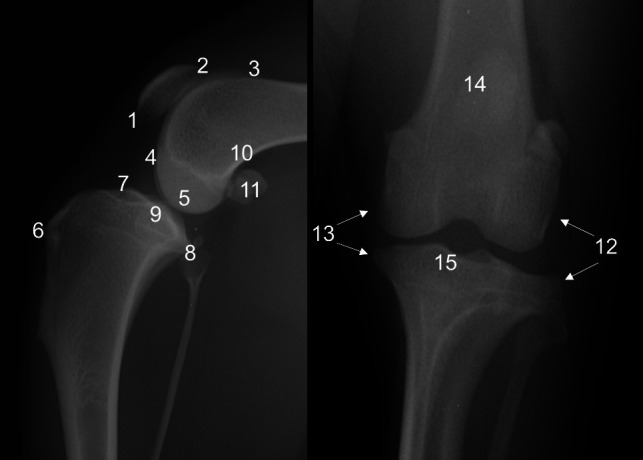
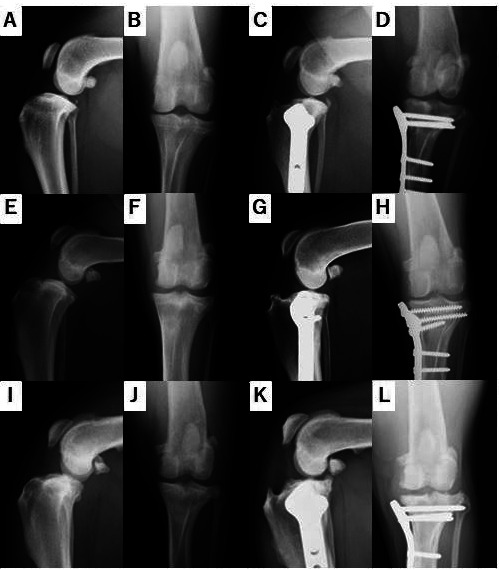
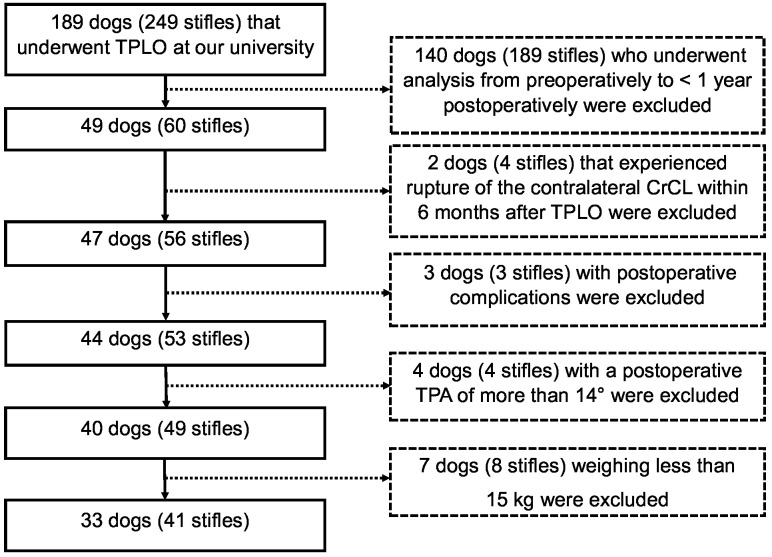
The object of this study is to evaluate the long-term outcome of hind limb weight-bearing function and progression of stifle osteoarthritis (OA) after tibial plateau leveling osteotomy (TPLO). Groups were classified by the degree of cranial cruciate ligament (CrCL) damage and presence or absence of medial meniscus damage as macroscopically evaluated during surgery. Weight-bearing function was assessed via the peak vertical force (PVF), and OA progression was assessed via the radiographic OA score (OAS) preoperatively and 1, 3, 6, 12, 18, 24, and 36 months postoperatively. In all stifles, PVF was significantly higher within 6 months postoperatively than preoperatively, and this high ratio was maintained for 36 months. The OAS was significantly higher 24 months postoperatively than preoperatively in stifles with a partial CrCL tear, and significantly increased at each timepoint after 3 months postoperatively in stifles with complete CrCL rupture. The OAS remained consistently lower in stifles with a partial CrCL tear and no treatment of the medial meniscus than in stifles with complete rupture. Thus, after TPLO, the weight-bearing function improved in the early postoperative period and was maintained for as long as 36 months. Although OA progressed over time after TPLO, the progression was more gradual in stifles with partial tears than in those with complete rupture. Canine patients would benefit from earlier surgical intervention through development of technology that enables early detection of ligament degeneration.
本研究旨在评估胫骨平台平整术(TPLO)后后肢负重功能的长期结果和膝关节关节炎(OA)的进展。根据手术中宏观评估的前十字韧带(CrCL)损伤程度和内侧半月板损伤的存在与否对各组进行分类。通过峰值垂直力(PVF)评估负重功能,通过术前和术后 1、3、6、12、18、24 和 36 个月的放射学 OA 评分(OAS)评估 OA 进展。在所有膝关节中,术后 6 个月内 PVF 均明显高于术前,且该高比值维持 36 个月。在部分 CrCL 撕裂的膝关节中,术后 24 个月的 OAS 明显高于术前,而在完全 CrCL 断裂的膝关节中,术后 3 个月后每个时间点的 OAS 均显著增加。在部分 CrCL 撕裂且未治疗内侧半月板的膝关节中,OAS 始终低于完全断裂的膝关节。因此,TPLO 后,负重功能在术后早期得到改善,并可维持长达 36 个月。尽管 TPLO 后 OA 随时间推移而进展,但在部分撕裂的膝关节中,进展更为缓慢。通过开发能够早期检测韧带退变的技术,犬类患者将受益于更早的手术干预。