Zhang Xian, Lu Xin-An, Yang Junfang, Zhang Gailing, Li Jingjing, Song Lisong, Su Yunchao, Shi Yanze, Zhang Min, He Jiujiang, Song Dan, Lv Fanyong, Li Wenqian, Wu Yan, Wang Hui, Liu Hongxing, Zhou Xiaosu, He Ting, Lu Peihua
Lu Daopei Hospital, Langfang, Hebei, China.
Lu Daopei Institute of Hematology, Beijing, China; and.
Blood Adv. 2020 May 26;4(10):2325-2338. doi: 10.1182/bloodadvances.2020001466.
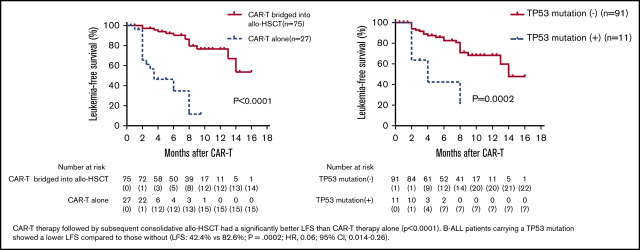
Anti-CD19 chimeric antigen receptor (CAR) T-cell therapy is effective in patients with advanced B-cell acute lymphoblastic leukemia (B-ALL). However, efficacy data is sparse in subgroups of patients with high-risk features such as BCR-ABL+, TP53 mutation, extramedullary disease (including central nervous system leukemia) or posttransplant relapse. It is also uncertain whether there is an added benefit of transplantation after anti-CD19 CAR T-cell therapy. We conducted a phase 1/2 study of 115 enrolled patients with CD19+ B-ALL. A total of 110 patients were successfully infused with anti-CD19 CAR T cells. In all, 93% of patients achieved a morphologic complete remission, and 87% became negative for minimal residual disease. Efficacy was seen across all subgroups. One-year leukemia-free survival (LFS) was 58%, and 1-year overall survival (OS) was 64% for the 110 patients. Seventy-five nonrandomly selected patients (73.5%) subsequently received an allogeneic hematopoietic stem cell transplant (allo-HSCT). LFS (76.9% vs 11.6%; P < .0001; 95% confidence interval [CI], 11.6-108.4) and OS (79.1% vs 32.0%; P < .0001; 95% CI, 0.02-0.22) were significantly better among patients who subsequently received allo-HSCT compared with those receiving CAR T-cell therapy alone. This was confirmed in multivariable analyses (hazard ratio, 16.546; 95% CI, 5.499-49.786). Another variate that correlated with worse outcomes was TP53 mutation (hazard ratio, 0.235; 95% CI, 0.089-0.619). There were no differences in complete remission rate, OS, or LFS between groups of patients age 2 to 14 years or age older than 14 years. Most patients had only mild cytokine release syndrome and neurotoxicity. Our data indicate that anti-CD19 CAR T-cell therapy is safe and effective in all B-ALL subgroups that have high-risk features. The benefit of a subsequent allo-HSCT requires confirmation because of nonrandom allocation. This trial was registered at www.clinicaltrials.gov as #NCT03173417.
抗CD19嵌合抗原受体(CAR)T细胞疗法对晚期B细胞急性淋巴细胞白血病(B-ALL)患者有效。然而,在具有高危特征的患者亚组中,如BCR-ABL+、TP53突变、髓外疾病(包括中枢神经系统白血病)或移植后复发,疗效数据稀少。抗CD19 CAR T细胞治疗后进行移植是否有额外益处也不确定。我们对115例入组的CD19+B-ALL患者进行了1/2期研究。共有110例患者成功输注了抗CD19 CAR T细胞。总体而言,93%的患者实现了形态学完全缓解,87%的患者微小残留病转为阴性。所有亚组均观察到疗效。110例患者的1年无白血病生存率(LFS)为58%,1年总生存率(OS)为64%。75例非随机选择的患者(73.5%)随后接受了异基因造血干细胞移植(allo-HSCT)。与仅接受CAR T细胞治疗的患者相比,随后接受allo-HSCT的患者的LFS(76.9%对11.6%;P<.0001;95%置信区间[CI],11.6-108.4)和OS(79.1%对32.0%;P<.0001;95%CI,0.02-0.22)显著更好。多变量分析证实了这一点(风险比,16.546;95%CI,5.499-49.786)。另一个与较差预后相关的变量是TP53突变(风险比,0.235;95%CI,0.089-0.619)。2至14岁或14岁以上的患者组之间在完全缓解率、OS或LFS方面没有差异。大多数患者仅有轻度细胞因子释放综合征和神经毒性。我们的数据表明,抗CD19 CAR T细胞疗法在所有具有高危特征的B-ALL亚组中是安全有效的。由于非随机分配,后续allo-HSCT的益处需要进一步证实。该试验已在www.clinicaltrials.gov上注册,注册号为#NCT03173417。