College of Information Engineering, Shanghai Maritime University, 1550 Haigang Ave., Shanghai 201306, China.
Comput Math Methods Med. 2020 May 5;2020:8153295. doi: 10.1155/2020/8153295. eCollection 2020.
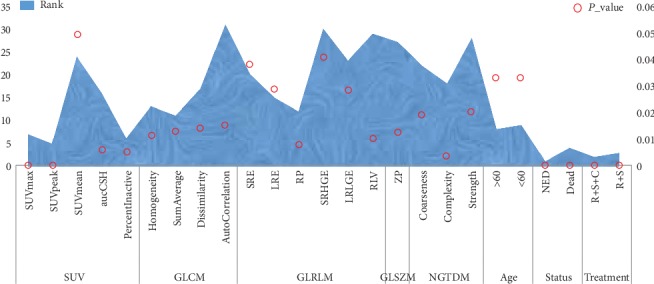
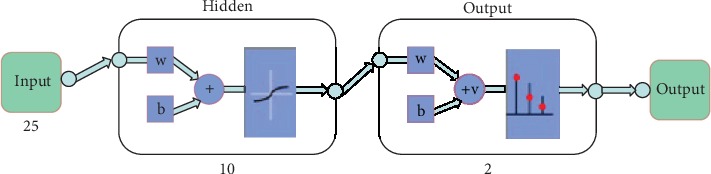
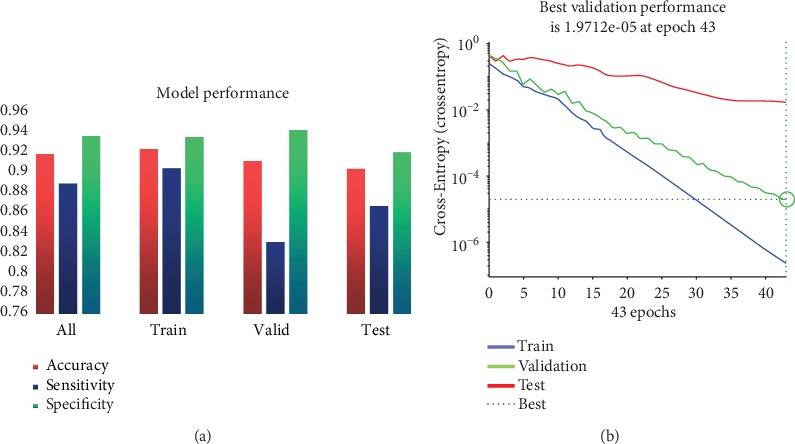
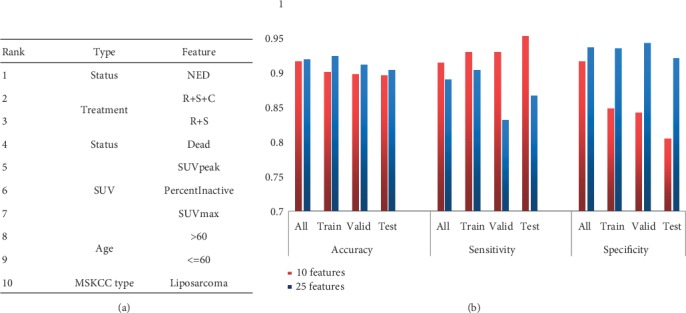
Extracting massive features from images to quantify tumors provides a new insight to solve the problem that tumor heterogeneity is difficult to assess quantitatively. However, quantification of tumors by single-mode methods often has defects such as difficulty in features extraction and high computational complexity. The multimodal approach has shown effective application prospects in solving these problems. In this paper, we propose a feature fusion method based on positron emission tomography (PET) images and clinical information, which is used to obtain features for lung metastasis prediction of soft tissue sarcomas (STSs). Random forest method was adopted to select effective features by eliminating irrelevant or redundant features, and then they were used for the prediction of the lung metastasis combined with back propagation (BP) neural network. The results show that the prediction ability of the proposed model using fusion features is better than that of the model using an image or clinical feature alone. Furthermore, a good performance can be obtained using 3 standard uptake value (SUV) features of PET image and 7 clinical features, and its average accuracy, sensitivity, and specificity on all the sets can reach 92%, 91%, and 92%, respectively. Therefore, the fusing features have the potential to predict lung metastasis for STSs.
从图像中提取大量特征来量化肿瘤,为解决肿瘤异质性难以定量评估的问题提供了新的思路。然而,单模态方法对肿瘤的定量往往存在特征提取困难、计算复杂度高等缺陷。多模态方法在解决这些问题方面表现出了有效的应用前景。本文提出了一种基于正电子发射断层扫描(PET)图像和临床信息的特征融合方法,用于获取软组织肉瘤(STS)肺转移预测的特征。采用随机森林方法通过消除不相关或冗余特征来选择有效特征,然后将其与反向传播(BP)神经网络结合进行肺转移预测。结果表明,使用融合特征的模型的预测能力优于仅使用图像或临床特征的模型。此外,使用 3 个 PET 图像标准摄取值(SUV)特征和 7 个临床特征可以获得良好的性能,在所有数据集上的平均准确率、敏感度和特异度分别可达 92%、91%和 92%。因此,融合特征有可能用于预测 STS 的肺转移。