de Almeida Arthur José Pontes Oliveira, de Almeida Rezende Mathania Silva, Dantas Sabine Helena, de Lima Silva Sonaly, de Oliveira Júlio César Pinheiro Lúcio, de Lourdes Assunção Araújo de Azevedo Fátima, Alves Rayanne Maira Felix Ribeiro, de Menezes Geovânia Maria Sales, Dos Santos Pablo Ferreira, Gonçalves Tays Amanda Felisberto, Schini-Kerth Valérie B, de Medeiros Isac Almeida
Departamento de Ciências Farmacêuticas/Centro de Ciências da Saúde, Universidade Federal da Paraíba, Cidade Universitária-Campus I, Caixa Postal 5009, 58.051-970 João Pessoa, PB, Brazil.
INSERM (French National Institute of Health and Medical Research), UMR 1260, Regenerative Nanomedicine, Faculty of Pharmacy, University of Strasbourg, 67000 Strasbourg, France.
Oxid Med Cell Longev. 2020 May 8;2020:1954398. doi: 10.1155/2020/1954398. eCollection 2020.
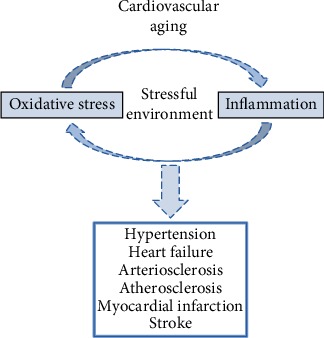
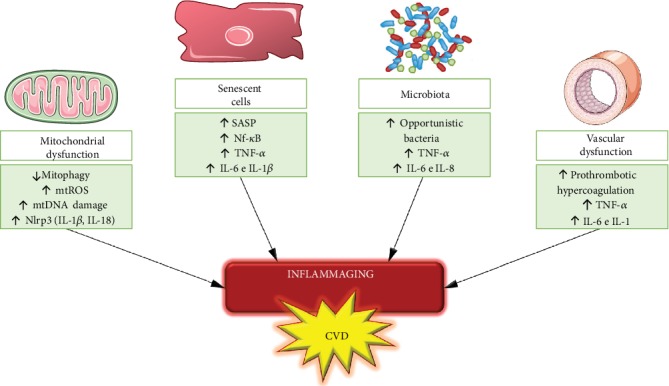
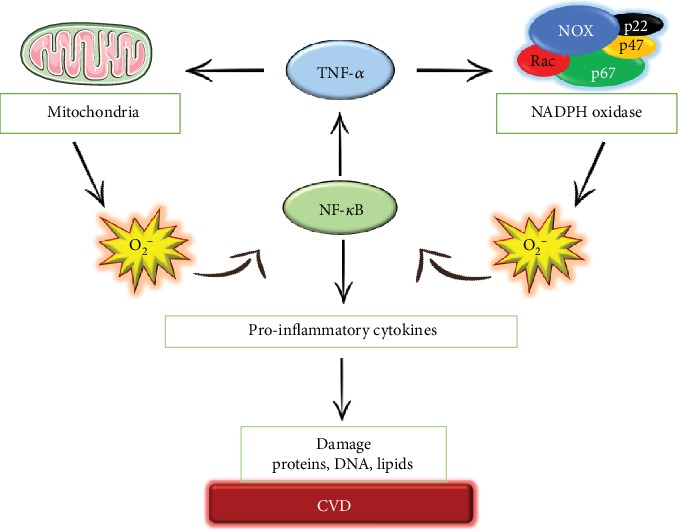
The global population above 60 years has been growing exponentially in the last decades, which is accompanied by an increase in the prevalence of age-related chronic diseases, highlighting cardiovascular diseases (CVDs), such as hypertension, atherosclerosis, and heart failure. Aging is the main risk factor for these diseases. Such susceptibility to disease is explained, at least in part, by the increase of oxidative stress, in which it damages cellular components such as proteins, DNA, and lipids. In addition, the chronic inflammatory process in aging "inflammaging" also contributes to cell damage, creating a stressful environment which drives to the development of CVDs. Taken together, it is possible to identify the molecular connection between oxidative stress and the inflammatory process, especially by the crosstalk between the transcription factors Nrf-2 and NF-B which are mediated by redox signalling and are involved in aging. Therapies that control this process are key targets in the prevention/combat of age-related CVDs. In this review, we show the basics of inflammation and oxidative stress, including the crosstalk between them, and the implications on age-related CVDs.
在过去几十年中,全球60岁以上的人口呈指数增长,与此同时,与年龄相关的慢性疾病患病率也在上升,其中突出的是心血管疾病,如高血压、动脉粥样硬化和心力衰竭。衰老是这些疾病的主要危险因素。这种对疾病的易感性至少部分是由氧化应激的增加所解释的,氧化应激会损害细胞成分,如蛋白质、DNA和脂质。此外,衰老过程中的慢性炎症过程“炎症衰老”也会导致细胞损伤,营造出一种促使心血管疾病发展的应激环境。综上所述,有可能确定氧化应激与炎症过程之间的分子联系,特别是通过转录因子Nrf-2和NF-κB之间的相互作用,它们由氧化还原信号介导并参与衰老过程。控制这一过程的疗法是预防/对抗与年龄相关的心血管疾病的关键靶点。在这篇综述中,我们展示了炎症和氧化应激的基础知识,包括它们之间的相互作用,以及对与年龄相关的心血管疾病的影响。