• 文献检索
  • 文档翻译
  • 深度研究
  • 学术资讯
  • Suppr Zotero 插件Zotero 插件
  • 邀请有礼
  • 套餐&价格
  • 历史记录
应用&插件
Suppr Zotero 插件Zotero 插件浏览器插件Mac 客户端Windows 客户端微信小程序
定价
高级版会员购买积分包购买API积分包
服务
文献检索文档翻译深度研究API 文档MCP 服务
关于我们
关于 Suppr公司介绍联系我们用户协议隐私条款
关注我们

Suppr 超能文献

核心技术专利:CN118964589B侵权必究
粤ICP备2023148730 号-1Suppr @ 2026

文献检索

告别复杂PubMed语法,用中文像聊天一样搜索,搜遍4000万医学文献。AI智能推荐,让科研检索更轻松。

立即免费搜索

文件翻译

保留排版,准确专业,支持PDF/Word/PPT等文件格式,支持 12+语言互译。

免费翻译文档

深度研究

AI帮你快速写综述,25分钟生成高质量综述,智能提取关键信息,辅助科研写作。

立即免费体验

估算中国 COVID-19 疫情的时变基本再生数。

Estimation of the time-varying reproduction number of COVID-19 outbreak in China.

机构信息

Beijing International Center for Mathematical Research, Peking University, China.

School of Mathematical Sciences, Peking University, China.

出版信息

Int J Hyg Environ Health. 2020 Jul;228:113555. doi: 10.1016/j.ijheh.2020.113555. Epub 2020 May 11.

DOI:10.1016/j.ijheh.2020.113555
PMID:32460229
原文链接:https://pmc.ncbi.nlm.nih.gov/articles/PMC7211652/
Abstract

BACKGROUND

The 2019 novel coronavirus (COVID-19) outbreak in Wuhan, China has attracted world-wide attention. As of March 31, 2020, a total of 82,631 cases of COVID-19 in China were confirmed by the National Health Commission (NHC) of China.

METHODS

Three approaches, namely Poisson likelihood-based method (ML), exponential growth rate-based method (EGR) and stochastic Susceptible-Infected-Removed dynamic model-based method (SIR), were implemented to estimate the basic and controlled reproduction numbers.

RESULTS

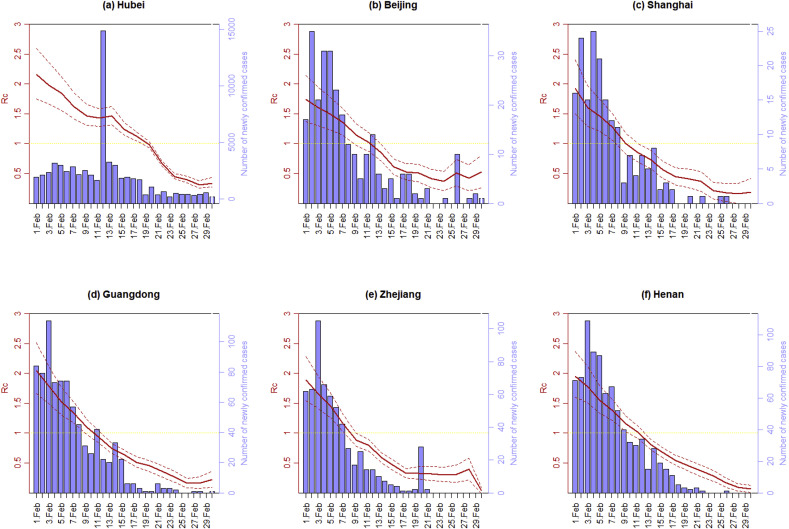
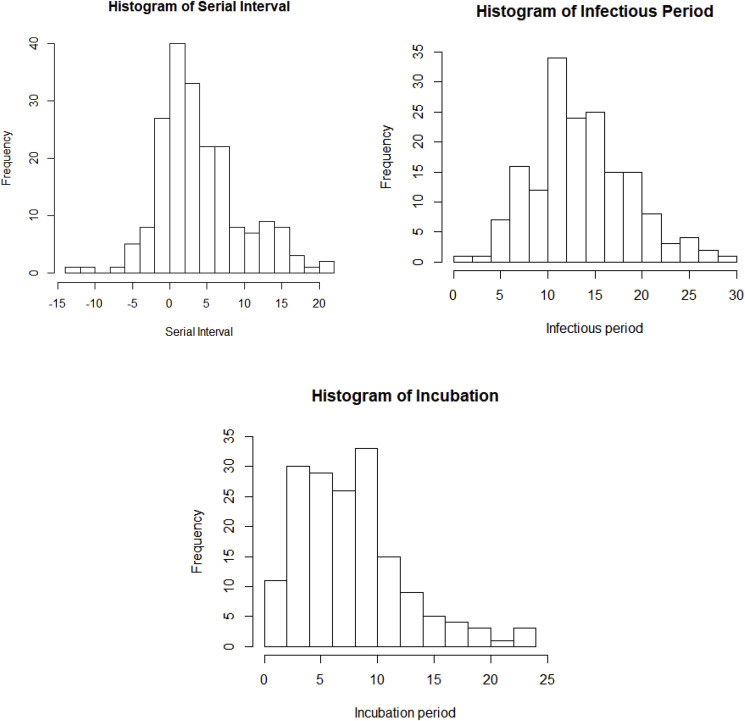
A total of 198 chains of transmission together with dates of symptoms onset and 139 dates of infections were identified among 14,829 confirmed cases outside Hubei Province as reported as of March 31, 2020. Based on this information, we found that the serial interval had an average of 4.60 days with a standard deviation of 5.55 days, the incubation period had an average of 8.00 days with a standard deviation of 4.75 days and the infectious period had an average of 13.96 days with a standard deviation of 5.20 days. The estimated controlled reproduction numbers, R, produced by all three methods in all analyzed regions of China are significantly smaller compared with the basic reproduction numbers R.

CONCLUSIONS

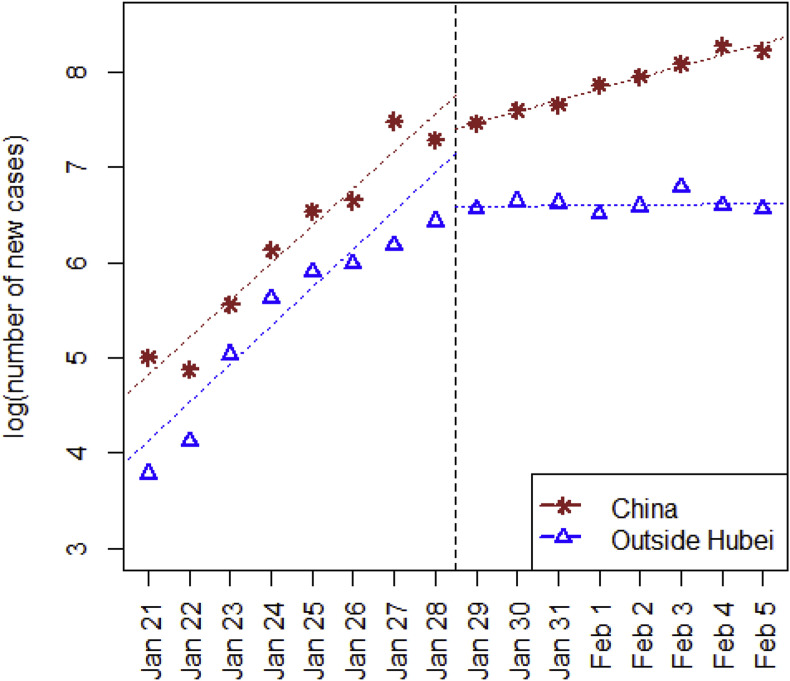
The controlled reproduction number in China is much lower than one in all regions of China by now. It fell below one within 30 days from the implementations of unprecedent containment measures, which indicates that the strong measures taken by China government was effective to contain the epidemic. Nonetheless, efforts are still needed in order to end the current epidemic as imported cases from overseas pose a high risk of a second outbreak.

摘要

背景

中国武汉发生的 2019 年新型冠状病毒(COVID-19)疫情引起了全球关注。截至 2020 年 3 月 31 日,中国国家卫生健康委员会(NHC)共确诊 COVID-19 病例 82631 例。

方法

采用泊松似然法(ML)、指数增长率法(EGR)和随机易感感染清除动力学模型法(SIR)三种方法估计基本和控制繁殖数。

结果

截至 2020 年 3 月 31 日,共报告了 14829 例湖北省以外确诊病例,其中共发现 198 条传播链,以及症状发作日期和 139 例感染日期。基于这些信息,我们发现序列间隔的平均值为 4.60 天,标准差为 5.55 天,潜伏期的平均值为 8.00 天,标准差为 4.75 天,传染期的平均值为 13.96 天,标准差为 5.20 天。所有三种方法在分析的中国所有地区的估计控制繁殖数 R 均明显小于基本繁殖数 R。

结论

到目前为止,中国的控制繁殖数在所有地区都远低于 1。从采取前所未有的遏制措施之日起 30 天内,该数就降至 1 以下,这表明中国政府采取的有力措施有效地遏制了疫情。尽管如此,由于从海外输入的病例带来了二次爆发的高风险,仍需努力以结束当前的疫情。
https://cdn.ncbi.nlm.nih.gov/pmc/blobs/9e79/7211652/90b34966a646/gr3_lrg.jpg
https://cdn.ncbi.nlm.nih.gov/pmc/blobs/9e79/7211652/722892a56a61/gr1_lrg.jpg
https://cdn.ncbi.nlm.nih.gov/pmc/blobs/9e79/7211652/2d9446829eac/gr2_lrg.jpg
https://cdn.ncbi.nlm.nih.gov/pmc/blobs/9e79/7211652/90b34966a646/gr3_lrg.jpg
https://cdn.ncbi.nlm.nih.gov/pmc/blobs/9e79/7211652/722892a56a61/gr1_lrg.jpg
https://cdn.ncbi.nlm.nih.gov/pmc/blobs/9e79/7211652/2d9446829eac/gr2_lrg.jpg
https://cdn.ncbi.nlm.nih.gov/pmc/blobs/9e79/7211652/90b34966a646/gr3_lrg.jpg

相似文献

1
Estimation of the time-varying reproduction number of COVID-19 outbreak in China.估算中国 COVID-19 疫情的时变基本再生数。
Int J Hyg Environ Health. 2020 Jul;228:113555. doi: 10.1016/j.ijheh.2020.113555. Epub 2020 May 11.
2
Basic reproduction number and predicted trends of coronavirus disease 2019 epidemic in the mainland of China.基本再生数和中国大陆 2019 冠状病毒病流行趋势预测。
Infect Dis Poverty. 2020 Jul 16;9(1):94. doi: 10.1186/s40249-020-00704-4.
3
Risk estimation and prediction of the transmission of coronavirus disease-2019 (COVID-19) in the mainland of China excluding Hubei province.中国大陆(不含湖北省) 2019 年冠状病毒病(COVID-19)传播的风险估计和预测。
Infect Dis Poverty. 2020 Aug 24;9(1):116. doi: 10.1186/s40249-020-00683-6.
4
Estimation of exponential growth rate and basic reproduction number of the coronavirus disease 2019 (COVID-19) in Africa.估算 2019 年冠状病毒病(COVID-19)在非洲的指数增长率和基本繁殖数。
Infect Dis Poverty. 2020 Jul 16;9(1):96. doi: 10.1186/s40249-020-00718-y.
5
Covid-19 Outbreak Progression in Italian Regions: Approaching the Peak by the End of March in Northern Italy and First Week of April in Southern Italy.意大利各地区的新冠疫情进展:北部地区将于 3 月底达到高峰,南部地区将于 4 月初达到高峰。
Int J Environ Res Public Health. 2020 Apr 27;17(9):3025. doi: 10.3390/ijerph17093025.
6
Data-based analysis, modelling and forecasting of the COVID-19 outbreak.基于数据的 COVID-19 疫情分析、建模和预测。
PLoS One. 2020 Mar 31;15(3):e0230405. doi: 10.1371/journal.pone.0230405. eCollection 2020.
7
Evolving epidemiology and transmission dynamics of coronavirus disease 2019 outside Hubei province, China: a descriptive and modelling study.中国湖北省以外地区 2019 年冠状病毒病的流行病学和传播动态演变:描述性和建模研究。
Lancet Infect Dis. 2020 Jul;20(7):793-802. doi: 10.1016/S1473-3099(20)30230-9. Epub 2020 Apr 2.
8
[Estimating the basic reproduction number of COVID-19 in Wuhan, China].[估算中国武汉新冠病毒病的基本再生数]
Zhonghua Liu Xing Bing Xue Za Zhi. 2020 Apr 10;41(4):476-479. doi: 10.3760/cma.j.cn112338-20200210-00086.
9
[Study on assessing early epidemiological parameters of COVID-19 epidemic in China].[中国新冠疫情早期流行病学参数评估研究]
Zhonghua Liu Xing Bing Xue Za Zhi. 2020 Apr 10;41(4):461-465. doi: 10.3760/cma.j.cn112338-20200205-00069.
10
Risk estimation of the SARS-CoV-2 acute respiratory disease outbreak outside China.中国境外新型冠状病毒急性呼吸道疾病爆发的风险评估
Theor Biol Med Model. 2020 Jun 5;17(1):9. doi: 10.1186/s12976-020-00127-6.

引用本文的文献

1
Impact of non-pharmacological interventions on incidence of hand, foot and mouth disease during the COVID-19 pandemic: a large population-based observational study.非药物干预对 COVID-19 大流行期间手足口病发病率的影响:一项基于人群的大型观察性研究。
BMC Infect Dis. 2024 Nov 27;24(1):1353. doi: 10.1186/s12879-024-10252-z.
2
Basic Reproduction Number (R0), Doubling Time, and Daily Growth Rate of the COVID-19 Epidemic: An Echological Study.新型冠状病毒肺炎疫情的基本繁殖数(R0)、倍增时间和每日增长率:一项生态学研究
Arch Acad Emerg Med. 2024 Sep 5;12(1):e66. doi: 10.22037/aaem.v12i1.2376. eCollection 2024.
3
Retrospective estimation of the time-varying effective reproduction number for a COVID-19 outbreak in Shenyang, China: An observational study.

本文引用的文献

1
Protocol for Prevention and Control of COVID-19 (Edition 6).新型冠状病毒肺炎防控方案(第六版)
China CDC Wkly. 2020 May 8;2(19):321-326. doi: 10.46234/ccdcw2020.082.
2
Temporal dynamics in viral shedding and transmissibility of COVID-19.新冠病毒脱落和传播的时间动态。
Nat Med. 2020 May;26(5):672-675. doi: 10.1038/s41591-020-0869-5. Epub 2020 Apr 15.
3
An updated estimation of the risk of transmission of the novel coronavirus (2019-nCov).新型冠状病毒(2019-nCov)传播风险的最新评估。
回顾性估计中国沈阳 COVID-19 疫情的时变有效繁殖数:一项观察性研究。
Medicine (Baltimore). 2024 May 31;103(22):e38373. doi: 10.1097/MD.0000000000038373.
4
Analysis of the impact of COVID-19 variants and vaccination on the time-varying reproduction number: statistical methods.分析 COVID-19 变异株和疫苗接种对时变繁殖数的影响:统计方法。
Front Public Health. 2024 Jul 3;12:1353441. doi: 10.3389/fpubh.2024.1353441. eCollection 2024.
5
SARS-CoV-2 Transmission in Alberta, British Columbia, and Ontario, Canada, January 2020-January 2022.2020 年 1 月至 2022 年 1 月期间加拿大艾伯塔省、不列颠哥伦比亚省和安大略省的 SARS-CoV-2 传播情况。
Emerg Infect Dis. 2024 May;30(5):956-967. doi: 10.3201/eid3005.230482.
6
How robust are estimates of key parameters in standard viral dynamic models?标准病毒动力学模型中关键参数估计的稳健性如何?
PLoS Comput Biol. 2024 Apr 16;20(4):e1011437. doi: 10.1371/journal.pcbi.1011437. eCollection 2024 Apr.
7
Transmission characteristics and inactivated vaccine effectiveness against transmission of the SARS-CoV-2 Omicron BA.2 variant in Shenzhen, China.中国深圳 SARS-CoV-2 奥密克戎 BA.2 变异株传播特性和灭活疫苗对传播的有效性。
Front Immunol. 2024 Jan 8;14:1290279. doi: 10.3389/fimmu.2023.1290279. eCollection 2023.
8
Symptom prevalence and secondary attack rate of SARS-CoV-2 in rural Kenyan households: A prospective cohort study.肯尼亚农村家庭中 SARS-CoV-2 的症状流行率和二次感染率:一项前瞻性队列研究。
Influenza Other Respir Viruses. 2023 Sep;17(9):e13185. doi: 10.1111/irv.13185.
9
A computational approach to identifiability analysis for a model of the propagation and control of COVID-19 in Chile.一种用于分析智利 COVID-19 传播和控制模型可识别性的计算方法。
J Biol Dyn. 2023 Dec;17(1):2256774. doi: 10.1080/17513758.2023.2256774.
10
Incidence rate drive the multiple wave in the COVID-19 pandemic.发病率推动了新冠疫情中的多波疫情。
MethodsX. 2023 Aug 6;11:102317. doi: 10.1016/j.mex.2023.102317. eCollection 2023 Dec.
Infect Dis Model. 2020 Feb 11;5:248-255. doi: 10.1016/j.idm.2020.02.001. eCollection 2020.
4
Estimation of the Transmission Risk of the 2019-nCoV and Its Implication for Public Health Interventions.2019新型冠状病毒传播风险评估及其对公共卫生干预措施的启示
J Clin Med. 2020 Feb 7;9(2):462. doi: 10.3390/jcm9020462.
5
Nowcasting and forecasting the potential domestic and international spread of the 2019-nCoV outbreak originating in Wuhan, China: a modelling study.实时预测和预报源自中国武汉的 2019-nCoV 疫情在国内和国际的潜在传播:一项建模研究。
Lancet. 2020 Feb 29;395(10225):689-697. doi: 10.1016/S0140-6736(20)30260-9. Epub 2020 Jan 31.
6
Transmission of 2019-nCoV Infection from an Asymptomatic Contact in Germany.德国一名无症状接触者传播2019新型冠状病毒感染
N Engl J Med. 2020 Mar 5;382(10):970-971. doi: 10.1056/NEJMc2001468. Epub 2020 Jan 30.
7
Early Transmission Dynamics in Wuhan, China, of Novel Coronavirus-Infected Pneumonia.新型冠状病毒感染肺炎在中国武汉的早期传播动力学。
N Engl J Med. 2020 Mar 26;382(13):1199-1207. doi: 10.1056/NEJMoa2001316. Epub 2020 Jan 29.
8
Clinical features of patients infected with 2019 novel coronavirus in Wuhan, China.中国武汉地区 2019 年新型冠状病毒感染患者的临床特征。
Lancet. 2020 Feb 15;395(10223):497-506. doi: 10.1016/S0140-6736(20)30183-5. Epub 2020 Jan 24.
9
A novel coronavirus outbreak of global health concern.一场引发全球卫生关注的新型冠状病毒疫情。
Lancet. 2020 Feb 15;395(10223):470-473. doi: 10.1016/S0140-6736(20)30185-9. Epub 2020 Jan 24.
10
Comparison of methods to Estimate Basic Reproduction Number ( ) of influenza, Using Canada 2009 and 2017-18 A (H1N1) Data.使用2009年加拿大及2017 - 18年甲型(H1N1)流感数据对估算流感基本再生数( )方法的比较
J Res Med Sci. 2019 Jul 24;24:67. doi: 10.4103/jrms.JRMS_888_18. eCollection 2019.