Zucchi Benedetta, Mangone Massimiliano, Agostini Francesco, Paoloni Marco, Petriello Luisa, Bernetti Andrea, Santilli Valter, Villani Ciro
Department of Anatomy, Histology, Forensic Medicine and Orthopedics, Sapienza University, Rome, Italy.
Biores Open Access. 2020 May 21;9(1):151-161. doi: 10.1089/biores.2019.0035. eCollection 2020.
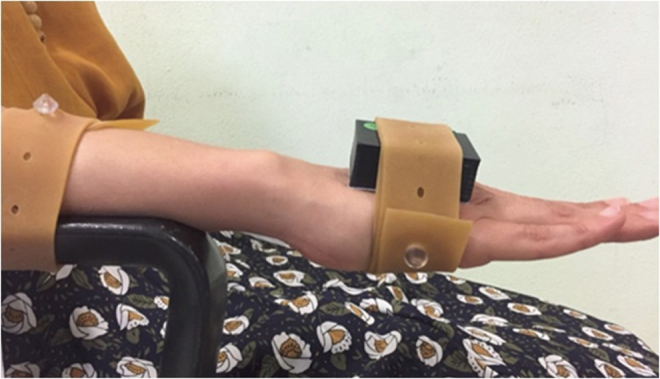
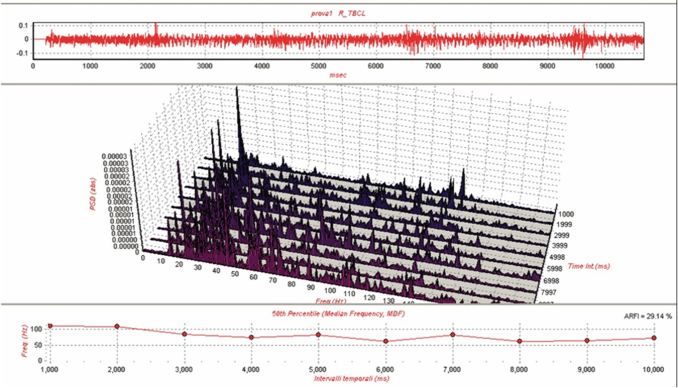
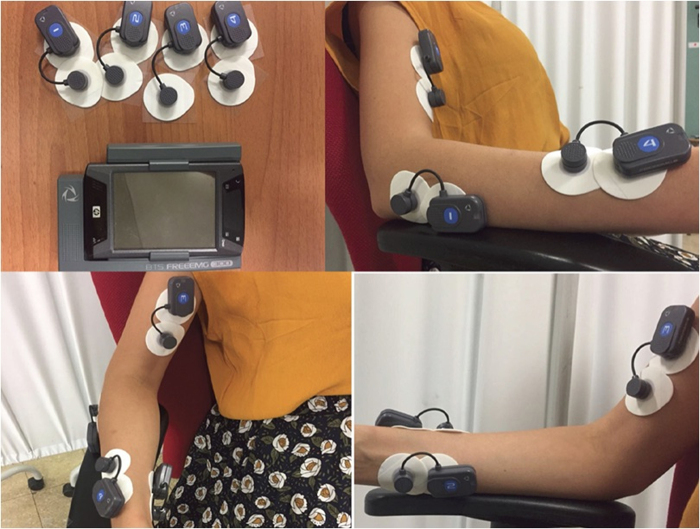
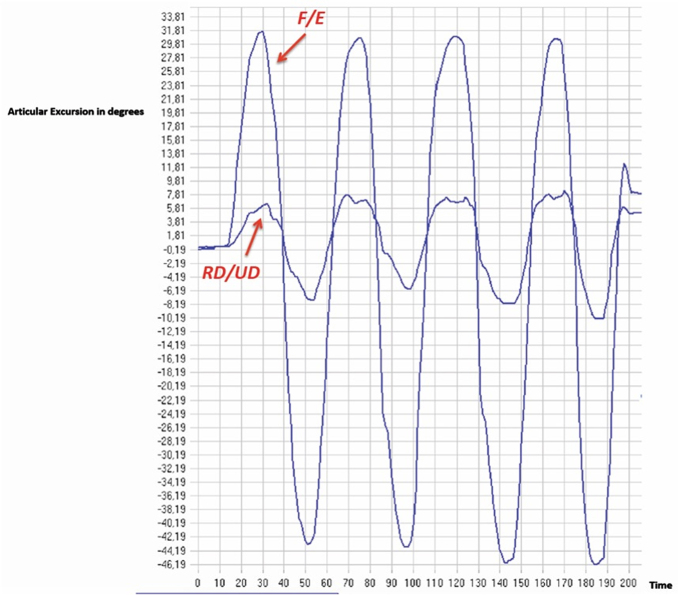
Inertial measurement unit (IMU) has recently been used to evaluate a movement of a body segment to provide accurate information of movement's characteristics. IMU systems have been validated to successfully measure joint angle during upper limb range of motion (ROM). The study aimed to retrospectively evaluate, using an IMU, the ROM recovery of the wrist after surgical treatment for distal-radius fractures with Kirschner wire fixation (KWF) or with volar plate fixation (VPF) and screws. To assess pain in the wrist joint, muscle-fatigue (MF), and functional difficulties in activities of daily living, we evaluated the patients through patient-related wrist evaluation questionnaire (PRWE) scale, disability of the arm, shoulder and hand (DASH) scale, Hand Grip Strength (HGS), and surface electromyography (EMG). We used a single IMU composed of three-axis gyroscope, a three-axis accelerometer, and a magnetometer. We calculated the value of ROM as a percentage with respect to the unaffected wrist. We also recorded surface-EMG signals over biceps brachialis, flexor carpi radialis (FCR), extensor carpi radialis (ECR), and pronator teres muscles. Forty patients were recruited for our study. Ulnar deviation (UD) was significantly higher for VPF than for KWF ( = 0.017); supination was significantly higher for VPF than for KWF ( = 0.031). The percentage of decay of the median frequency of FCR of volar plate was significantly higher than KWF. The HGS of KWF was significantly higher than VPF. In literature, there were no significant differences between the two types of treatment at long-term follow-up. Our results demonstrate a superior efficacy of VPF in terms of ROM improvement in UD and supination, but for these patients, muscle fatigue is greater than the KWF group. Based on the data available, VPF is similar to KWF for the treatment of distal radius fractures. The IMU sensor could be used in the future to evaluate ROM after surgery during patient's rehabilitation and to compare the effects with stratified analysis regarding age and fracture type, paralleled with cost-effectiveness analysis.
惯性测量单元(IMU)最近被用于评估身体节段的运动,以提供运动特征的准确信息。IMU系统已被验证可成功测量上肢运动范围(ROM)期间的关节角度。本研究旨在使用IMU回顾性评估采用克氏针固定(KWF)或掌侧钢板固定(VPF)及螺钉治疗桡骨远端骨折后手腕的ROM恢复情况。为了评估腕关节疼痛、肌肉疲劳(MF)和日常生活活动中的功能困难,我们通过患者相关腕关节评估问卷(PRWE)量表、手臂、肩部和手部功能障碍(DASH)量表、握力(HGS)和表面肌电图(EMG)对患者进行了评估。我们使用了一个由三轴陀螺仪、三轴加速度计和磁力计组成的单一IMU。我们计算了ROM相对于未受影响手腕的百分比值。我们还记录了肱二头肌、桡侧腕屈肌(FCR)、桡侧腕伸肌(ECR)和旋前圆肌的表面EMG信号。40名患者被纳入我们的研究。VPF组的尺偏(UD)明显高于KWF组(=0.017);VPF组的旋后明显高于KWF组(=0.031)。掌侧钢板组FCR中位频率的衰减百分比明显高于KWF组。KWF组的HGS明显高于VPF组。在文献中,两种治疗方法在长期随访中没有显著差异。我们的结果表明,VPF在改善UD和旋后ROM方面具有更好的疗效,但对于这些患者,肌肉疲劳大于KWF组。根据现有数据,VPF在治疗桡骨远端骨折方面与KWF相似。未来,IMU传感器可用于评估患者康复期间手术后的ROM,并与年龄和骨折类型的分层分析效果进行比较,同时进行成本效益分析。