Safieddine Batoul, Sperlich Stefanie, Beller Johannes, Lange Karin, Epping Jelena, Tetzlaff Juliane, Tetzlaff Fabian, Geyer Siegfried
Medical Sociology Unit OE 5420, Hannover Medical School, Carl-Neuberg-Str. 1, 30625, Hannover, Germany.
Medical Psychology Unit OE 5430, Hannover Medical School, Carl-Neuberg-Str. 1, 30625, Hannover, Germany.
SSM Popul Health. 2020 May 11;11:100596. doi: 10.1016/j.ssmph.2020.100596. eCollection 2020 Aug.
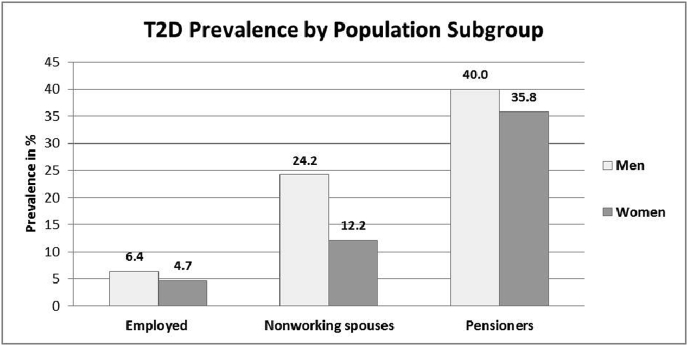
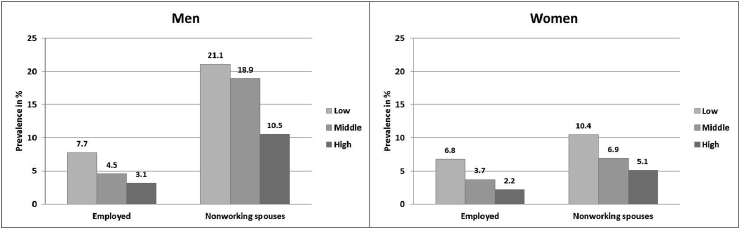
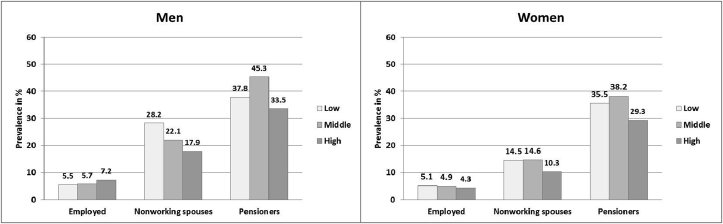
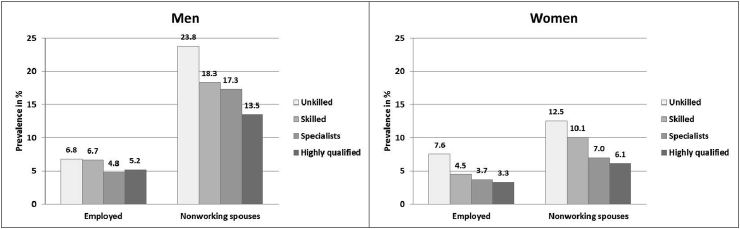
Type 2 diabetes (T2D) is a rising global epidemic with lower socioeconomic groups being more affected. Considering specific population subgroups to examine prevalence and socioeconomic inequalities in T2D is rare. Moreover, using one indicator to depict socioeconomic inequalities in health is a common practice despite evidence on differences in what different socioeconomic indicators ought to measure. This study has two aims: 1. Examine the prevalence of T2D in employed individuals, nonworking spouses and pensioners. 2. Examine socioeconomic inequalities in T2D in the three population subgroups and determine the explanatory power of income, education and occupation in employed individuals and nonworking spouses. This study is based on claims data from a statutory health insurance provider in Lower Saxony, Germany. T2D prevalence in the period between 2013 and 2017 was examined in employed individuals, nonworking spouses and pensioners. Multivariate logistic regression analysis was applied to examine socioeconomic inequalities in T2D in the three population subgroups. Explanatory power of the three socioeconomic indicators was determined by deviance analysis. Results showed that T2D prevalence was four times higher in male nonworking spouses (24.2%) and 2.6 times higher in female nonworking spouses (12.7%) compared to employed men (6.4%) and women (4.7%) respectively, while it accounted for 40% of men and 36% of women in pensioners. T2D inequalities emerged for all three socioeconomic indicators and were observed in the three subgroups. School education had the highest explanatory power in employed men and women and male nonworking spouses. Nonworking spouses are an important target group in T2D prevention interventions. The three socioeconomic indicators have independent effects and differ in their explanatory power where low school education appears to be a major risk factor. It can be discussed that health literacy and the associated health behavior play a role in mediating the association between school education and T2D.
2型糖尿病(T2D)在全球范围内呈上升趋势,社会经济地位较低的群体受影响更大。考虑特定人群亚组来研究T2D的患病率和社会经济不平等情况的研究很少。此外,尽管有证据表明不同的社会经济指标在衡量内容上存在差异,但使用单一指标来描述健康方面的社会经济不平等却是常见做法。本研究有两个目的:1. 调查在职人员、无工作配偶和退休人员中T2D的患病率。2. 研究这三个人口亚组中T2D的社会经济不平等情况,并确定在职人员和无工作配偶中收入、教育和职业的解释力。本研究基于德国下萨克森州一家法定健康保险提供商的理赔数据。对2013年至2017年期间在职人员、无工作配偶和退休人员的T2D患病率进行了调查。应用多变量逻辑回归分析来研究这三个人口亚组中T2D的社会经济不平等情况。通过偏差分析确定这三个社会经济指标的解释力。结果显示,男性无工作配偶的T2D患病率(24.2%)分别是在职男性(6.4%)的四倍,女性无工作配偶的T2D患病率(12.7%)是在职女性(4.7%)的2.6倍,而在退休人员中,男性占40%,女性占36%。所有三个社会经济指标都出现了T2D不平等情况,并在这三个亚组中都有观察到。学校教育在在职男性和女性以及男性无工作配偶中具有最高的解释力。无工作配偶是T2D预防干预的重要目标群体。这三个社会经济指标具有独立影响,且解释力不同,其中低学校教育似乎是一个主要风险因素。可以讨论的是,健康素养和相关的健康行为在调节学校教育与T2D之间的关联中发挥了作用。