Department of Hepatobiliary Surgery, Lishui Municipal Central Hospital, Zhejiang, China.
Department of Hepatobiliary and Pancreas Minimally Invasive Surgery, Zhejiang Provincial People's Hospital, Zhejiang, China.
Biosci Rep. 2020 Jul 31;40(7). doi: 10.1042/BSR20194026.
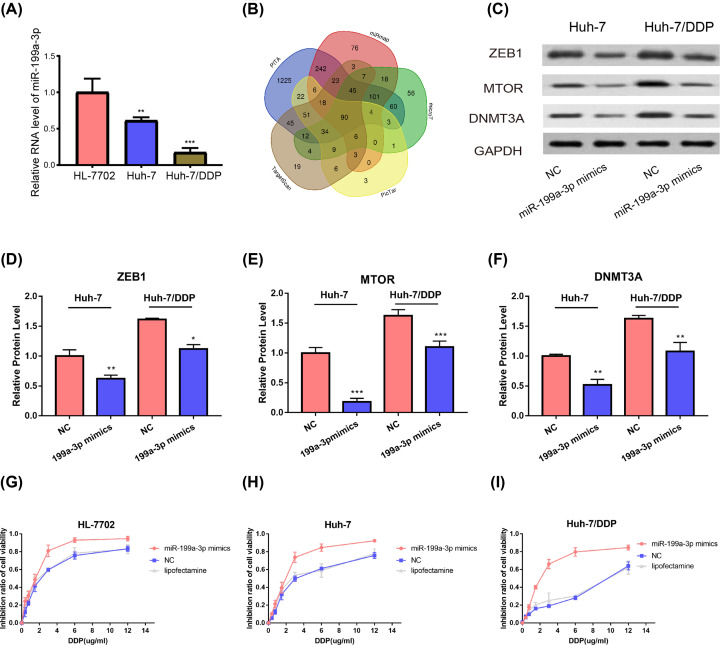
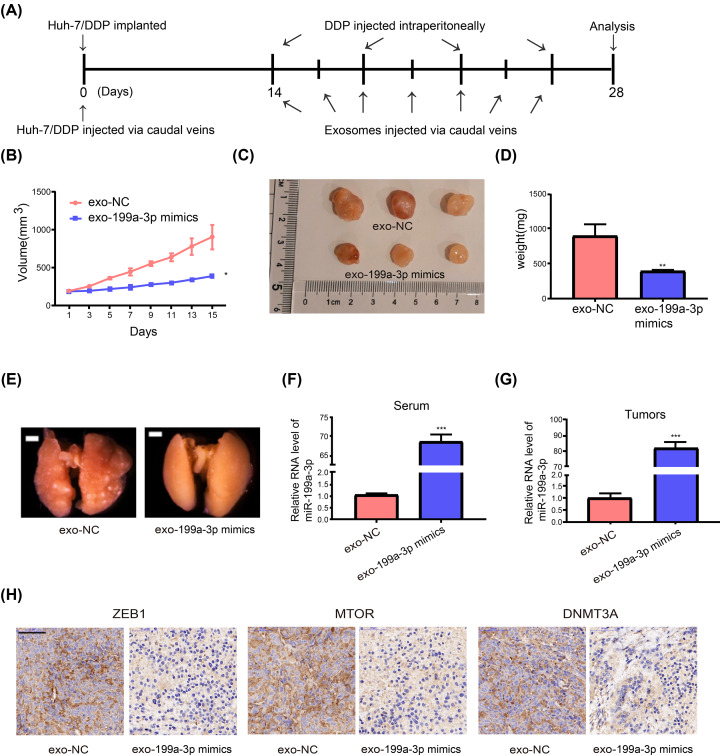
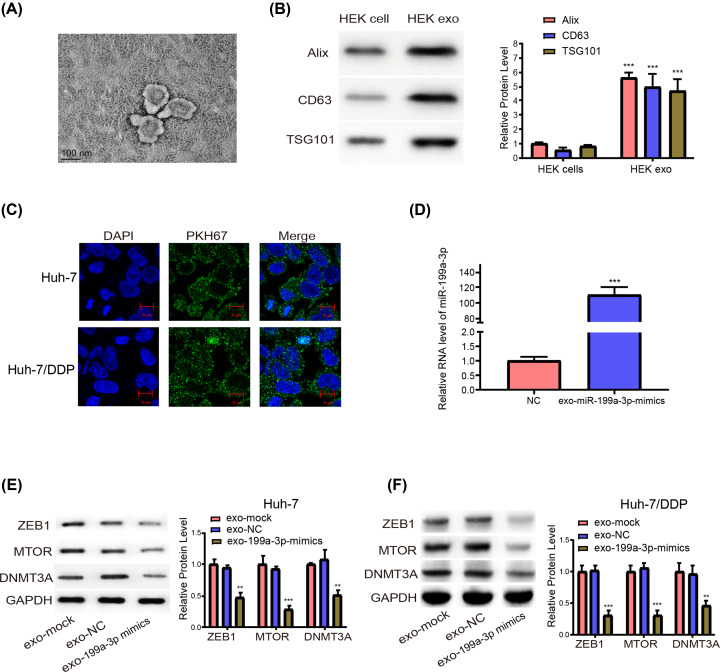
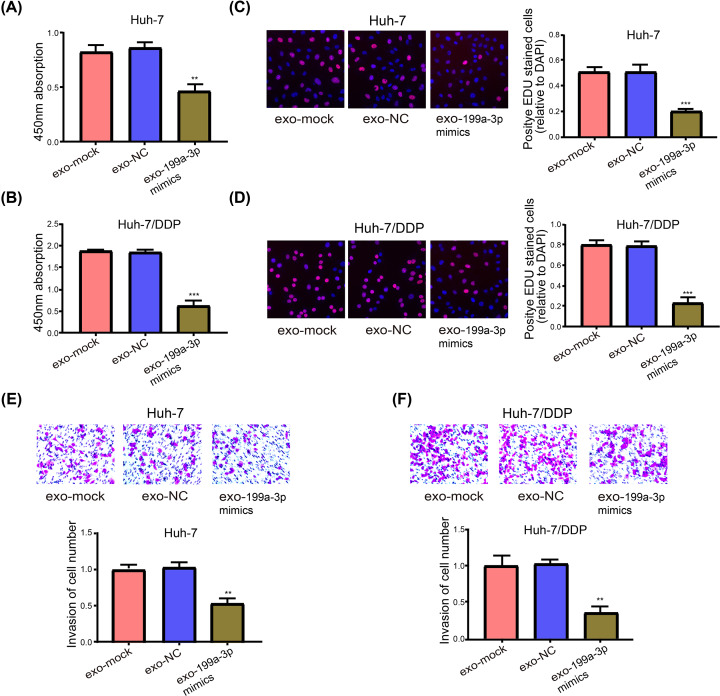
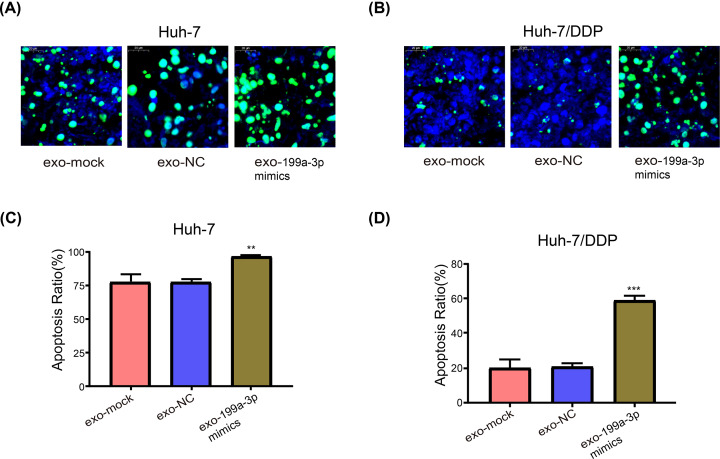
Hepatocellular carcinoma (HCC) is a frequently seen malignant tumor globally. The occurrence of cisplatin (DDP) resistance is one of the main reasons for the high mortality of HCC patients. Therefore, it is of great theoretical significance and application value to explore the mechanism of chemotherapy resistance. Drug resistance can be modulated by exosomes containing mRNAs, micro RNAs (miRNAs) and other non-coding RNA (ncRNAs). Exosomal miR-199a-3p (Exo-miR-199a-3p) was subjected to extraction and verification. Whether exo-miR-199a-3p could make HCC cells sensitive to DDP in vitro was verified via flow cytometry, Cell Counting Kit-8 (CCK-8) assay, immunofluorescence assay and Transwell assay. Intravenous injection of exo-miR-199a-3p and intraperitoneal injection of DDP were carried out in vivo. Moreover, the possible targets of miR-199a-3p were screened through bioinformatics analysis, which were ascertained by Western blotting (WB). Then, miR-199a-3p levels in human normal liver epithelial cell line HL-7702 and HCC cell lines HuH7 and HuH7/DDP were elevated in a concentration-dependent manner. Exo-miR-199a-3p has abilities to adjust underlying targets and conjugate cells, to repress cells to invade, stimulate their apoptosis and abate their ability. Additionally, the caudal injection of exo-miR-199a-3p reversed the chemoresistance of tumors and slowed down their growth in the body owing to the up-regulation of miR-199a-3p and down-regulation of underlying target proteins in tumors. Finally, exo-miR-199a-3p was found to overturn the HCC's resistance to DDP, and it may function in DDP-refractory HCC therapy as an underlying option in the future.
肝细胞癌(HCC)是全球常见的恶性肿瘤。顺铂(DDP)耐药的发生是 HCC 患者高死亡率的主要原因之一。因此,探讨化疗耐药的机制具有重要的理论意义和应用价值。外泌体中包含的 mRNAs、microRNAs(miRNAs)和其他非编码 RNA(ncRNAs)可调节药物耐药性。提取并验证了外泌体 miR-199a-3p(Exo-miR-199a-3p)。通过流式细胞术、Cell Counting Kit-8(CCK-8)检测、免疫荧光检测和 Transwell 检测验证了 Exo-miR-199a-3p 是否可以使 HCC 细胞在体外对 DDP 敏感。体内进行 Exo-miR-199a-3p 静脉注射和 DDP 腹腔注射。此外,通过生物信息学分析筛选 miR-199a-3p 的可能靶标,并用 Western blot(WB)进行验证。然后,miR-199a-3p 水平在人正常肝上皮细胞系 HL-7702 和 HCC 细胞系 HuH7 和 HuH7/DDP 中呈浓度依赖性升高。Exo-miR-199a-3p 具有调节靶基因和细胞结合、抑制细胞侵袭、刺激细胞凋亡和减弱细胞侵袭能力的能力。此外,尾静脉注射 Exo-miR-199a-3p 由于肿瘤中 miR-199a-3p 的上调和靶蛋白的下调,逆转了肿瘤的耐药性并减缓了其在体内的生长。最后,发现 Exo-miR-199a-3p 逆转了 HCC 对 DDP 的耐药性,它可能作为未来 DDP 耐药 HCC 治疗的一种潜在选择。