Hubrecht Institute-Royal Netherlands Academy of Arts and Sciences and University Medical Center Utrecht, Uppsalalaan 8, 3584 CT, Utrecht, the Netherlands.
Department of Nephrology and Hypertension, University Medical Center Utrecht, Heidelberglaan 100, 3584 CX, Utrecht, the Netherlands.
Cells. 2020 May 26;9(6):1326. doi: 10.3390/cells9061326.
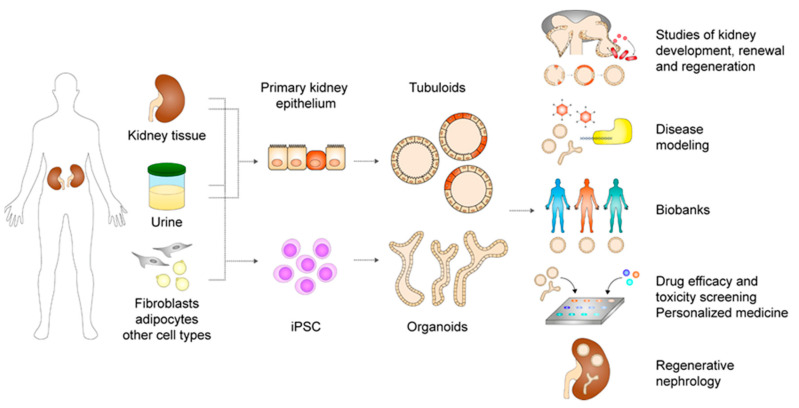
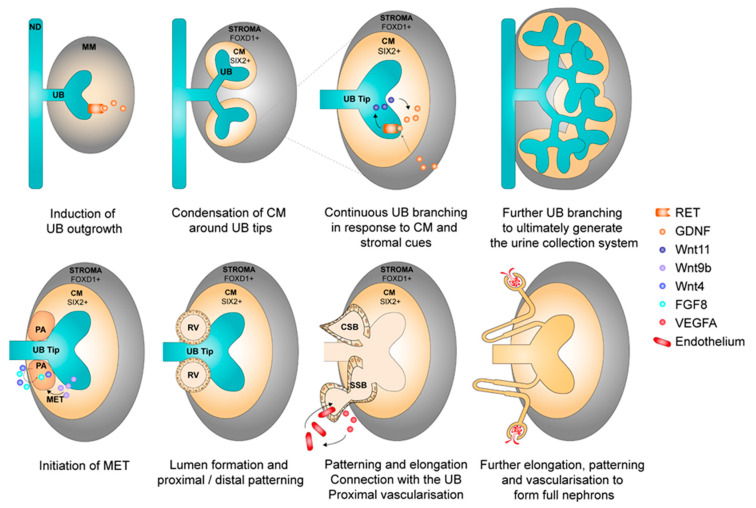
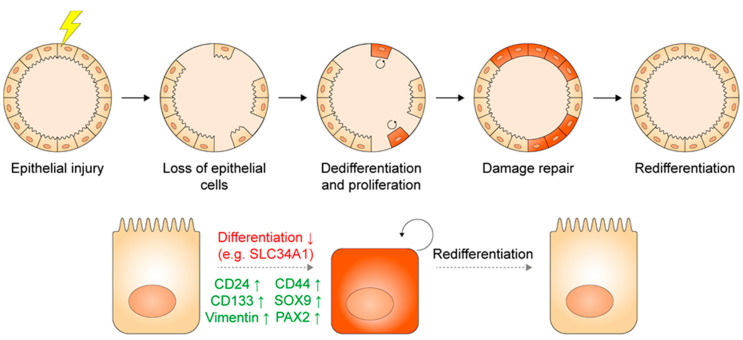
In the past five years, pluripotent stem cell (PSC)-derived kidney organoids and adult stem or progenitor cell (ASC)-based kidney tubuloids have emerged as advanced in vitro models of kidney development, physiology, and disease. PSC-derived organoids mimic nephrogenesis. After differentiation towards the kidney precursor tissues ureteric bud and metanephric mesenchyme, their reciprocal interaction causes self-organization and patterning in vitro to generate nephron structures that resemble the fetal kidney. ASC tubuloids on the other hand recapitulate renewal and repair in the adult kidney tubule and give rise to long-term expandable and genetically stable cultures that consist of adult proximal tubule, loop of Henle, distal tubule, and collecting duct epithelium. Both organoid types hold great potential for: (1) studies of kidney physiology, (2) disease modeling, (3) high-throughput screening for drug efficacy and toxicity, and (4) regenerative medicine. Currently, organoids and tubuloids are successfully used to model hereditary, infectious, toxic, metabolic, and malignant kidney diseases and to screen for effective therapies. Furthermore, a tumor tubuloid biobank was established, which allows studies of pathogenic mutations and novel drug targets in a large group of patients. In this review, we discuss the nature of kidney organoids and tubuloids and their current and future applications in science and medicine.
在过去五年中,多能干细胞(PSC)衍生的肾类器官和成人干细胞或祖细胞(ASC)衍生的肾小管类器官已成为肾脏发育、生理学和疾病的先进体外模型。PSC 衍生的类器官模拟了肾发生。在向输尿管芽和后肾间充质等肾脏前体组织分化后,它们的相互作用导致体外的自我组织和模式化,生成类似于胎儿肾脏的肾单位结构。另一方面,ASC 肾小管类器官再现了成人肾脏小管的更新和修复,并产生长期可扩展和遗传稳定的培养物,其中包括成人近端小管、Henle 袢、远端小管和收集管上皮。这两种类器官类型都具有很大的潜力:(1)研究肾脏生理学,(2)疾病建模,(3)药物功效和毒性的高通量筛选,以及(4)再生医学。目前,类器官和肾小管类器官成功地用于模拟遗传性、感染性、毒性、代谢性和恶性肾脏疾病,并筛选有效的治疗方法。此外,还建立了肿瘤肾小管类器官生物库,可对一大群患者的致病突变和新的药物靶点进行研究。在这篇综述中,我们讨论了肾脏类器官和肾小管类器官的性质,以及它们在科学和医学中的当前和未来应用。