Yang Aizheng, Akhtar Saqib Saleem, Fu Qiang, Naveed Muhammad, Iqbal Shahid, Roitsch Thomas, Jacobsen Sven-Erik
School of Water Conservancy and Civil Engineering, Northeast Agriculture University, 150030 Harbin, China.
Department of Plant and Environmental Sciences, Faculty of Science, University of Copenhagen, Højbakkegård Allé 13, DK-2630 Tåstrup, Denmark.
Plants (Basel). 2020 May 26;9(6):672. doi: 10.3390/plants9060672.
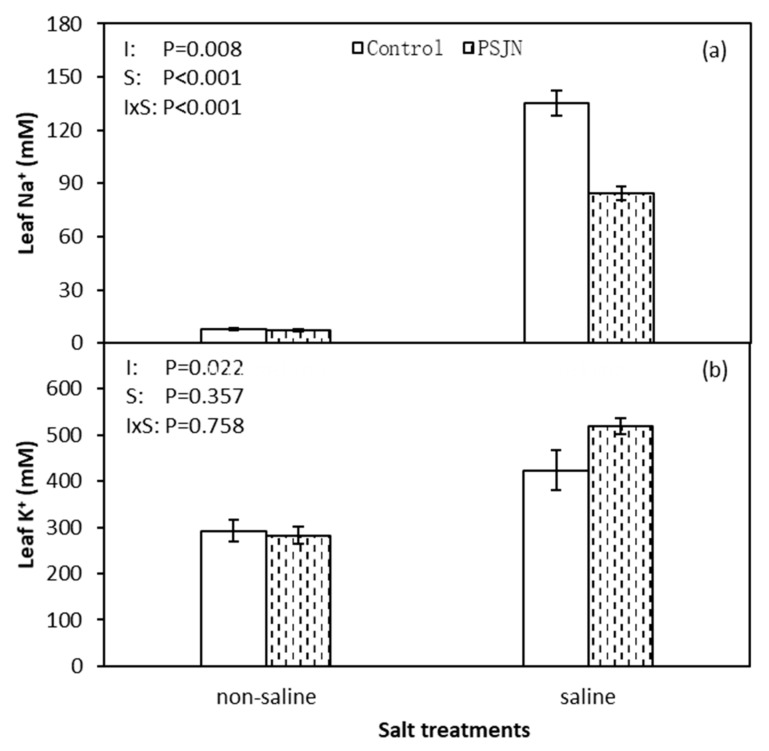
One of the major challenges in agriculture is to ensure sufficient and healthy food availability for the increasing world population in near future. This requires maintaining sustainable cultivation of crop plants under varying environmental stresses. Among these stresses, salinity is the second most abundant threat worldwide after drought. One of the promising strategies to mitigate salinity stress is to cultivate halotolerant crops such as quinoa. Under high salinity, performance can be improved by plant growth promoting bacteria (PGPB). Among PGPB, endophytic bacteria are considered better in stimulating plant growth compared to rhizosphere bacteria because of their ability to colonize both in plant rhizosphere and plant interior. Therefore, in the current study, a pot experiment was conducted in a controlled greenhouse to investigate the effects of endophytic bacteria i.e., PsJN on improving growth, physiology and yield of quinoa under salinity stress. At six leaves stage, plants were irrigated with saline water having either 0 (control) or 400 mM NaCl. The results indicated that plants inoculated with PsJN mitigated the negative effects of salinity on quinoa resulting in increased shoot biomass, grain weight and grain yield by 12%, 18% and 41% respectively, over un-inoculated control. Moreover, inoculation with PsJN improved osmotic adjustment and ion homeostasis ability. In addition, leaves were also characterized for five key reactive oxygen species (ROS) scavenging enzyme in response to PsJN treatment. This showed higher activity of catalase (CAT) and dehydroascobate reductase (DHAR) in PsJN-treated plants. These findings suggest that inoculation of quinoa seeds with PsJN could be used for stimulating growth and yield of quinoa in highly salt-affected soils.
农业面临的主要挑战之一是在不久的将来为不断增长的世界人口确保充足且健康的食物供应。这需要在不同环境压力下维持作物的可持续种植。在这些压力中,盐胁迫是仅次于干旱的全球第二大普遍威胁。减轻盐胁迫的一个有前景的策略是种植耐盐作物,如藜麦。在高盐度条件下,植物促生细菌(PGPB)可以提高作物性能。在PGPB中,内生细菌被认为比根际细菌更能促进植物生长,因为它们能够在植物根际和植物内部定殖。因此,在本研究中,在可控温室中进行了盆栽试验,以研究内生细菌即PsJN对盐胁迫下藜麦生长、生理和产量的影响。在六叶期,用含有0(对照)或400 mM NaCl的盐水灌溉植株。结果表明,接种PsJN的植株减轻了盐胁迫对藜麦的负面影响,与未接种的对照相比,地上部生物量、粒重和籽粒产量分别提高了12%、18%和41%。此外,接种PsJN提高了渗透调节和离子稳态能力。此外,还对叶片中五种关键的活性氧(ROS)清除酶进行了表征,以响应PsJN处理。结果表明,PsJN处理的植株中过氧化氢酶(CAT)和脱氢抗坏血酸还原酶(DHAR)的活性较高。这些发现表明,用PsJN接种藜麦种子可用于促进高盐渍土壤中藜麦的生长和产量。