Xi'an Center for Disease Control and Prevention, Xi'an, Shaanxi, China.
Xi'an Medical University, Xi'an, Shaanxi, China.
J Clin Microbiol. 2020 Jul 23;58(8). doi: 10.1128/JCM.00958-20.
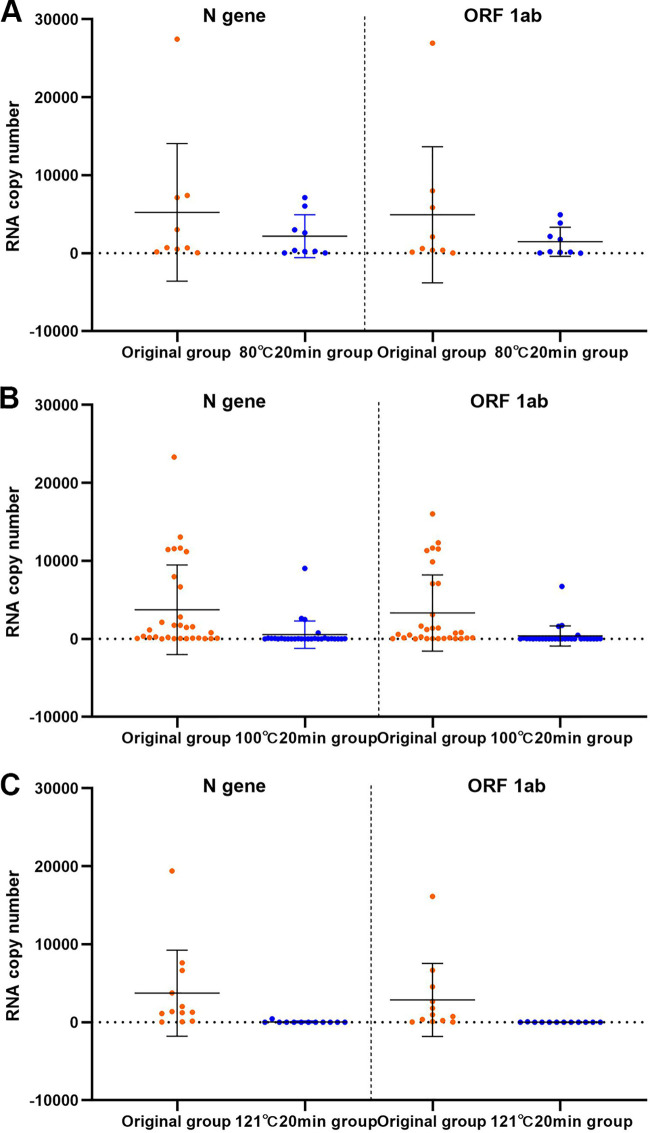
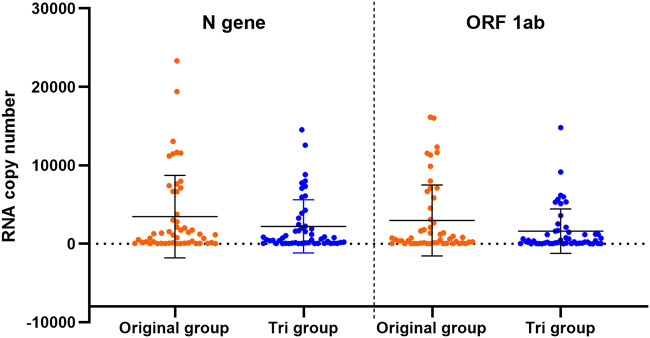
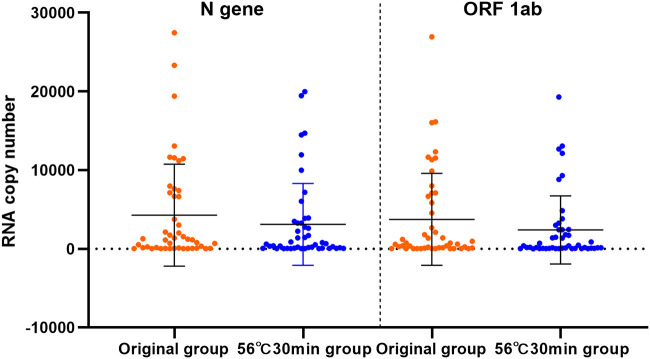
The outbreak of coronavirus disease 2019 (COVID-19) has spread across the world and was characterized as a pandemic. To protect medical laboratory personnel from infection, most laboratories inactivate the virus causing COVID-19, severe acute respiratory syndrome coronavirus 2 (SARS-CoV-2), in clinical samples before testing. However, the effect of inactivation on the detection results remains unknown. Here, we used a digital PCR assay to determine the absolute SARS-CoV-2 RNA copy number in 63 nasopharyngeal swab samples and assess the effect of inactivation methods on viral RNA copy number. Viral inactivation was performed by three different methods: (i) incubation with the TRIzol LS reagent for 10 min at room temperature, (ii) heating in a water bath at 56°C for 30 min, and (iii) high-temperature treatment, including autoclaving at 121°C for 20 min, boiling at 100°C for 20 min, and heating at 80°C for 20 min. Compared to the amount of RNA in the original sample, TRIzol treatment destroyed 47.54% of the nucleocapsid protein (N) gene and 39.85% of open reading frame (ORF) 1ab. For samples treated at 56°C for 30 min, the copy number of the N gene and ORF 1ab was reduced by 48.55% and 56.40%, respectively. The viral RNA copy number dropped by 50 to 66% after heating at 80°C for 20 min. Nearly no viral RNA was detected after autoclaving at 121°C or boiling at 100°C for 20 min. These results indicate that inactivation reduced the quantity of detectable viral RNA and may cause false-negative results, especially in weakly positive cases. Thus, use of the TRIzol reagent rather than heat inactivation is recommended for sample inactivation, as the TRIzol reagent had the least effect on the RNA copy number among the tested methods.
2019 年冠状病毒病(COVID-19)的爆发已经在全球范围内蔓延,并被定性为大流行。为了保护医学实验室人员免受感染,大多数实验室在检测前会对临床样本中的 COVID-19 致病病毒,即严重急性呼吸综合征冠状病毒 2(SARS-CoV-2)进行灭活。然而,灭活对检测结果的影响尚不清楚。在这里,我们使用数字 PCR 检测法测定了 63 例鼻咽拭子样本中 SARS-CoV-2 的绝对 RNA 拷贝数,并评估了不同灭活方法对病毒 RNA 拷贝数的影响。采用三种不同的方法进行病毒灭活:(i)室温下用 TRIzol LS 试剂孵育 10 分钟,(ii)在 56°C 水浴中孵育 30 分钟,(iii)高温处理,包括 121°C 高压灭菌 20 分钟、100°C 煮沸 20 分钟和 80°C 加热 20 分钟。与原始样本中的 RNA 量相比,TRIzol 处理破坏了核衣壳蛋白(N)基因的 47.54%和开放阅读框(ORF)1ab 的 39.85%。对于 30 分钟 56°C 处理的样本,N 基因和 ORF 1ab 的拷贝数分别减少了 48.55%和 56.40%。加热至 80°C 20 分钟后,病毒 RNA 拷贝数下降 50%至 66%。121°C 高压灭菌或 100°C 煮沸 20 分钟后几乎检测不到病毒 RNA。这些结果表明,灭活会降低可检测病毒 RNA 的数量,可能导致假阴性结果,尤其是弱阳性病例。因此,建议使用 TRIzol 试剂而不是热灭活来进行样本灭活,因为与其他测试方法相比,TRIzol 试剂对 RNA 拷贝数的影响最小。